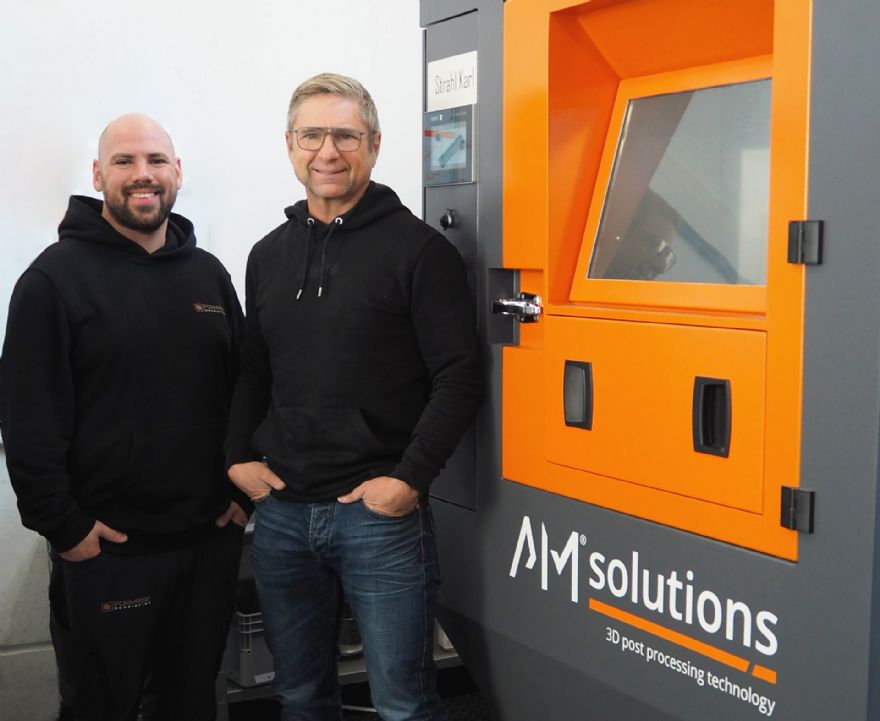
 With the introduction of the automated S1 blasting system from AM Solutions, German 3-D printing service provider Formrise has significantly enhanced the efficiency of its selective laser sintering (SLS) post-processing. By integrating a 2-in-1 process for cleaning and surface finishing, the company reduced post-processing time by approximately 50% while simultaneously lowering the consumption of blasting media, energy, and compressed air.
Additive manufacturing (AM) using Selective Laser Sintering (SLS) enables the cost-effective production of complex geometries, functional prototypes, and small batch series. However, only reproducible and economical post-processing makes components truly market-ready. Surface quality, process stability, and cost per part are significantly influenced by post-processing.
This challenge was also faced by German 3-D printing service provider
Formrise. With over 20 years of experience in AM, the company serves customers in demanding industries such as automotive, aerospace, medical technology, and the luxury goods and jewellery sectors. Accordingly, the requirements for quality, reproducibility, and process reliability are exceptionally high.
Limitations of a multi-stage post-processingAt Formrise, the post-processing of SLS components was initially carried out through several sequential blasting processes on systems from a market competitor. First, the components were cleaned of excess powder using glass beads. This was followed by pre-compaction of the surface with polybeads before the parts were dyed and finally blasted again.
This multi-stage process was distributed across several systems and required partial manual processing – in some cases, up to two hours per batch. As utilisation increased and quality requirements rose, this concept became increasingly inefficient. The blasting media preparation proved particularly problematic. The previous preparation method, relying solely on cyclone separation, was insufficient to reliably separate blasting media and powder, ensuring consistently clean processing. As a result, the consumption of polybeads was extremely high.
At the same time, the quality of the blasting media continuously deteriorated because colour particles and abrasion were not effectively separated. This directly impacted process stability: light-coloured components could not be processed arbitrarily in contaminated systems. Formrise was forced to plan production strictly: light parts at the beginning of the week, darker parts later on. Spontaneous customer orders or last-minute changes were nearly impossible to accommodate. At the end of the week, the systems also required extensive cleaning.
An additional issue, familiar to many SLS users, arose: when cleaning with glass beads, fine glass particles often remained embedded in the surface. These inclusions led to inhomogeneous colour results and visible defects, particularly when dyeing the components.
A better solutionAgainst this backdrop, Formrise actively sought a new solution for the post-processing of its SLS components. The requirement was a system that efficiently combines cleaning and surface finishing while featuring a high-performance, reliable blasting media preparation system.
At Formnext 2023, Formrise first encountered the S1 from
AM Solutions. The system combines decades of shot blasting expertise from the Rösler Group with a process concept specifically developed for additive manufacturing. The blasting media preparation system, tailored for polymer powder bed applications and featuring a large cyclone and integrated vibrating screen, serves as the central element, ensuring clean classification of the blasting media.
However, what was decisive for Formrise was not only the technical details but the holistic approach: with the S1, cleaning and surface finishing can be performed in a single automated 2-in-1 process – using only one blasting medium and in one system. Formrise now operates three systems of this type.
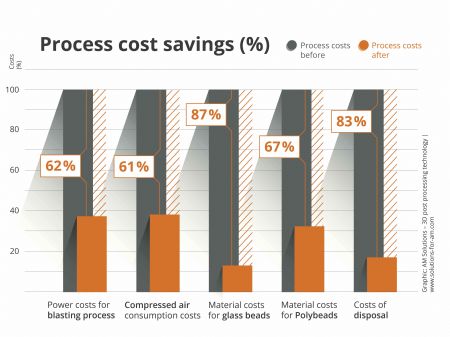
Following the commissioning of the new systems, measurable improvements in post-processing were quickly observed. The consumption of polybeads decreased by more than 60% within the first year, as the blasting media is maintained far more efficiently in the circuit.
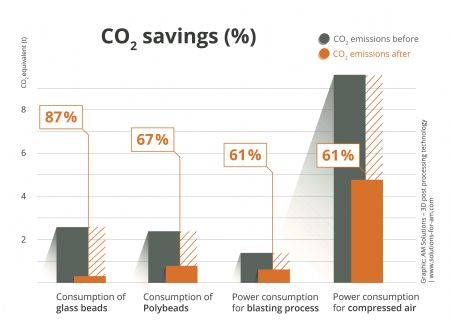
This alone resulted in a CO2 savings of approximately 1.6 tonnes. At the same time, the use of glass beads was nearly eliminated, virtually eliminating the known issues during component dyeing. Additionally, disposal costs were significantly reduced.
Another key effect was the increased process performance of the system. Due to the high blasting power and the elimination of multiple process steps, the overall post-processing time was reduced by nearly 50%. This not only lowered energy and compressed air requirements but also significantly reduced manual labour.
Component quality was further improved as well. The surfaces of the SLS components are more homogeneous and exhibit a noticeably higher-quality appearance. Customers report that the components already appear nearly polished after the blasting process, despite being exclusively blasted, and are better suited for downstream processes.
Strategic savingsIn total, the annual savings at Formrise amount to approximately 35,000 Euro, with more than half attributed to the reduced compressed air consumption. Simultaneously, the CO
2 emissions of the post-processing process were reduced by more than 12 tonnes per year.
Peter Spitzwieser, Formrise managing director, said: “For the post-processing of SLS parts, AM Solutions offers a solution with the S1 that is absolutely unmatched in the market and has convinced us in every respect. It is clear here exactly what potential lies in the optimal alignment of the blasting process with the requirements of AM, particularly in blasting media preparation. AM Solutions recognised and fully leveraged this potential – and in doing so, provided us with the opportunity to optimise our post-processing in ways we could not have previously imagined.”
SLS service providers face immense cost pressure – from competitors, market demands, and rising customer expectations. The S1 enables a new level of efficiency in post-processing: faster throughput, cleaner results, and reduced manual effort, without compromising on quality.