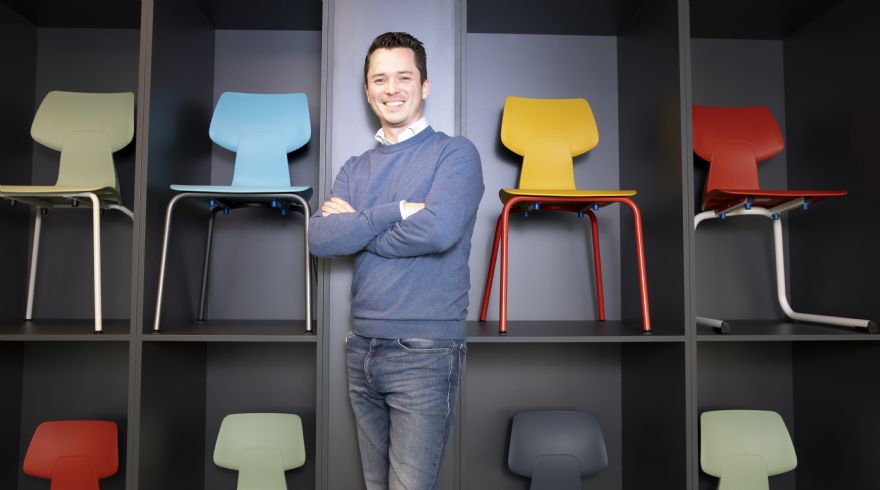
 Anthony Goossens, product manager at Gispen, part of the Royal Ahrend Group
School furniture rarely attracts much attention – until it breaks. Chairs and desks in classrooms take a pounding from boisterous children, are moved, dragged and stacked often, and expected to last for years with minimal maintenance. That durability does not happen by accident. At Royal Ahrend’s manufacturing facility in Arnhem, the Netherlands, long product life is the outcome of deliberate choices in design, materials and modern production technology.
Part of the internationally active
Royal Ahrend Group, Gispen has been manufacturing school furniture for more than a century. Today, 30 to 40% of all chairs used in Dutch primary schools are produced at the Arnhem site. The factory plays a dual role: delivering high‑volume, high‑quality output while acting as a social enterprise, providing employment to people who face barriers to work.
To support that mission (and to cope with growing demand) Royal Ahrend recently invested in an automated laser tube cutting system from Trumpf, bringing precision, capacity and process reliability into a traditionally labour‑intensive operation.
Inclusive production by designAround 190 people work at the Arnhem plant. More than half of them would struggle to secure employment elsewhere, explains Anthony Goossens, production manager at the site.
“These are people who, for a variety of reasons, find it difficult to enter the labour market,” he says. “Here, they are a fully valued part of our operation.”
Employees focus mainly on final assembly and supporting production processes, while automation takes over repetitive or physically demanding tasks. From the outset, the factory has been set up to balance industrial efficiency with social responsibility, a balance that strongly influences its investment decisions.
Sustainability at Royal Ahrend goes well beyond energy efficiency or waste reduction. The company is widely regarded as a pioneer of circular furniture design, with products engineered for disassembly, repair and reuse.
“All our furniture is modular,” explains Goossens. “That makes it easier to extend product life, reduce material use and lower CO
2 emissions.”
Most Gispen school furniture is manufactured and sold within the Netherlands, minimising transport emissions. Materials are selected with equal care. A recent example is the brightly coloured Gispen WIZZ chair, whose seat shell is made from recycled plastic fruit crates.
Mr Goossens added: “Designed to grow with a child, the chair uses interchangeable shells and frames so it can be adapted across multiple stages of education. “That kind of flexibility is good for schools, good for the environment and good for society.”
Why tube cutting mattersUnderneath the colourful plastics and ergonomic forms, Gispen chairs rely on stainless‑steel tube frames. These are produced in a wide range of diameters from 12 to 80mm and profiles, including round, oval and rectangular sections. Tube lengths must be cut precisely and feature multiple apertures before bending and powder coating. Until recently, this step had become a bottleneck.
“Our previous tube cutting system had reached the end of its useful life,” says Goossens. “It simply couldn’t keep up with rising production volumes.” A replacement machine had to meet clear criteria: easy operation, high repeatability, and a level of automation that would reduce routine manual work while supporting future growth.
Following positive feedback from colleagues at another Royal Ahrend site, the Arnhem factory opted for a TruLaser Tube 5000 from Trumpf, equipped with customised automation. The system uses a LoadMaster Tube for fully automatic material loading of profiles up to 6m long. Trumpf’s Smart Profile Detection identifies tube orientation and automatically positions the clamping unit, eliminating manual alignment.
After cutting, finished profiles are transferred via a conveyor to an unloading system supplied by Trumpf partner company transfluid. Cut parts are guided, sorted into bundles and placed into transport containers, all with minimal manual intervention. The result is a continuous, largely unattended material flow.
Productivity and peopleFor Royal Ahrend, automation is not about replacing labour, but about using people where they add most value. “Automation allows us to keep growing,” Goossens explains. “It takes repetitive tasks out of the hands of our employees and lets them focus on meaningful work.”
Just as importantly for an inclusive workforce, the system does not require specialist laser knowledge. “That was crucial for us. The TruLaser Tube 5000 is extremely easy to operate, which fits perfectly with our working environment.”
The change has also had an unexpected benefit: an uptick in morale. Where operators once avoided the old system, the new machine is actively welcomed on the shopfloor.
Reliability is critical. July and August are peak months, as schools prepare for the new academic year. “This is when everything has to run perfectly,” says Goossens. “Furniture has to be delivered on time, without disruption.”
For that reason, supplier support mattered as much as machine capability. “We need a partner who is available when it counts – even during the summer holidays. That’s why Trumpf fits so well for us.”
For the next generation of Dutch pupils, it means classrooms equipped on time, every time with furniture designed to last.