 Flex
Flex and
Teradyne Robotics have announced an expansion of their long-standing partnership, aiming to accelerate the adoption of intelligent automation across global manufacturing operations, with UK-based robotics expertise playing a central role.
The agreement builds on more than 20 years of collaboration between the two companies in the manufacture of Teradyne semiconductor test equipment and extends the relationship into robotics and advanced automation. As global manufacturers face growing complexity, flexibility requirements and skills pressures, the partners say the expanded collaboration will help deliver scalable, validated automation solutions at speed.
Under the enhanced partnership, Flex takes on a dual role. The global manufacturing specialist is deploying Teradyne Robotics solutions within its own production facilities, while also manufacturing key robotics components that support large-scale automation deployments for Teradyne Robotics customers worldwide. This approach combines real-world operational use with volume production, enabling faster learning cycles and the rapid replication of proven automation workflows.
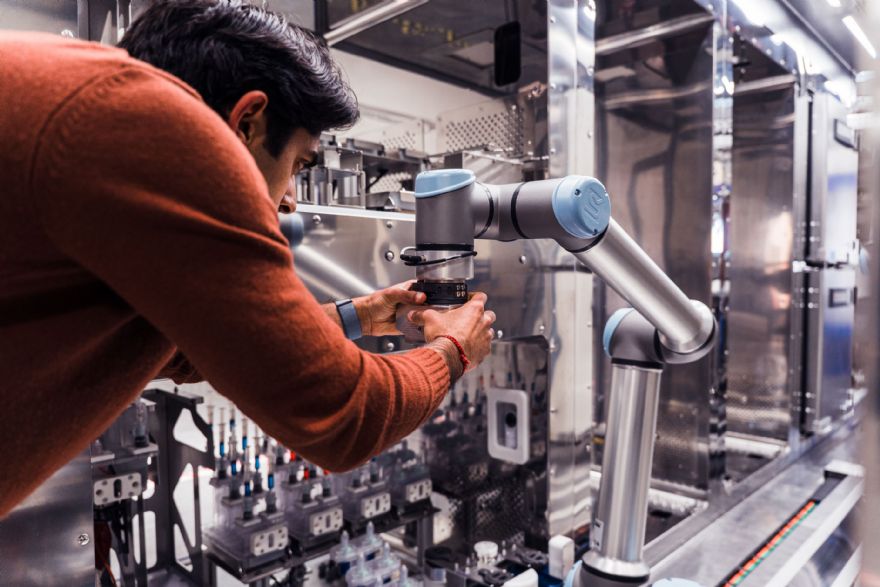
Teradyne Robotics’ portfolio includes Universal Robots and Mobile Industrial Robots, both of which play a significant role in the collaboration. Universal Robots’ UK operations are based in Sheffield, underlining the contribution of British robotics expertise to the global programme. Flex manufactures core components for
Universal Robots, while also deploying its collaborative robots alongside Mobile Industrial Robots’ autonomous mobile robots within Flex factories.
The close integration of manufacturing and deployment allows continuous operational feedback from live production environments. According to the partners, this helps validate robotics technologies at scale and ensures that solutions can be quickly rolled out across multiple sites and regions.
Dennis Kirkpatrick, president of lifestyle, consumer devices, and core industrial at Flex, said: “For more than 20 years, Flex and Teradyne have partnered to deliver semiconductor equipment at global scale. Expanding our relationship into robotics and intelligent automation builds on a strong foundation, combining Teradyne Robotics’ industry-leading technologies with Flex’s advanced manufacturing capabilities, global footprint and execution expertise.”
Natural supply chain evolutionFlex already supports Teradyne through advanced manufacturing, systems integration and global supply chain execution for semiconductor test platforms used across electronics and semiconductor production environments. Extending this relationship into intelligent automation reflects what both companies describe as a natural evolution, applying shared expertise to manufacturing automation challenges.
Rodrigo DallOglio, president of operational excellence and transformation at Flex, said: “Working closely with Teradyne Robotics as an automation partner allows us to scale intelligent automation while supporting increasingly complex manufacturing environments for customers in electronics, industrial equipment, data centre infrastructure and other critical sectors.”
The expanded partnership also focuses on next-generation automation, incorporating emerging physical AI technologies into collaborative robots and autonomous mobile robots. These capabilities are designed to deliver more adaptive and flexible automation that can respond to changing production demands.
Jean-Pierre Hathout, president of the Teradyne Robotics Group, concluded: Flex’s experience in manufacturing complex products across industries, combined with its global scale and resilient supply chain, makes it an ideal partner for advancing intelligent automation. Together, we are accelerating the adoption of robotics technologies that improve productivity, flexibility and operational resilience across manufacturing environments worldwide.”
By combining advanced robotics platforms with real-world deployment and manufacturing expertise, Flex and Teradyne Robotics aim to help manufacturers improve consistency, throughput and efficiency as intelligent automation becomes an increasingly critical part of global production strategies.