 When most people think of robotics on the factory floor, they often picture large automotive assembly lines with industrial robots performing repetitive tasks away from human workers. However, this model has rarely suited specialist manufacturers, where the challenge has been finding automation that is flexible enough for their ways of working. Here, Suraj Jandu, lead project engineer at Pailton Engineering and speaker at Robotics & Automation 2026, explains how collaborative robots, or cobots, are changing that.
The UK’s productivity challenge is well documented, and relatively low robot adoption is widely cited as a contributing factor. According to the
International Federation of Robotics (IFR), the UK sits consistently below leading manufacturing economies in robot density rankings, particularly when compared with countries such as Germany, Singapore and South Korea.
For high-volume, low-mix manufacturers, the business case for automation is straightforward. For specialist, low-volume, high-mix producers, it has been historically more difficult to make the numbers work. Set-up times, programming complexity and integration costs combined with the sheer variety of components moving through a facility can make traditional automation feel prohibitively rigid and expensive.
The result is a persistent gap, with many highly capable UK manufacturers effectively excluded from the automation advances adopted by larger manufacturers years ago. Cobots do not solve every part of that problem, but they do change the equation significantly. Faster to deploy and designed for flexibility rather than fixed-function operation, cobots offer a more accessible entry point for manufacturers that have not previously found one.
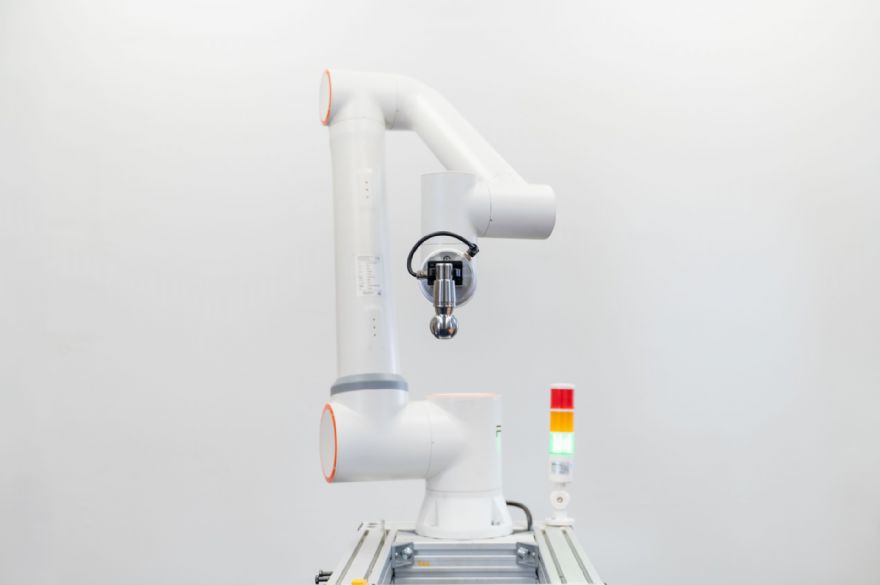
At Pailton Engineering, that shift is already underway. Following a successful trial period, the company recently installed a FAIRINO FR10 cobot in its induction hardening ball pin cell, a considered move that reflects a broader programme of modernisation taking place across the facility.
The FR10 is purpose-built for exactly this kind of environment. It also offers a level of precision brings genuine consistency to tasks that previously relied on sustained manual effort, while the cobot’s collaborative design means it works cohesively alongside the team rather than in isolation from it.
This approach speaks to a broader philosophy at Pailton Engineering around automation. Rather than a wholesale transformation of the production line, the cobot represents a deliberate first step of proving the concept, building confidence internally and establishing a foundation for what comes next. Taking that first step inevitably surfaces challenges that no amount of planning can fully anticipate. For Pailton Engineering, integrating the FR10 into a live production environment has been as instructive as the efficiency gains it has delivered. The process forces a business to examine its own operations with fresh eyes, identifying where bottlenecks sit, where variability creeps in and where the case for machine precision is the strongest.
For many manufacturers, the hesitation around automation isn’t purely financial. The prospect of introducing robotics into a facility where skilled and experienced people work raises questions that don’t always have straightforward answers. Transparency is critical during this stage of adoption. Businesses should involve their team throughout the process while keeping the message simple and consistent: automation exists to make workers’ lives better, not make them redundant. In a sector where skilled engineers are difficult to recruit and retain, this approach is as much a business strategy as it is good HR practice. Automation that your workforce believes in is automation that genuinely works.
With technology advancing and barriers to entry lowering, the business case for incremental automation is stronger than ever. However, it remains uneven across much of UK manufacturing. It requires more manufacturers sharing practical examples of what adoption looks like on the ground, alongside a clearer understanding of how automation can be introduced in stages rather than as a single transformation programme. The tools are already available and the economic case is increasingly clear. The challenge is not technological capability, but having the confidence to begin.
Suraj Jandu will be speaking at Robotics & Automation 2026 on 17 June in Coventry, sharing Pailton Engineering's experience of cobot adoption and what it means in practice for specialist manufacturers considering their first step.