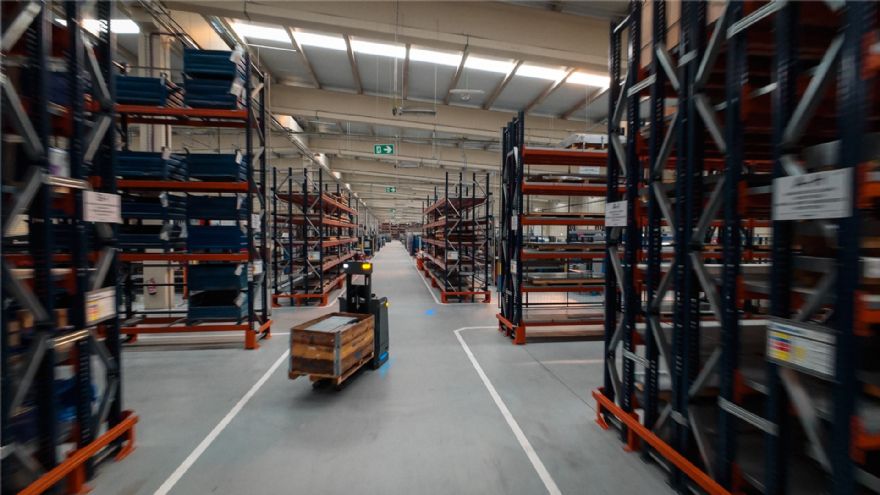
 In this article Mark Gray, UK sales manager for industrial automation specialist Teradyne, discusses how autonomous mobile robots are helping manufacturers rethink material handling and building smarter intralogistics.
For decades, the forklift has been the backbone of industrial material handling. Since its widespread adoption in the mid-20th century, it has enabled manufacturers to move raw materials, components and finished goods efficiently around factories and warehouses.
Combined with palletisation, forklifts helped shape the modern manufacturing environment, offering a flexible and cost-effective way to support production. However, manufacturing has changed significantly since then.
With a demand for greater product variability and a growing pressure to maximise throughput, traditional intralogistics has become increasingly reactive, especially with ongoing labour shortages.
This regularly means factories experience material flow disruptions and production delays as products wait to be delivered to the next part of the production line. As a result, many manufacturers are beginning to question whether traditional approaches to internal transport remain the most effective solution for modern operations.
Intralogistics in modern manufacturingAs efficient material movement becomes a critical factor in modern manufacturing, businesses are, therefore, increasingly looking beyond traditional forklift-based operations.
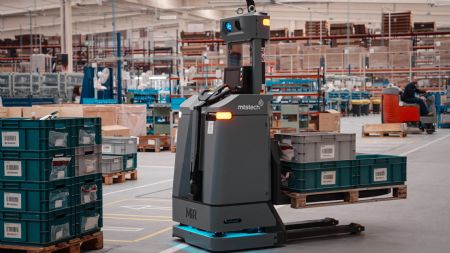
Technologies such as autonomous mobile robots (AMRs) are enabling them to automate the transportation of materials throughout their facilities in ways which haven’t been possible before.
Unlike traditional automated systems, AMRs can be deployed within a factory floor without having to alter existing infrastructure. This means there’s less downtime in implementation, but it also enables manufacturers to automate internal material movements while maintaining the flexibility needed to respond to changing production demands.
Supporting tasks such as line feeding, pallet transport and the movement of work-in-progress, AMRs help ensure materials arrive at the right place at the right time. This reduces reliance on forklifts, improves material flow and supports more consistent production processes.
By taking over repetitive transport tasks traditionally carried out by forklift operators, AMRs can also help reduce vehicle traffic and ease labour pressures – the latter allowing employees to focus on higher-value activities.
A flexible approach to material flowAs part of a wider intralogistics strategy, AMRs are helping manufacturers like Fermator build smarter, safer and more agile operations, where materials move seamlessly through production with less reliance on manual intervention.
Faced with the challenge of improving safety and efficiency across its operations, the company introduced an AMR solution to automate internal pallet transport and material flows.
Operating autonomously and without requiring changes to existing infrastructure, the system uses intelligent navigation and AI-driven route optimisation to move materials more efficiently throughout the facility.
As a result, Fermator minimised waiting times between processes and improved production continuity. The company also increased its internal safety performance from 60% to 90%.
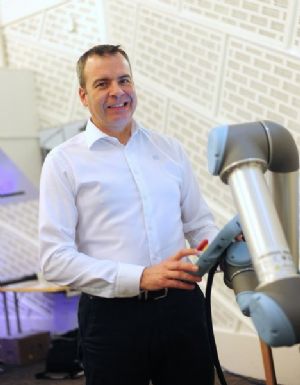 Pic: Mark Gray, UK Sales Manager for industrial automation at Teradyne
Similar benefits are being realised by Italian manufacturer Vibo. At its Trissino assembly plant, the company relied on operator-driven forklifts to move pallets between production and storage areas. However, equipment charging cycles and manual handling requirements meant employees were spending valuable time on repetitive transport activities.
To address these challenges, Vibo deployed an AMR solution - MiR1200 Pallet Jack - to automate pallet movements across the facility. It operated safely alongside employees and other vehicles in a mixed-traffic environment and, as with Fermator’s example, the system was implemented without modifications to the existing layout.
Using autonomous navigation and AI-enabled pallet detection, the robots handle a variety of load types while operating continuously throughout the day.
The result meant Vibo had more consistent material flow throughout the plant. And by removing repetitive transport tasks, it was also able to reassign operators to higher-value activities, improving operational resilience.
These examples demonstrate how manufacturers are using technology to address intralogistics challenges, which are common across factories in the UK. Complementing existing infrastructure, AMRs and other similar technologies – such as collaborative industrial robots (cobots) – are helping businesses to future proof their material flow strategies.
Future proofing factoriesThe factory of the future is unlikely to eliminate forklifts altogether, but it will almost certainly rely on them less. However, the future of manufacturing will depend as much on the movement of materials as the production process itself.
As labour shortages persist and pressure grows to improve productivity, manufacturers will have to place greater focus on intralogistics as a source of operational improvement. And as a result, they will need to incorporate new technologies, alongside established processes, to support more efficient material flow.
It will be the manufacturers that take a more strategic approach to material movement that will be better positioned to improve productivity, enhance safety and build resilience in an increasingly competitive market.