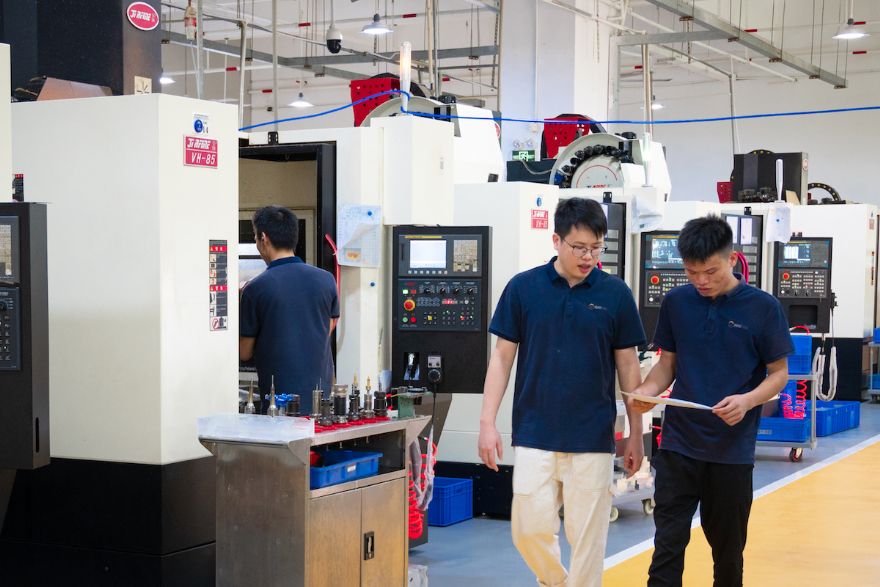
Inside WayKen, managing complexity in low‑volume CNC manufacturing begins with an acceptance that traditional manufacturing economics no longer apply. In short production runs, the time consumed by machine setup, fixture installation, tool measurement, and first‑piece inspection frequently exceeds the actual cutting time. This shifts cost drivers away from machining efficiency and toward setup reduction. To offset this imbalance, WayKen relies on modular quick‑change fixtures, offline tool presetting, validated CAM template libraries, and pre‑approved inspection protocols, allowing efficiency to be maintained even when batch sizes are limited.
Manufacturability in this environment is dictated by the interaction between part geometry, tool mechanics, and material behaviour. Deep cavities generate tool deflection, thin walls are susceptible to vibration, and tight internal radii demand specialised tooling. These constraints require targeted CNC solutions, including vibration‑damping toolholders for long overhangs, adaptive feed rates to stabilize thin features, and trochoidal toolpaths to control corner loading. Each approach is carefully integrated into the process plan to protect dimensional accuracy and surface finish across small‑lot production.
In
low-volume CNC machining, each product order introduces additional variables. Components with complex angles may require four‑ or five‑axis simultaneous machining or multiple indexed 3+2‑axis setups, with each operation needing its own work coordinate system and verified G‑code. Workholding strategies vary widely by geometry, from soft jaws and vacuum chucks to custom mandrels, all requiring individual clamping force evaluation and datum alignment. Tooling diversity further increases complexity, as long‑reach end mills, high‑feed cutters, chamfer tools, and ball‑nose mills each carry specific overhang limits, coatings, spindle speeds, and feed requirements. Together, these factors place added strain on CAM programming resources, spindle utilization, and dimensional consistency.
Reducing complexity before it reaches the shopfloorTo prevent complexity from reaching the shopfloor unresolved,
WayKen emphasises front‑loaded engineering. Formal DFM reviews are conducted during the quotation stage to identify geometric risks such as thin sections prone to warping, deep cavities beyond standard tool reach, undercuts requiring T‑slot cutters, and corner radii incompatible with conventional tools. Engineers then recommend design changes, alternative machining strategies such as trochoidal or high‑efficiency milling, or the use of multi‑axis processes to mitigate these risks early.
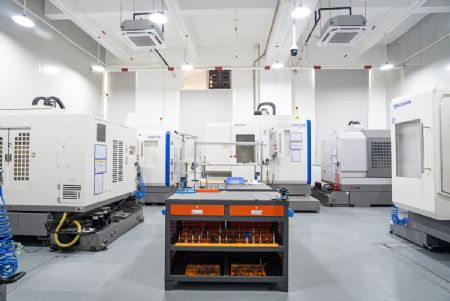
Once an order is confirmed, customer CAD data is translated into WayKen’s internal production formats. Drawings undergo two independent reviews to eliminate discrepancies before CAM programming begins. A verified tooling list is then created, defining carbide geometries, insert grades, coatings, and optimised cutting parameters validated against machine capability. Joint process‑planning meetings bring together CAM programmers, machine operators, and CMM personnel to align tooling, fixturing, and inspection strategy, ensuring compatibility with machine kinematics and quality requirements before G‑code is released.
Process planning converts complexity into a controlled manufacturing sequence. WayKen applies staged machining strategies to manage cutting forces, thermal growth, and residual stress. Initial roughing operations use indexable carbide or high‑feed cutters to remove the majority of material at aggressive engagement levels. Semi‑finishing follows with solid carbide end mills and reduced radial step overs to stabilise part geometry while minimising thermal distortion or work hardening, particularly in titanium and Inconel. Final finishing operations employ precision‑ground tools to achieve the required surface finish and tight tolerances.
Fixture strategy and datum control are developed to maintain a constant reference frame across all setups, preventing tolerance stacking on both three‑ and five‑axis machines. Every toolpath is simulated in Vericut to verify tool access, eliminate collision risk, and optimise machine motion. For thin‑walled aerospace or medical components, WayKen may incorporate intermediate supports, vacuum workholding, or staged material removal to preserve rigidity throughout machining. Axis utilisation is evaluated component‑by‑component to determine whether full five‑axis contouring, 3+2 positioning, or conventional three‑axis indexing provides the most stable and efficient solution.
Quality control: managing variation through measurementQuality control is driven by continuous, measurement‑based feedback. WayKen operates under ISO 9001:2015 and IATF 16949 certifications, with every work order supported by a finalised control plan defining PPAP requirements, critical dimensions, GD&T callouts, inspection methods, and sampling frequency. Inspection occurs after roughing, semi‑finishing, and final machining using bore gauges, micrometers, and on‑machine probing to detect tool wear, thermal drift, or setup deviation as early as possible.
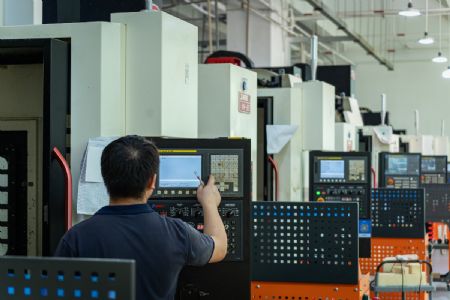
To ensure measurement capability exceeds part requirements, WayKen’s inspection laboratory is equipped with a ZEISS Captum and a Serein Croma coordinate measuring machine for comprehensive geometric verification, along with a KEYENCE LM‑8010 optical measurement system for rapid feature capture. These systems are supported by surface roughness testers, hardness testers, XRF alloy analysers, 3-D scanners, and a full suite of Mitutoyo gauges. All inspection results are recorded in quality management software and linked to work orders, machines, and tool serial numbers, creating full traceability for every part produced.
When deviations occur due to tool deflection, fixture movement, or thermal expansion, WayKen isolates non‑conforming parts and implements corrective actions such as adjusting cutter compensation, modifying feeds and speeds, refining clamping sequences, or replacing worn inserts. This closed‑loop inspection and correction process steadily reduces variation across successive parts.
Managing complexity in low‑volume CNC manufacturing ultimately requires foresight, discipline, and coordination. Through upfront DFM analysis, collaborative process planning, staged machining strategies, and rigorous metrology, WayKen demonstrates how complex low‑volume work can be controlled rather than constrained. By treating each order as a fully engineered project from quote through quality control, manufacturers can deliver demanding components reliably without allowing “complex” to become “chaotic”.