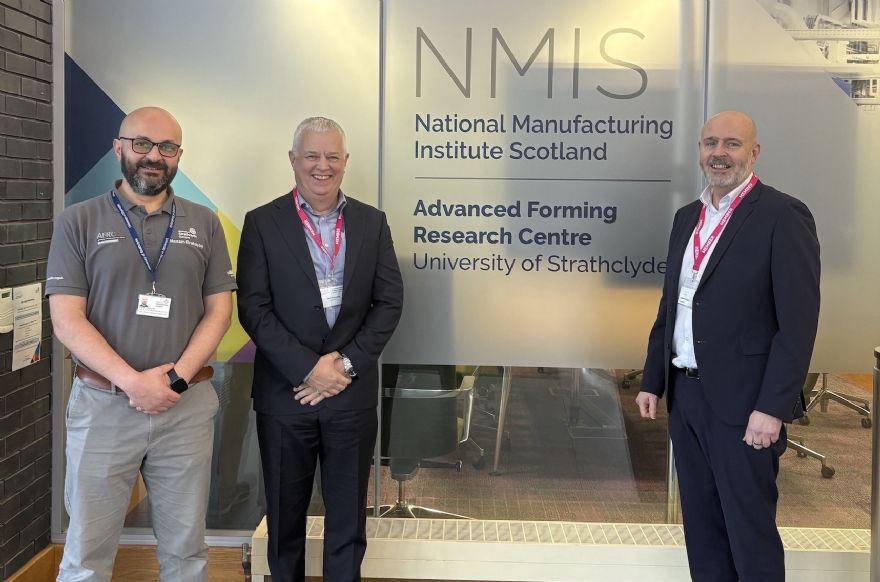
 Pic: (l-r) Hosam Elrakayby, AFRC senior knowledge exchange fellow, with Alan Pickering and Julian Kidger – joint managing directors, Unison LtdUnison Ltd
, the UK’s leading manufacturer of tube and pipe bending machines, and the inventor of precision all-electric tube manipulation, has joined the University of Strathclyde’s
Advanced Forming Research Centre (AFRC).
A specialist centre within the National Manufacturing Institute Scotland
(NMIS), the AFRC provides member organisations of all sizes with access to cutting-edge equipment and technical capabilities to help push the boundaries of advanced manufacturing, material behaviour, and material processing.
As the only tube bending machinery manufacturer within the AFRC, Unison is uniquely positioned to provide consultancy across tube manipulation processes. This includes delivering industry-leading expertise, insight and technical support to projects undertaken by the AFRC, as well as assisting with collaborative research projects.
“We are delighted to have been invited to join the AFRC,” commented Unison’s joint managing director, Alan Pickering. “Our Tier Two Membership will enable us to support even more of the world’s leading companies with their tube manipulation, wire and end-forming challenges. At the same time, we look forward to utilising the AFRC’s considerable technical forming and modelling expertise to assist in the development of several new tube forming technologies we have in the pipeline – particularly in relation to the aerospace sector.
“At Unison we are committed to championing businesses to Buy British – especially as Britain produces some of the finest technologies and machine tools in the world. Our AFRC membership will also help us to fly the flag for British manufacturing,” he added.
“It is a pleasure to welcome Unison Ltd to the AFRC,” said director of the Advanced Forming Research Centre, Brad Wynne. “As the UK’s leading manufacturer of ultra-precise tube-bending machinery, Unison will work with us to extend our research in the area of rotary draw tube bending. We envisage that initial projects will explore areas such as novel tooling, process modelling, physical trials, and material analysis – all helping unlock rotary draw bending for higher-integrity applications across defence, aerospace, energy, and other advanced manufacturing sectors.”
“For our part, we look forward to working with Unison to utilise their expertise, capabilities and equipment in various collaborative projects and, where appropriate, with many of the global organisations that are part of our membership,” added Tracy McCarroll, head of membership and strategic relations at NMIS. “We also look forward to involving Unison in suitable R&D proposals which would benefit from their considerable knowledge and input.”