 At its Ditzingen headquarters, German industrial machinery specialist Trumpf presents quality not as a final inspection or tick-box exercise, but as the foundation underpinning every stage of its operations. From incoming goods and production processes to digital testing and customer service, the company integrates quality management across the entire value chain.
Johannes Böttcher, head of quality in the machine tool division, describes a guiding principle focused on preventing disruption for customers: avoiding delays, maintaining reliable delivery dates, and ensuring dependable planning worldwide. “We believe quality is not just a test to be completed at the end,” he says. “It runs through the entire value chain.”
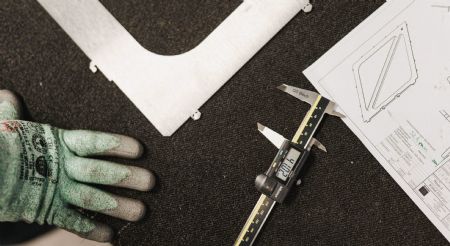
A millimetre that mattersInside the development hall at Ditzingen, a single component sits on a table marked with a red “Locked” label. The defect is minimal — just one millimetre — yet sufficient to compromise machine assembly.
“The part did not pass the quality test,” explains Danijel Novak, a Trumpf quality inspector. Nearby, 15 identical components from the same batch have also been isolated. Novak and Thomas Kieferle, who is responsible for production quality at the Ditzingen and Hettingen sites, face a familiar but critical decision: can these parts be salvaged or must they be scrapped? Further testing will determine the outcome.
For Mr Böttcher, however, the focus extends beyond the immediate fault. The more significant question is how the defect arose and what it reveals about the system. “If something is not running optimally, our aim is to continuously scrutinise processes and take countermeasures as quickly as possible,” he says.
Such moments are not treated as isolated incidents but as learning opportunities. The faster a defect is identified, the more effectively cost, complexity and risk can be controlled – not only internally, but for customers whose operations depend on reliable machinery.
Building quality from the startFor Marielouise Schäferling, head of corporate quality management at Trumpf, events like this are an essential part of a structured approach rather than exceptions. “Quality is not something you check at the end,” she says. “It must be integrated into the system in such a way that deviations are detected at an early stage and responsibility is clear.”
This philosophy begins at goods receipt, where components arriving from suppliers and international Trumpf facilities undergo rigorous evaluation. Items are measured, sampled, assessed and, where necessary, blocked before entering production.
“Everything that leaves the store must be of a precisely defined quality,” Mr Böttcher emphasises. “We do not deliver parts that do not meet our requirements.”
Trumpf’s approach is deliberately preventative. The company works closely with suppliers to establish clear standards, maintain communication before and after delivery, and minimise rework. The objective is straightforward: fewer rejects, stable delivery timelines, and reduced uncertainty for customers.
In practice, this means quality management starts long before assembly begins. By identifying and resolving potential issues early, the company reduces both operational disruption and downstream costs.
Embedded expertise on the shopfloorOn the production floor, where machines operate continuously and components move through complex workflows, quality management is deeply embedded within daily operations. Work is organised around product groups, with cross-functional teams comprising experts from Quality, Development, Production and Service.
A dedicated quality assurance manager (known internally as the QSV) ensures coordination between these functions. This structure enables rapid identification and resolution of issues, while maintaining alignment across departments.
The incident involving the faulty batch of components illustrates how the system works in practice. According to Mr Kieferle, the process functional but not perfect. “The quality assurance process has been successful here, although only to a mediocre extent,” he says. The problem was detected, but later than desired. “Our aim is for the worker to recognise the fault immediately,” he adds.
Timing is critical. Late detection increases costs, disrupts throughput and can ultimately affect delivery schedules. By contrast, early intervention keeps operations efficient and predictable.
Ms Schäferling highlights the importance of accountability in making such systems effective. “Standards only help if someone is responsible for them,” she notes. At Trumpf, quality is not an abstract principle but a clearly defined, managed discipline.
Digital tools to prevent downtimeBeyond physical production, Trumpf is investing heavily in digital solutions to enhance quality assurance. Within the testing department, engineers simulate machine behaviour using advanced software – a process designed to identify issues before they affect real-world operations.
Stefan Sailer, R&D manager for testing and second-level support in technical service, explains the approach: “We are trying to digitally simulate machine behaviour. We can simulate many more scenarios than on the actual machine and do not cause any idle states.”
While digital testing cannot yet capture every variable (material flows and certain physical effects still require real-world validation) the direction is clear. By expanding simulation capabilities, Trumpf aims to reduce risk and optimise machine performance before deployment.
Ms Schäferling sees this as a critical advantage. “We gain an advantage if we avoid mistakes before damage occurs,” she says. “The earlier we learn, the more we can reduce the disadvantage for us and for the customer.”
 Pic: Marielouise Schäferling, Head of Corporate Quality Management at Trumpf
A practical example is the company’s Cutting Assistant, a tool developed to streamline processes such as preparing cutting data, running programmes and evaluating outcomes. By reducing the need for repeated physical trials, the system saves time, materials and specialist labour.
Customer service as a feedback engineThe final link in Trumpf’s quality chain is Technical Service, where real-world performance data and customer feedback converge. This function handles around 14,000 cases annually in Germany alone (approximately 300 each week) ranging from major machine breakdowns to minor spare parts enquiries.
More than 80% of issues are resolved remotely or by telephone, supported by technical guides that help customers interpret error codes and implement solutions.
Work colleagues, Alexander Mai, Tobias Böschek and Michael Dubberke, analyse data daily, diagnose faults and coordinate service interventions. When on-site support is required, engineers are dispatched with prior knowledge of the issue.
“Depending on the fault in question, we send a service engineer who is already familiar with the problem,” says Mr Böschek. “This is how we ensure that the machine is up and running again quickly and that the customer can process orders. If there is a problem, we are great at finding a solution.”
Crucially, insights gathered through service are fed back into development, testing and quality planning. In this sense, service functions as an early warning system, identifying recurring issues and enabling systematic improvements.
A foundation for competitivenessFor Trumpf, quality is not an isolated objective but the foundation supporting its entire business model. Ms Schäferling summarises the philosophy succinctly: “Quality is not an added extra. It is the foundation for everything.”
The company’s global quality management team works continuously to refine standards, aligning them closely with operational realities and customer expectations. Feedback plays a central role, ensuring processes evolve in response to real-world demands.
By embedding quality across every stage, from supplier coordination and production to digital simulation and customer support, Trumpf aims to deliver consistent performance and reliability. The result is not only improved internal efficiency but also enhanced competitiveness and stronger customer satisfaction.