 Teqram
 has launched the EasyWelder-YT, a welding cobot cell aimed at fabricators looking to increase output without sacrificing flexibility, particularly in environments characterised by short runs and frequent changeovers.
Designed with a dual-station layout and intuitive operation, the system addresses common challenges such as labour shortages, variable batch sizes and rising expectations around quality and delivery reliability.
Frans Tollenaar, director of Teqram explains: “Most welding cobots are technically impressive, but in reality, they lose a lot of time during product changeovers. That was our starting point. With the EasyWelder, we developed a system that keeps production running continuously and is incredibly simple to programme. At the same time, we raise welding quality to a higher level. This makes robotic welding viable and profitable for a much wider group of fabricators.”
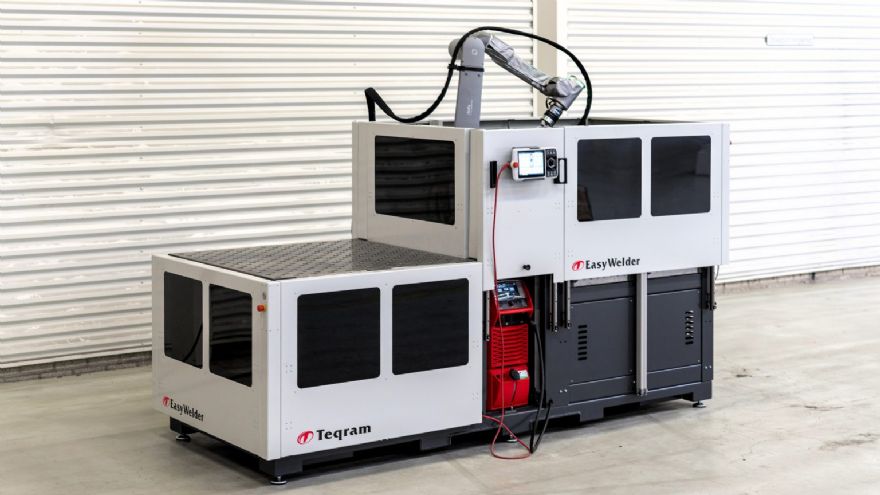
At the heart of the EasyWelder is its dual-station configuration. Unlike conventional single-table cobot cells, the system features two separate welding tables, enabling simultaneous operations. While the robot is active on one station, the operator can load or unload parts on the other, ensuring uninterrupted production flow.
By eliminating pauses for manual part exchange, manufacturers can significantly reduce downtime and increase effective arc-on time, which Teqram says can reach up to 80%.
The workspace has been designed with both safety and accessibility in mind. An automatic moving guard with UV-filtering windows allows the cobot to operate safely at high speed while maintaining visibility of the process. Both 1200 x 1200mm tables are accessible from three sides, simplifying part clamping and handling. For larger components, the stations can be quickly combined into a single working area measuring 2900 x 1200mm, providing additional versatility.
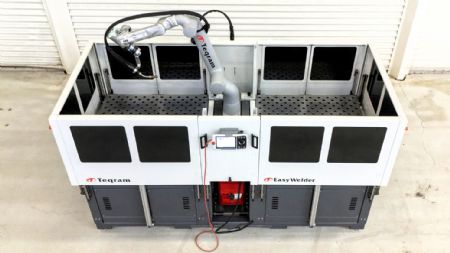 Pic: EasyWelder has a dual-station configuration enabling simultaneous operation
Ease of use is a central feature. Recognising that many fabrication shops do not employ dedicated robotics specialists, Teqram has equipped the EasyWelder with an intuitive interface and pre-configured programming templates. Operators can create programmes for common welding tasks such as circular welds, stitch welding, tack welding, multi-pass welding and straight seams within minutes.
Manual guidance further reduces setup time; the operator physically guides the robot arm along the weld path and records points using controls on the torch or a dedicated ring, after which the system automatically generates the welding code. Teqram claims this approach can cut programming time by up to 70%, with experienced welders able to work independently after just half a day of training.
Consistency and repeatability are also key benefits. Unlike manual welding, which can be influenced by fatigue and individual technique, the cobot delivers identical welds every cycle, reducing rework and scrap while improving predictability.
An integrated weld seam tracking system further enhances performance by detecting the actual position of the joint in real time and adjusting the robot path automatically. This compensates for tolerances and clamping variations without requiring frequent reprogramming, drawing on Teqram’s expertise in AI-driven 3D vision.
The EasyWelder combines components from established suppliers, including the ABB GoFa cobot and Fronius welding power sources. The GoFa offers a path accuracy of 0.03mm and maximum speeds of 2.2m/second, supporting both precision and productivity. Fronius systems are known for arc stability and advanced processes, enabling clean welding on materials such as stainless steel and aluminium with minimal spatter and distortion. Integration between the two is plug-and-play, simplifying installation.
Compact and mobile, the unit has a footprint of 3100 x 1600mm and does not require anchoring, allowing it to be repositioned easily using a forklift. Installation is straightforward, requiring only connections to power, compressed air and shielding gas.
Teqram positions the EasyWelder as a practical automation solution for modern subcontractors, offering increased capacity without compromising flexibility in increasingly demanding production environments.