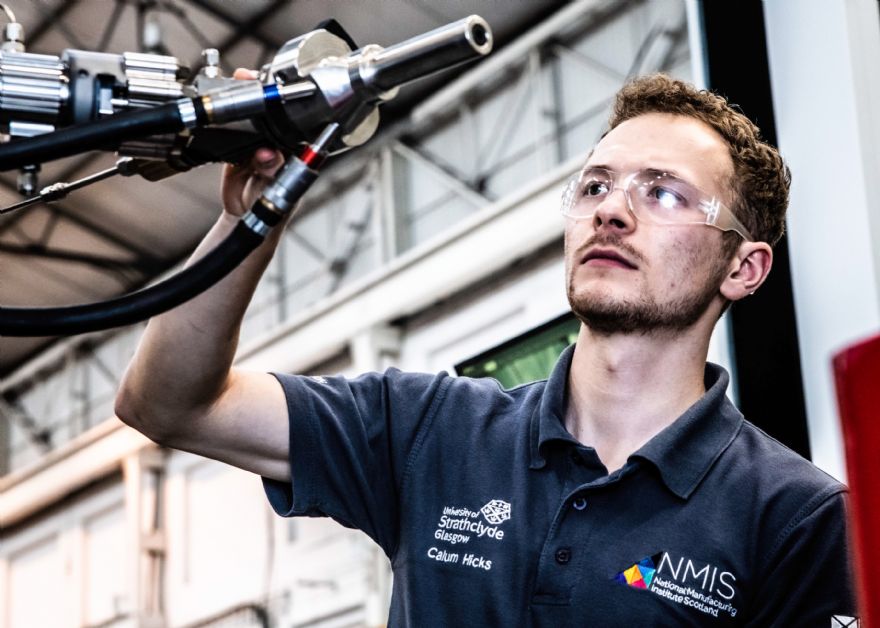
 In this article Calum Hicks, senior technologist at the Digital Factory, National Manufacturing Institute Scotland (NMIS) discusses the benefits of the cold spray additive process for aircraft MRO applications.
Aircraft continually operate in demanding environments that can challenge the integrity of wing skins. Corrosion of these components remains one of the most costly and persistent challenges in aviation manufacturing, creating critical maintenance obstacles for the sector. Corrosion drives extensive downtime, requires repeated interventions, and disrupts efficient workflow planning.
Despite the ability of traditional repair methods - such as epoxy filler and doubler plates - to extend aircraft life through material replacement and reinforcement techniques, they also bring about the need for frequent repairs, limiting operational efficiencies.
Modern aircraft operate in demanding environments and due to the high safety margins required by the industry, they have a very low tolerance for any component damage or degradation. The industry therefore needs a more resilient, durable approach to wing skin restoration - one that can withstand extreme conditions while reducing repeat maintenance and cost.
Addressing this challenge requires a shift away from traditional repair practices and towards advanced manufacturing techniques that can re-shape resilience. Crucially, any new approach must integrate seamlessly into existing MRO operations without introducing excessive disruption or complexity.
Cold spray manufacturing represents that shift. This additive manufacturing technology – a solid-state process that forms metal parts by firing metallic powder at supersonic speed - offers a significantly more corrosion-resistant repair and longer lasting alternative to epoxy-based methods.
Through dimensional restoration, cold spray rebuilds damaged wing skins to their original specifications, by replacing the damaged material with new aluminium alloy. The result is a longer service life and a reduced need for repeat repairs.
Unlike other additive manufacturing processes, cold spray can be applied directly inside hangars thanks to its low operating temperatures and portable functionality. This provides immediate access to damaged wing skins – transforming the engineering that can be carried out inside the maintenance facility. Used this way cold spray has the potential become the new standard for aircraft wing skin repair.
The cold spray process can treat corrosion-affected areas within hours, significantly outperforming traditional methods that can take days to complete due to curing requirements, underscoring cold spray’s suitability as a core aircraft repair process.
Cold spray also supports the aviation industry’s transition towards greater sustainability. By restoring the original material with cold spray technology, it allows for components to remain in service for longer, reducing material waste and supporting the sectors transition to a low-carbon economy.
Yet, despite its clear advantages, widespread UK adoption of cold spray is hindered by barriers that require targeted investment as operators need specialised training, and the process must undergo rigorous validation and certification to meet stringent aerospace standards.
Safety concerns also persist, as cold spray equipment generates extreme noise and involves the handling of hazardous metallic powders. These challenges are reasons to invest in workforce skills and robust safety measures, and to accelerate the UK’s capability in this fast-growing technology.
Countries such as the USA, Canada and Germany are already considered leaders in the development and application of cold spray technology, with extensive use across various manufacturing sectors. Their success highlights the strategic importance of early investment and the opportunity for the UK to strengthen its position in advanced aircraft manufacturing.
The aviation industry is now entering a new era of maintenance and repair. Traditional techniques, that once served the industry well, are no longer appropriate for the requirements of modern aircraft manufacturing where efficiency, sustainability and engineering excellence are essential.
Cold spray additive manufacturing offers a future-proof solution that meets these demands. By embracing the technology now, the sector can move beyond outdated practices and transform industry standards for aircraft resilience.