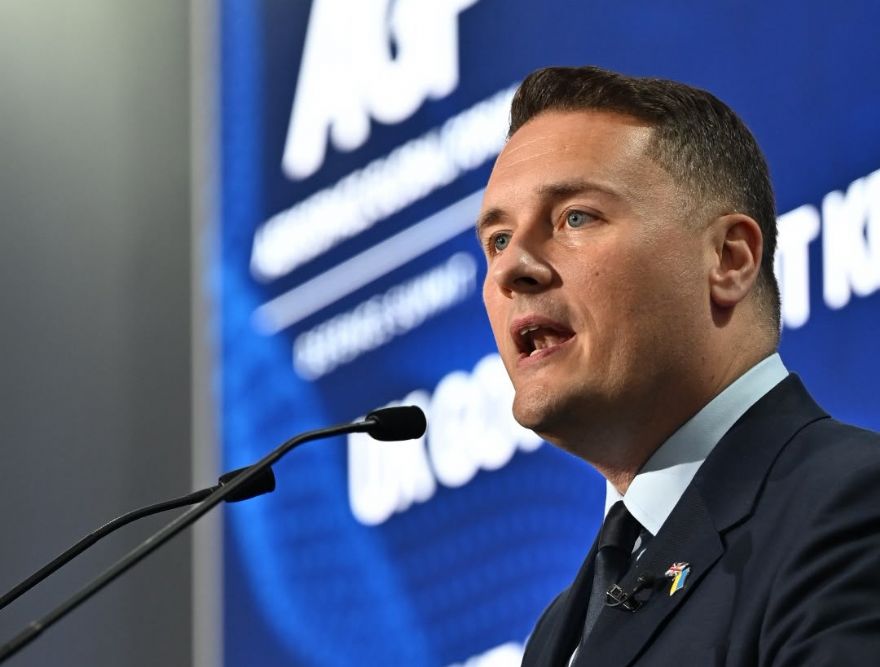
The UK Government has pledged to accelerate defence investment, modernise military capabilities and strengthen the country's industrial base, with Defence Secretary Wes Streeting (pictured) using his keynote address at the AGF Defence Summit at
Farnborough International Air Show to outline an ambitious vision for the future of British air power.
Speaking just days after the publication of the Government's Defence Investment Plan (DIP), Mr Streeting said the UK faces a more dangerous and unpredictable security environment, with state-on-state competition returning and advances in technology transforming modern warfare.
He said: "The skies today are increasingly contested, complex and lethal. Air dominance is not a given, it is not a right. But our Defence Investment Plan will ensure that we earn it once again."
Streeting highlighted the Government's commitment to spend £298 billion on defence over the next four years, including an additional £15 billion beyond the previous Spending Review settlement. He also pointed to NATO members' renewed commitment to spending 3.5% of GDP on defence by 2035.
The Defence Secretary said the publication of the investment plan had already provided greater confidence to industry, revealing that more than £11.8 billion worth of contracts had been agreed within ten days of its release.
"Defence is up and flying again," he said.
A key theme of the speech was the need to combine increased spending with reform and faster procurement processes. Streeting argued that investment alone would not be sufficient to meet future threats and called for a more agile approach to defence acquisition and innovation.
"Modernisation without investment is impractical, but investment without modernisation is irresponsible," he asserted.
The future of air power featured heavily in the address. Streeting confirmed continued support for the Royal Air Force's Typhoon fleet through a programme worth more than £1 billion, aimed at extending the aircraft's operational effectiveness into the 2040s.
However, he argued that the future battlefield would increasingly depend on integrating crewed and autonomous systems. The Defence Secretary highlighted the recently announced Collaborative Combat Air programme, known as StormFighter, which will see autonomous uncrewed combat aircraft operating alongside conventional fighters.
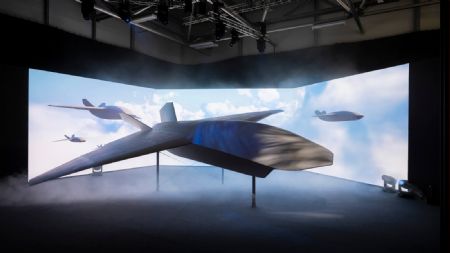 Pic: BAE System's Brontanax CCA platform unveiled at Farnborough
According to Mr Streeting, the autonomous platforms will provide surveillance, carry weapons and create additional challenges for adversaries while being significantly cheaper than traditional combat aircraft.
"Our ambition is to get a demonstrator CCA flying in the air next year and have StormFighter operational by the end of the decade," he said.
The programme is expected to support around 2,000 jobs once production is fully established and forms part of a growing market that Mr Streeting said could be worth more than £125 billion globally by 2050.
He also welcomed
BAE Systems' launch of its sovereign collaborative combat aircraft programme and praised a recent rapid upgrade project that introduced a lower-cost anti-drone weapon system for the Typhoon. The development cycle took just 42 days from start to finish, which Streeting described as an example of the pace defence procurement must achieve in future.
The Defence Secretary said his department would adopt a new approach to risk management to accelerate innovation and technology deployment.
"Not every decision will come off, but that's the price of moving at the pace of modern warfare," he said.
Streeting reaffirmed the Government's commitment to the Global Combat Air Programme (GCAP), which is being developed alongside Italy and Japan. The Defence Investment Plan allocates £8.6 billion to the programme, described by the Defence Secretary as essential to securing future air superiority.
He also confirmed that Canada has joined the initiative as an observer nation, strengthening international collaboration on next-generation combat aircraft development.
Further support was announced for the wider Future Combat Air System programme, which currently employs more than 4,500 people across the UK. Streeting revealed that the Government had signed a £708 million contract extension with BAE Systems to continue work on critical sovereign technologies.
Beyond military capability, Streeting repeatedly emphasised defence's role as an industrial and economic driver. The UK air sector currently employs around 70,000 people, and he argued that defence manufacturing would play a central role in the Government's wider ambition to re-industrialise the country.
"Defence will not just be a recipient of the proceeds of economic growth," he said. "It will be a central contributor to building that growth."
Concluding his speech, Mr Streeting paid tribute to RAF personnel involved in recent operations supporting NATO, responding to humanitarian missions and countering threats in the Middle East. He said Britain was entering one of the most significant periods of change in air power history but insisted the country remained capable of meeting the challenge through a combination of military excellence, industrial innovation and technological leadership.
"We have matched the courage of those who serve with the ingenuity of those who build," he said. "And together, we will do so again."