
Electrical faults are not exceptions in modern power systems, they are an operating condition. As networks grow more interconnected and dependent on power electronics, fault behaviour becomes harder to predict using traditional approaches. The question is no longer whether faults occur, but how systems respond. Here, Mike Torbitt, managing director of resistor manufacturer
Cressall, explains why electrical systems must be engineered to fail safely.
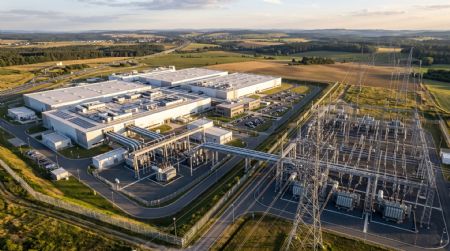
This was illustrated in March 2025, when an electrical fault at National Grid's North Hyde substation caused a major power outage affecting Heathrow Airport. Moisture ingress into a high-voltage transformer bushing compromised its insulation, creating the conditions that resulted in an electrical fault. Protection systems detected the fault and isolated the affected equipment, highlighting how a single electrical fault can have far-reaching consequences within critical infrastructure. In environments where continuity of supply is essential, controlling fault behaviour is just as important as preventing faults from occurring in the first place.
No electrical system, however carefully maintained, is immune to faults. Insulation ages, lightning strikes overhead lines, switching operations go wrong and equipment fails despite best efforts. These causes lead to specific fault conditions such as phase-to-earth faults caused by insulation breakdown, phase-to-phase faults resulting from conductor contact, cable sheath failures that expose live conductors, transformer winding fault and switchgear flashovers. Treating faults as rare exceptions risks a design that copes well, right up until a serious fault exposes the gap.
A more resilient approach starts from the assumption that a fault will occur, at some point, within the system. Once that is accepted, the design question changes. Rather than trying to prevent every possible fault, the priority becomes containing its consequences, limiting the energy that reaches sensitive equipment and giving protection relays and switchgear a fault current they can measure, interrupt and clear. Designing around realistic fault scenarios, rather than best-case assumptions, tends to reduce the extent of equipment damage when a fault does occur and supports faster, safer fault clearance. Much of that containment comes down to a decision made long before any fault occurs: how the system is grounded.
Earthing strategy shapes how a system behaves under fault conditions as it determines how earth faults play out from the moment they start. In a solidly earthed system, earth-fault currents can be very high, allowing rapid fault detection but potentially creating greater mechanical and thermal stress on equipment. In an unearthed system, fault current may be low enough that a first earth fault can remain in service, but locating the fault becomes more difficult and a second fault can be far more serious. A system connected through a neutral earthing resistor (NER) sits between these extremes, deliberately limiting fault current to a controlled value while still allowing protection systems to detect and isolate the fault effectively.
An NER connects the system's neutral point to the ground, limiting the magnitude of earth fault current to a controlled, known value. This matters for two reasons. First, it protects transformers, generators and switchgear from the mechanical and thermal stress of a high-magnitude fault. Second, it leaves enough current flowing for protection relays to detect the fault and isolate the affected section. Without that, the current could be too low to notice, or too high for protection to act before damage is done.
Specifying an NER is not simply a case of picking a resistance value from a catalogue. It needs to reflect the fault current the network can tolerate, the sensitivity of the protection scheme, and how the resistor itself will absorb and dissipate that energy without failing under the very conditions it exists to manage. Get that specification right, and the benefit extends well beyond a single fault event.
Critical infrastructure is becoming more interconnected, and networks now carry more sensitive, high-value loads, from data centres to hospitals to industrial process lines. As this happens, there is less room for fault behaviour that cannot be predicted or controlled. This is not just about handling a single fault. It is about a network that behaves the same way every time a fault occurs, so operators, protection engineers and asset managers can plan around it with confidence.
A grounding and protection design that produces a predictable, repeatable fault response supports uptime by allowing faster restoration once a fault clears. It protects assets by keeping fault energy within the levels equipment was specified to withstand. And it builds long-term operational confidence, because engineers know how the system will behave under stress rather than hoping it holds together.
None of this removes the need for good maintenance, monitoring or asset management. Instead, it gives that work something solid to build on, rather than a system whose fault behaviour is unpredictable.