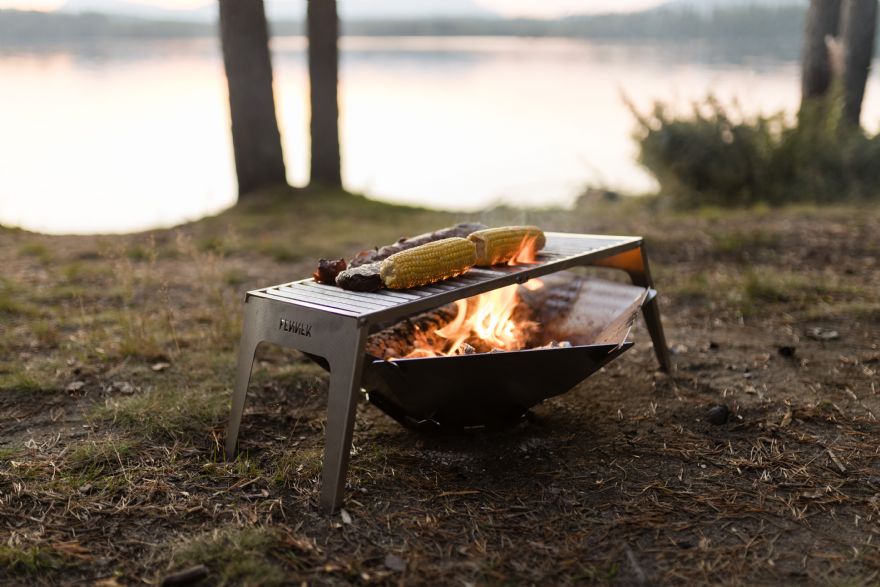
A portable barbecue originally conceived for a music festival has evolved into a successful new business venture for German sheet metal manufacturer
WWS Metallformen, highlighting how industrial engineering expertise can be applied to consumer products.
Based in Hatzenbühl in Germany's southern Palatinate region, the family-owned company has developed a range of portable grills, fire pits and outdoor cooking products under its FENNEK brand. The products are manufactured using the same production facilities and engineering know-how that WWS employs to serve customers in the automotive, aerospace, agricultural and construction equipment sectors.
The idea emerged when an employee from the company's laser department approached managing director Christian Weigel with a proposal to build a portable grill for use at a festival. While the project initially appeared to be a one-off personal requirement, Weigel quickly recognised wider potential.
A keen fisherman, he could immediately see the appeal of a compact, lightweight and easily transportable grill that combined practicality with high-quality construction.
"Our team was immediately enthusiastic," recalls Jakob Haag, head of marketing at WWS Metallformen. "After all, we had the necessary machines in-house."
With design, prototyping and manufacturing capabilities already available, the development process moved quickly. The first grill was designed, tested and produced internally, earning positive feedback from colleagues and customers alike. Encouraged by the response, the company expanded the concept into a dedicated product range.
Today, FENNEK offers portable and stationary grills, fire bowls, camping stoves and accessories. What started as a side project has become an important additional revenue stream for the business.
The move represents a significant diversification for a company more commonly associated with industrial manufacturing. WWS develops and produces prototypes, production parts, assemblies, tools and fixtures for demanding engineering sectors.
"In addition to the automotive industry, including commercial vehicles and motorcycles, we also supply sectors such as the aerospace industry and the agricultural and construction equipment sectors," says Haag.
The expertise developed through these industries has helped shape every FENNEK product. Precision is particularly important in portable outdoor equipment, where components must be lightweight, compact and easy to assemble while maintaining strength and durability.
Production is integrated into WWS's existing manufacturing operations, making use of available capacity while ensuring that industrial customers remain the priority.
"Our production is integrated into the production process wherever it fits in terms of timing and workflow," he explains. "Our industrial customers with fixed delivery dates remain our top priority."
Manufacturing takes place on
Trumpf equipment already used throughout the business. Components are cut on a TruLaser Cell 7040 3D laser cutting machine before being formed on a TruBend 5085 press brake.
"After cutting, the parts are ground, then folded, assembled, packaged and shipped to the customer," says Haag.
The original FENNEK Grill reflects the company's focus on simplicity and functionality. Consisting of just a handful of stainless steel components and an aluminium carrying case, it was designed around the principles of compact storage, easy transport and straightforward assembly.
The parts fit together using slots and tabs, reducing the need for tools. "We try to make everything in such a way that it can be assembled without tools," says Haag. "After all, you don't necessarily have a wrench with you on a picnic or camping trip."
Material selection is also a key consideration. Around 90% of the company's grills and accessories are made from stainless steel, chosen for its durability, corrosion resistance and low maintenance requirements. Portable products typically use sheet material between one and two millimetres thick, while larger griddle plates can be up to eight millimetres thick.
According to Haag, the flexibility of the company's manufacturing equipment is a major advantage. "Above all, we benefit from the flexibility of the TruLaser Cell 7040. For example, we can easily process all sheet metal thicknesses on the same machine," he says.
He adds that the machine's versatility allows production to fit seamlessly alongside the company's industrial workload. "We can switch between cutting, welding and cladding in no time at all. This means that the production of our grills fits seamlessly into WWS's regular production processes."
The ability to manufacture entirely in-house has also helped the company maintain quality standards and react quickly to customer feedback. "FENNEK now has many enthusiastic customers," says Haag. "Our main advantage is that we handle production right here on-site. This allows us to keep an eye on quality at all times and make adjustments on short notice."