Electric motors are becoming the preferred choice across an increasing number of applications and, according to
Fortune Business Insights, the global electric motor market is projected to almost double in value by 2034. Manufacturers are replacing hydraulic, pneumatic and combustion-powered systems with compact electric alternatives that consume less energy and require less maintenance. Designers naturally focus on batteries, motors and power electronics during development, but bearings are just as important to overall system performance. Here, Chris Johnson, managing director of miniature bearing specialist
SMB Bearings, explains how electrification is changing miniature bearing requirements.
Higher operating speeds are one of the most significant changes that we’re seeing with the move to electric motors. Unlike many conventional drive systems, electric motors often run at far greater rotational speeds while delivering high torque across a broad operating range. According to the
Energy Transitions Commission, electric drivetrains are also inherently more efficient than internal combustion engines, converting 75-90% of input energy into motion, compared with 20-30% for combustion engines.
With more of the available energy being converted into useful motion, minimising friction becomes even more important. Miniature bearings used in servo motors, drones and handheld equipment need to perform reliably at much higher rotational speeds, placing greater demands on bearing design, lubrication and manufacturing precision. A bearing that performs well in a conventional application may not deliver the same performance in a faster-running electric system.
Reducing friction is a key part of bearing design. Every source of mechanical resistance uses energy that could otherwise help extend battery life or improve efficiency. Friction also generates heat, which can affect lubricant performance and increase wear, particularly in compact systems where there is little room for cooling. Small improvements in bearing performance can therefore make a noticeable difference to efficiency and service life.
Electrification is also changing the way products are designed. Engineers are expected to deliver more performance from increasingly compact equipment, making efficient use of every millimetre of available space. The challenge extends beyond electric vehicles to applications including portable medical devices, inspection drones, collaborative robots and battery-powered tools. Miniature bearings must therefore continue to deliver smooth, accurate rotation despite operating within tighter design envelopes and under increasingly demanding conditions.
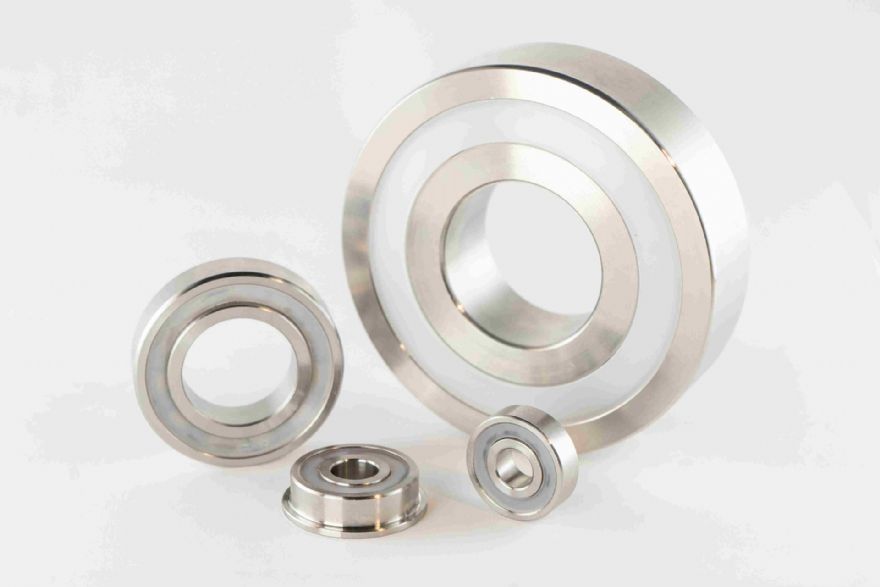
Choosing bearing materialsMeeting those demands starts with selecting the right bearing materials. Stainless steel bearings remain a popular choice where corrosion resistance is required, particularly in outdoor applications like e-bikes or portable equipment exposed to changing weather conditions. Hybrid ceramic bearings, which combine steel rings with ceramic balls, are often specified for higher-speed applications because ceramic balls are lighter than steel. Lower mass reduces centrifugal forces at high rotational speeds while the increased hardness of ceramic materials can improve wear resistance and running performance over time.
Lubrication deserves equal attention. Higher operating speeds increase the demands placed on lubricants, while many electrified products are expected to operate for long periods with little or no maintenance. Selecting an appropriate grease or oil is just as important as selecting the bearing itself. Low-friction lubricants may improve efficiency in one application, while another can require a lubricant capable of maintaining consistent performance across a wide operating temperature range. The correct choice depends on how the equipment will be used rather than applying a single solution to every design.
Precision is another consideration that is essential in electrified systems.
The International Federation of Robotics (IFR) identifies automation and AI-driven manufacturing among the key trends shaping industrial production in 2025, increasing demand for motion systems that deliver consistent, repeatable performance. Robotic joints, servo motors and medical devices often rely on highly accurate motion control. Bearing quality directly influences rotational accuracy, vibration levels and overall system performance. Tight manufacturing tolerances help maintain consistent operation while reducing the risk of premature wear that could affect positioning accuracy or product reliability.
Specifying miniature bearings has become a broader engineering decision than simply matching dimensions and load capacity. Engineers have to consider operating speed, efficiency targets, environmental conditions and expected service life alongside the application's physical constraints. Bearing performance should be evaluated in the context of the complete system rather than as an isolated mechanical component.
Electrification will continue to reshape the demands placed on miniature bearings as products become more compact and capable. Selecting the right bearing early in the design process helps engineers balance these competing requirements and avoid performance compromises later in development.