 Rodriguez
 is highlighting the benefits of its thin-section bearing technology for next-generation satellite and space systems, where minimising weight and installation space while maintaining precision and reliability are critical design requirements.
As satellite operators increasingly look to extend the operational life of spacecraft through servicing, maintenance, repair and repositioning activities in orbit, the demands placed on mechanical components continue to grow. Bearings used in these applications must combine low weight and compact dimensions with high rigidity and long-term reliability.
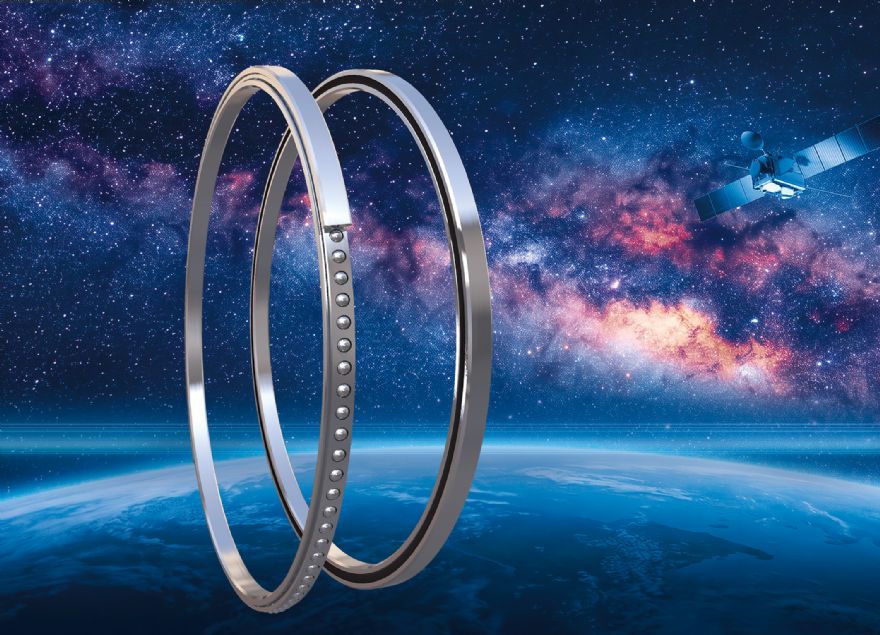
According to Rodriguez, thin-section bearings are particularly well suited to these challenges. Their design allows relatively large bearing diameters to be achieved with a small cross-section, helping to reduce both weight and the space required for installation, two important considerations in space applications where every gram counts.
Ulrich Schroth, head of the company's Value Added Products (VAP) division, said mechanical components must be able to withstand extreme conditions from launch onwards.
He commented: "Even during rocket launch, mechanical components must withstand severe vibrations and high G-forces. Once in orbit, the focus is then on executing movements precisely and reliably over long periods of time."
Applications for the bearings include robotic arms used for in-orbit servicing operations, enabling satellites to be maintained, repaired or repositioned. They are also suitable for movable solar arrays and other positioning systems that require accurate and dependable motion control.
Rodriguez says specially adapted bearing solutions have already been used for many years in robotic arms operating on the exterior of the International Space Station (ISS), demonstrating the technology's suitability for demanding space environments.
Custom-engineered for space
The company notes that standard bearing products are often unable to meet the unique requirements of space applications. As a result, Rodriguez develops customised thin-section bearing solutions tailored to individual installation and performance requirements.
Key design parameters including diameter, width, weight, materials and lubrication systems can all be adapted to suit the application. Engineers must also account for challenges specific to the space environment, such as vacuum conditions, outgassing, radiation exposure and extended operating life.
Development work is carried out within the company's VAP division, which designs bespoke solutions based on Rodriguez's own bearing components.
Schroth said: "We come into play where mechanical movement in space needs to be carried out precisely, reliably and within the smallest of spaces, and thin-section bearings are a key technology for this."
With both the number of satellites in orbit and their expected service life continuing to increase, Rodriguez believes demand will grow for lightweight, high-precision and application-specific bearing solutions capable of supporting increasingly sophisticated space missions.