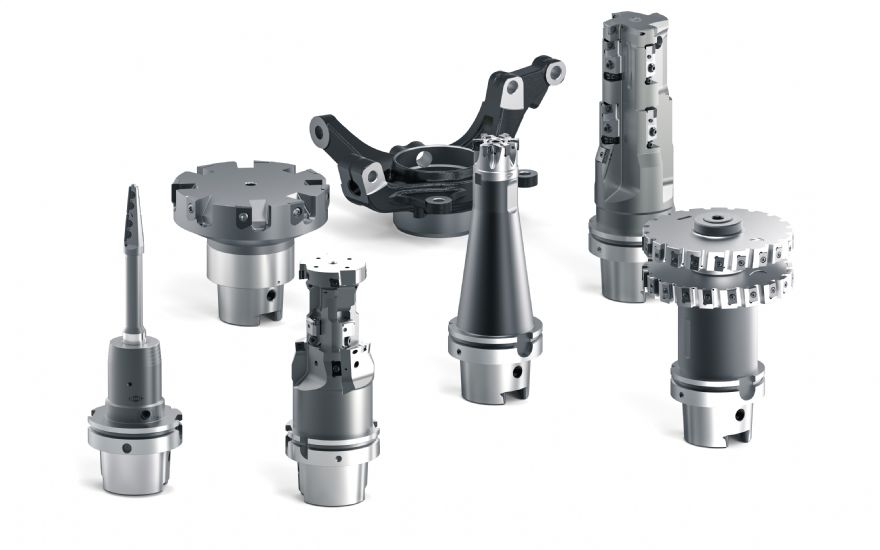
 As wheel carriers and steering knuckles become increasingly sophisticated, manufacturers require machining processes that can deliver exceptional precision, productivity and reliability. Mapal provides tailored tooling and process solutions that meet the demanding requirements of modern chassis components.
Wheel carriers and steering knuckles are among the most important chassis components in any vehicle. Responsible for wheel guidance, force transmission and steering kinematics, they have a direct influence on ride comfort, handling and safety. As vehicle designs evolve, these components have transformed from relatively simple structural parts into highly integrated functional modules that perform multiple tasks within the suspension and steering system.
This development has significantly increased the demands placed on machining operations. Tight tolerances, high surface quality requirements and increasingly complex geometries require advanced tooling concepts and carefully optimised manufacturing processes. As a technology partner for machining, MAPAL supports vehicle manufacturers and suppliers with customised solutions tailored to the specific requirements of each application.
The wide variety of steering knuckle and wheel carrier designs reflects differing vehicle concepts, steering systems, installation constraints and manufacturer preferences. Production volumes can be extremely high, often exceeding 500,000 parts annually for individual component variants. At the same time, manufacturers must achieve consistent quality while maintaining cost-effective production.
Material selection adds a further layer of complexity. Cast iron remains a popular choice for high-volume applications, particularly in lower vehicle segments, due to its cost advantages. However, its abrasive nature poses significant challenges for machining processes.
The drive for greater efficiency and vehicle lightweighting has encouraged a growing shift towards aluminium components. This trend has accelerated further with the rise of electromobility, where reducing weight is especially important. In addition, manufacturers are increasingly moving from die-cast to forged aluminium components. Forged aluminium offers greater strength and durability but introduces new machining challenges. Lower silicon content can make chip control more difficult and increase the tendency for material to adhere to cutting edges.
Functional integration drives machining complexityThe steadily increasing functional integration of steering knuckles is one of the most significant developments in chassis engineering.
Where suspension links were previously attached directly to the component, modern steering knuckles often incorporate integrated bearing arrangements that require highly accurate machined interfaces. To ensure bearings can be pressed into place reliably, manufacturers demand extremely tight tolerances and excellent surface finishes.
Today’s steering knuckles frequently incorporate mounting interfaces for wheel hubs, brake calipers, control arms and ABS systems. They are also increasingly being designed to accommodate sensors and technologies that support advanced driver assistance systems and autonomous driving functions. As a result, steering knuckles have become multifunctional modules that contribute directly to vehicle efficiency, driving dynamics and safety.
These developments have increased the importance of precision machining. Tolerance accuracy directly influences wheel alignment, bearing service life, vibration behaviour and noise levels. To minimise inaccuracies caused by re-clamping, manufacturers increasingly prefer machining strategies that complete components in a single setup, often on multi-spindle machines.
One of the most critical machining operations is the production of the main bearing bore. Depending on the manufacturing process, the bore may be supplied as a closed casting, a near-net-shape feature with substantial stock allowance, or a pre-punched opening. Each scenario requires a different machining strategy.
To remove large amounts of material efficiently, Mapal employs PCD circular milling tools that machine the bore close to its final contour. Depending on component geometry and process requirements, the company applies milling, drill-milling or boring operations, including back-boring processes using hook cutting edges. Tolerance requirements can be as demanding as IT6.
For applications involving multiple setups or unstable clamping conditions, Mapal offers a three-stage machining process. Initial rough machining is performed from both sides using a PCD milling cutter before finish machining is completed using dedicated PCD boring tools.
Where circular milling is possible, Mapal offers solutions that support higher cutting parameters and improved productivity. The OptiMill-Diamond-SPM milling cutter, equipped with brazed PCD cutting edges, is designed with highly positive cutting geometries and optimised chip spaces that significantly reduce cutting forces. This results in improved machining stability while maintaining high productivity levels.
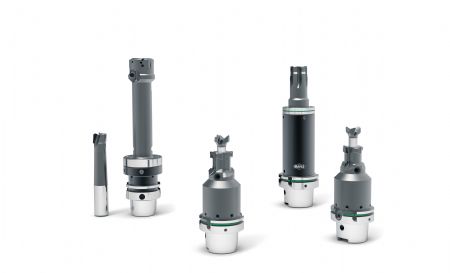
For applications requiring maximum dimensional accuracy, Mapal combines rough milling with semi-finishing using a multi-stage boring tool before carrying out final machining using a fine boring tool equipped with its EasyAdjust-System. The system incorporates the back taper directly into the insert cartridge, simplifying setup while allowing highly sensitive diameter adjustment for precise machining results.
For pre-punched aluminium steering knuckles, one-shot tooling concepts can further improve efficiency. Combination drill-milling and milling tools can complete multiple operations within a single tool, while tangential milling cutters enable manufacturers to consolidate several machining steps into one process.
Precision machining for critical interfacesBeyond the main bearing bore, the control arm connection represents another critical steering knuckle feature requiring extremely high machining accuracy.
As the primary interface between the steering knuckle and the chassis, this area is subject to demanding dimensional, form and positional tolerances, often reaching IT6 quality levels. Surface finish requirements are equally demanding because component accuracy directly affects wheel guidance and vehicle handling behaviour.
Machining begins with roughing operations performed from solid material. Since the control arm mounting lugs are often unsupported within the fixture, minimising cutting forces is essential to prevent distortion. Mapal therefore relies on the OptiMill-Diamond-SPM milling cutter, which machines bores using helical interpolation while maintaining component stability.
However, high-feed machining strategies can generate significant heat, particularly when minimum quantity lubrication (MQL) is employed. Excessive heat can encourage the formation of built-up edges on cutting tools, potentially resulting in bore deformation that may only become apparent after the component has cooled.
To prevent such issues, Mapal works closely with customers to optimise machining parameters and process strategies, balancing productivity and quality while ensuring stable manufacturing performance.
Finish machining presents further challenges. Depending on fixture design and component geometry, tooling may require overhang lengths of up to 300mm. Under such conditions, spindle engagement can create tilting forces that influence dimensional accuracy.
To maintain process capability, Mapal again employs the EasyAdjust-System. Its cartridge design allows diameter corrections to be made with micrometre precision using a single adjustment screw, enabling operators to maintain demanding tolerances efficiently. For applications with slightly less stringent requirements, brazed PCD boring tools provide an alternative finishing solution.
Another function-critical feature is the bolt-hole bore that forms the connection between the steering knuckle and wheel hub. These bores must achieve high contour accuracy because they transmit significant operational loads between components.
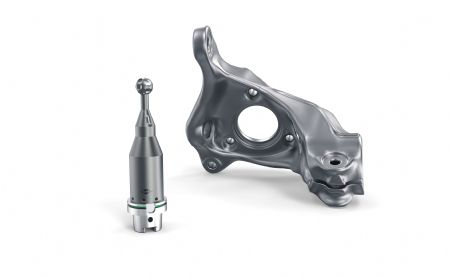
Machining these features often requires the component to be positioned at an angle, creating unfavourable cutting conditions. The resulting deflection forces can cause vibration in PCD ball-nose milling cutters, potentially affecting surface quality, dimensional accuracy, noise levels and tool life.
Mapal addresses these challenges through carefully optimised tool geometries. A precisely defined arrangement of cutting edges, combined with application-specific edge preparation, suppresses vibration and ensures stable machining performance even under difficult conditions.
Turnkey support for advanced manufacturingIncreasing component complexity is also driving demand for integrated manufacturing solutions. In response, turnkey projects have become an increasingly important part of Mapal’s offering.
Rather than supplying tooling alone, the company combines process engineering, fixture design, tooling development, programming and commissioning into a single coordinated approach. This allows manufacturers to benefit from a complete machining solution optimised for the specific component, machine tool and production environment.
By integrating expertise across the entire manufacturing process, Mapal helps customers implement highly demanding machining operations with greater confidence, productivity and process reliability. Whether machining cast iron or forged aluminium components, the company’s combination of tooling technology, application knowledge and turnkey support enables manufacturers to meet the increasingly stringent requirements of modern steering knuckles and wheel carriers.
As these safety-critical components continue to evolve into highly integrated functional modules, the importance of precision machining will only increase. Through tailored tooling concepts and comprehensive engineering support, Mapal is helping manufacturers deliver the levels of quality, efficiency and consistency required by the next generation of vehicle chassis systems.
Pics: For the main bearing bore in aluminium steering knuckles, Mapal says it provides the right solution for every requirement