
As the sliding head turning product specialist at
TaeguTec headquarters in South Korea, Jung Jae-Wook (Jess Jung), recently spent a week in the UK visiting customers with the
TaeguTec UK technical sales engineers. The scheduled tour included a visit to the
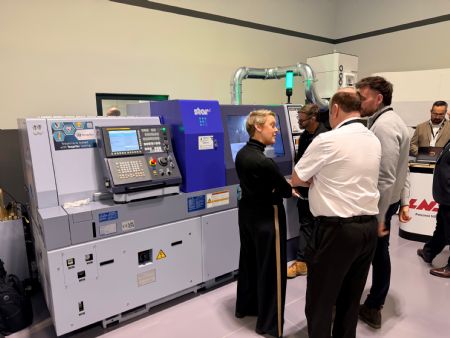
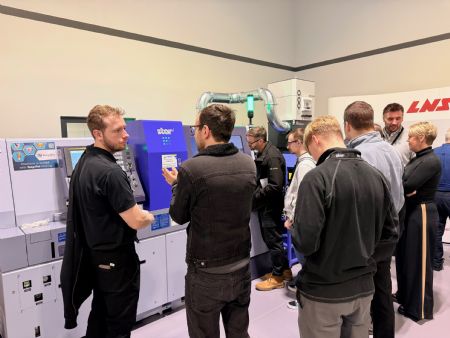
Star Micronics Open House. The trip also put a new product line in the spotlight, one that began as a request from a UK customer and is now heading for a worldwide launch.
The visit gave Mr Jung a close look at how the UK differs from the home market in Asia. He said: "I am very impressed by the technology in the UK. South Korea is very focused on mass production, but the UK is somewhat different. Customers have varied product lines, and the work is more complicated, with 5-axis and multi-spindle machines commonplace, and even multi-axis milling on sliding-head turning machines. In South Korea, we have higher volumes and more production parts, whereas the UK produces more high-value, complex parts that demand more complex machine tools."
He added: "Customers do a lot of precision machining, and the trend changes very quickly, which is why the products are ever-changing. To accommodate this, we have prepared new turning products and parting-off tools that will be launched in 2027 to cover a wide range of cases. This will be especially relevant for the UK market."
The product at the centre of the story is TaeguTec’s WinSwiss line of head-change tooling for sliding-head turning. This is now being extended from square shank to round shank tooling. The idea came from a challenge presented to TaeguTec by a globally renowned hydraulics manufacturer on the South Coast, which produces hydraulic spools and valves in reasonably high volumes on Miyano turning centres.
On the company’s Miyano BNE 51, the tool station is at the back of the machine, making insert changes awkward because of the powerhouse machine’s large work envelope. Iain Lacayo, senior sales engineer for TaeguTec UK, said: "The engineer made a request saying, 'This is the problem, have you got a solution?'. It was as simple as changing the inserts. The screw was very difficult to access, as it's right at the back of the machine, and you cannot get in there easily." Mr Jung saw the same issue on other machines. He said: "Some machines have a very niche tool position, and some customers use the opposite position. In this instance, we were challenged by a customer, and there is nothing we like to do more at TaeguTec than find solutions for the customer."
The project ran for around two years. Mr Lacayo identified the problem on a first visit to the South Coast, and through discussions and development work with Mr Jung, a solution was developed. Some months later, Mr Jung visited the UK with prototype tools. Mr Lacayo said: "We went straight out to the machine, put it in and hit the button, and the customer was very happy. He ordered four different heads straight away, external turning and then grooving. The improvement is so drastic that the customer immediately wanted to standardise on the new system." That order changed the plan. As Mr Jung continued: "Before the visit to the UK, I just wanted to make the new tool as a special. After the visit with Danfoss, we instantly won significant customer demand, so we prepared the line as standard."
Exceptional positional accuracyThe round shank WinSwiss works on the same principle as the square version. The operator can remove the head, fit another and carry on without chasing a screw around the machine. Mr Lacayo explained the interface: "There is a square that connects up to the centre point with a spigot, and then a flat like a whistle notch. When you put the screw in, it pulls the head back, which delivers exceptional positional accuracy, repeatability and stability. The square fitting keeps the orientation, so it is at the correct centre height." Rigidity is the first concern for most customers, according to Mr Jung, and the connection has been tested for it. "The connection is very rigid and very unique. We can guarantee repeatability of 10 microns, which is very good."
More than 10 different heads are already available. This covers parting, external turning and threading, with back turning also available. Each solution uses standard inserts from the existing ranges. Through coolant is also catered for. Mr Jung said: "Normally on the back side of the machine you only have the sleeve area for through coolant. We have an inlet near the head, so it is easy to connect to the manifold – and coolant is directed to the cutting edge to improve performance and swarf clearance."
The 16mm round shank launches in the new year, with the range extending from 19.05mm to 25.4mm for sliding head machines that run on imperial tooling. There is also a 22mm option. A head and shank for 10 by 10mm tool configurations is also arriving soon to suit the smaller sliding head machines.
Ease of access is only part of the benefit. Skilled setters are hard to find, and a head change system reduces the dependence on them. Mr Jung said: "It is difficult to find skillful people, and new starters find machine setup as a difficult task that takes too much time. Normally, an averagely skilled person needs around four to five minutes to change the insert and take off the holder. With our system, it takes only 30 seconds. When you save downtime and setup time, you can increase productivity." Mr Lacayo added that the system also helps whilst the machine is cutting. "If you have two heads, the operator can take one out, put the other head in and hit the button to start, and while it is running they can prepare the next head for the next changeover."
The round-shank range is currently semi-standard, with standard status expected in Spring 2027. Dimensions and head options will also be presented at the start of 2027, with UK availability expected from March or April. Interest from other markets is already building. Mr Jung said: "Whenever I visit customers and machine tool companies, I show them the samples, and they are keen to try our new product." Mr Lacayo is clear about where it began: "This new product line all stemmed from a UK customer visit. Our support for customers in the UK, and our internal communication and development globally, is what led to the development of what will soon be a globally available product."
A wider sliding-head programmeWinSwiss is one strand of a broader sliding-head tooling evolution. The QuadRush back-turning programme is expanding, and the TopCut double-ended grooving was also recently launched. This has drawn positive feedback from the medical sector since its launch. It is perfect for machining at depths up to 12mm with very small inserts – making it very well suited to parts such as implants.
Carbide pricing is shaping much of the rest. Mr Jung said: "Due to the APT problems and the increase in the price of tungsten carbide, we are moving from solid carbide tools to small insert type tools that reduce the cost for customers." The TaeguTec internal grooving range starts at 6mm diameter, and indexable milling inserts now cover everything from 8 to 30mm diameters on sliding head machines. Furthermore, these lines are fully ground to hold tolerance, improve performance and reduce cutting forces. Mr Lacayo puts it simply: "It is all driven by the cost of carbide. With these innovative indexable tools, the only consumable is the carbide at the business end, rather than the whole unit."
Taking steps to replace solid carbide tools with indexable alternatives has presented a challenge of solving chip evacuation issues. Mr Jung said: "We have a slope design on our inserts and toolholders to help chip evacuation for internal grooving. Rigidity and stability are also very important, so we have a multiple contact structure, which is very rigid compared with solid carbide." A triangular insert is also planned for next year, with three edges, a 55° front angle, and extra clearance at the back. Mr Lacayo said: "It is designed for sliding head machines. You can see the investment in R&D. TaeguTec is focusing on sliding head machines, and product development is very much aimed at users of these machines."
Asked what is driving demand in the markets visited around the world, Mr Jung had a clear answer: "At the moment, the trend is the AI industry, the global AI data centre industry. We get a lot of information from customers who are developing new solutions now, and we are also starting this journey to support our customers." One particular application is cooling. "AI draws a high volume of power, so there is a lot of heat during the process, and data centres are changing from air to liquid cooling. Each tray holds GPUs, CPUs and storage devices, and they need a lot of small liquid cooling parts. The coolant distribution units also need very small liquid-cooling parts, and it is vital to keep the area around the semiconductor leak-free."
Robotics is the second growth area. Mr Jung said: "Robotics is another rapidly expanding area worldwide, and robots require many tiny gears, especially in the fingers and elbows. Sliding head machines can produce a wide range of robotic components, such as small spur gears, and at TaeguTec, we have high-technology single-point gear machining systems. Korea predicts huge growth in robotics, and the potential is millions, even billions of parts."