 Tsubaki Kabelschlepp
 is highlighting its engineering expertise in the offshore sector, where cable carrier systems play a vital role in maintaining safe and reliable operation under some of the industry's most demanding conditions.
Offshore installations face constant exposure to wind, waves, corrosion and dynamic movement, creating significant challenges for equipment responsible for carrying power, data and media. Cable carriers are used in a wide range of applications, including top-drive systems, cranes, thrusters, winches and pipe-handling equipment, where any unplanned downtime can carry substantial economic and safety consequences.
The diverse nature of offshore applications means cable carrier systems must accommodate varying motion profiles, high additional loads and complex kinematics, often within restricted installation spaces. These challenges are further intensified by the continuous movement of offshore platforms across multiple axes.
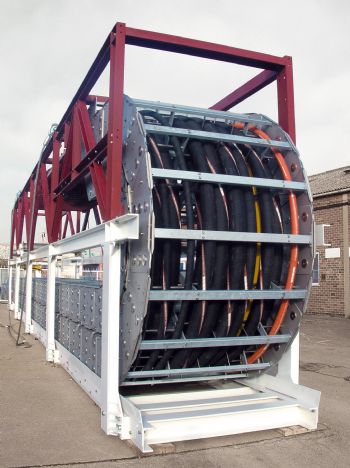
To address these requirements, Tsubaki kaKelschlepp develops application-specific solutions ranging from unsupported and gliding systems through to roller-supported cable carriers for long travel lengths and circular arrangements for rotating equipment. In the UK, the company's subsidiary, Metool Products Ltd., supports the offshore market and has supplied cable management systems for hundreds of offshore projects.
Material selection is a key consideration in offshore environments, where components are continually exposed to salt-laden air, sea spray, UV radiation and fluctuating temperatures. To maximise durability and service life, Tsubaki Kabelschlepp uses materials selected specifically for individual applications, including A4-grade stainless steel, seawater-resistant aluminium alloys and specialist engineering plastics designed for underwater use.
The company also places a strong emphasis on safety during the design and delivery process. Offshore cable carrier systems are engineered with secured threaded connections and redundant fastening arrangements, while comprehensive factory acceptance tests (FATs) form part of every project. Special transport frames are also incorporated to protect systems during shipment to offshore installations and subsequently become part of the final structure.
In addition to mechanical and environmental considerations, offshore projects must comply with a range of international standards and directives that vary according to plant type and operating location. As a result, tsubaki kabelschlepp works closely with customers throughout the development process, tailoring each solution to the specific application.
The growing adoption of condition monitoring technology is also influencing offshore cable management systems. Because offshore loading conditions can be difficult to predict accurately, the company applies conservative design principles and high safety factors when configuring cable carriers. Condition monitoring can then be used to identify changing load conditions and support condition-based maintenance strategies.
Jürgen Weichel, Industry Manager at tsubaki kabelschlepp, said: “More than 70 years ago, we invented the steel cable carrier. Based on these decades of experience, we can now derive a suitable solution for any application from a very broad portfolio.
“Our colleagues have a vast store of knowledge and are particularly strong in the development of customised solutions, which are par for the course when it comes to offshore plants.”
The wider Tsubaki Group, headquartered in Japan, is a major manufacturer of drive, conveyor and mechatronic technologies. In 2026, its European operations were brought together under Tsubaki Europe Holdings B.V., based in Dordrecht, the Netherlands, to strengthen collaboration across the group's businesses throughout Europe.