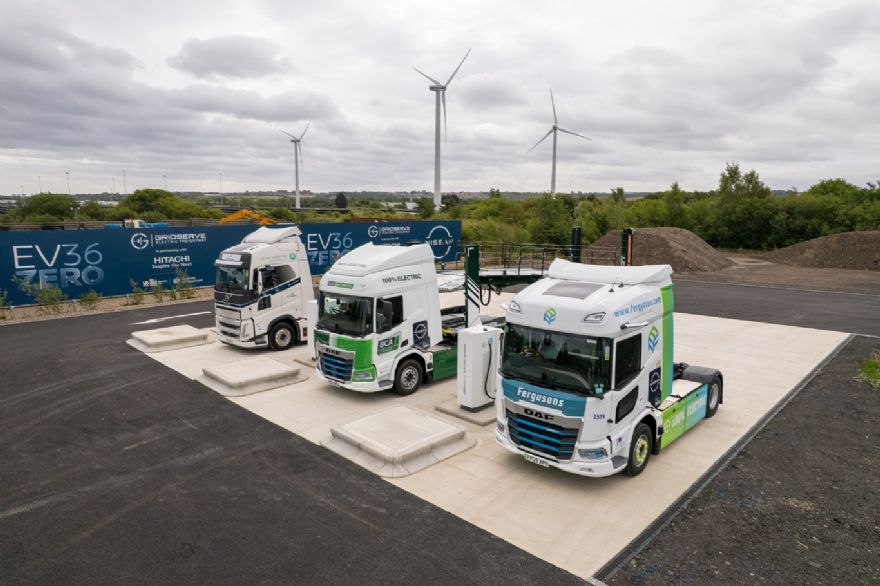
The UK's largest trial of zero-emission heavy goods vehicles has recorded more than 2.2 million miles of real-world operation, according to the first annual report from the Zero Emission HGV and Infrastructure Demonstrator (ZEHID) programme.
Published by
Innovate UK in partnership with
WSP, the report highlights significant progress in the deployment of battery-electric and hydrogen-powered trucks across commercial freight operations, providing what organisers describe as a growing evidence base for the future decarbonisation of road haulage.
Funded by the Department for Transport and delivered through Innovate UK, ZEHID is described as Europe's largest coordinated demonstration of zero-emission HGVs over 40 tonnes and the supporting infrastructure required to operate them.
The programme's three projects, Electric Freightway, eFreight 2030 and ZENFreight, have so far deployed more than 240 zero-emission trucks and established over 40 charging sites across the UK. By the end of 2026, those figures are expected to increase to around 300 vehicles and 70 infrastructure locations.
Data gathered during the first year of operation shows the vehicles have completed more than 85,000 freight journeys, transporting over 550,000 tonnes of goods and travelling a combined 2.2 million miles, equivalent to around 90 trips around the Earth.
The report suggests battery-electric HGVs weighing up to 44 tonnes are already proving capable of operating successfully on long-distance commercial routes throughout the UK, helping to build confidence in the technology among fleet operators and logistics businesses.
Significant environmental benefits have also been recorded. According to the report, the trial vehicles have delivered an estimated 81% reduction in greenhouse gas emissions compared with equivalent diesel-powered operations, resulting in cumulative carbon dioxide savings of more than 4,000 tonnes.
The programme has now entered a five-year monitoring and evaluation phase that will continue until 2031. Researchers will assess vehicle performance, infrastructure utilisation, operating costs, emissions and wider impacts on freight operations to support future investment and policy decisions.
Claire Spooner, director of the Innovation Service at Innovate UK, said the results demonstrated that zero-emission trucks are already capable of delivering in demanding operating environments.
She said: “Zero-emission HGVs are already demonstrating their potential in real-world freight operations across the UK. This first annual report marks an important milestone for the Zero Emission HGV and Infrastructure Demonstrator programme, providing valuable insight into what is working, where challenges remain and what will be needed to support the wider transition to zero-emission freight.”
Sofia Amaral, business director for sustainable transport at WSP, said the project was generating evidence on a scale not previously available to industry or government.
She said: “This first annual report marks an important milestone for the UK’s transition to zero-emission freight. Through our role as independent evaluator, WSP is helping to generate robust, real-world evidence on the performance of zero-emission HGVs and supporting infrastructure at unprecedented scale.”
With several hundred vehicles expected to be operating by the end of the year and monitoring continuing through to 2031, the ZEHID programme is set to provide one of the most comprehensive assessments yet of how battery-electric and hydrogen-powered trucks can contribute to the decarbonisation of UK freight transport.