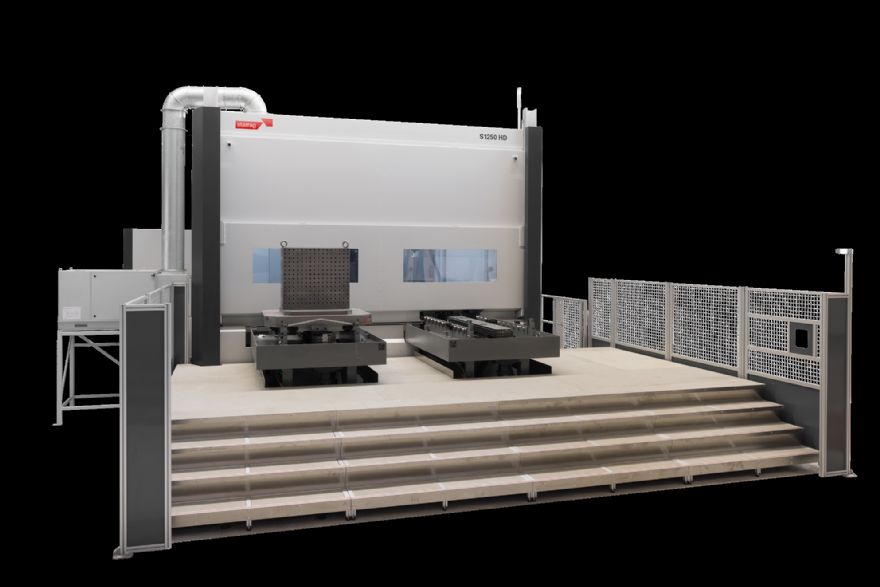
At EMO 2023,
Starrag presented the prototype of the hydrostatically guided Starrag S1250 HD 5-axis machining centre.
With its very high rigidity and damping, the machine has already set cutting parameter records for titanium roughing. The current standard version has raised these records to an even higher level, as shown in initial tests. An even more rigid structure, a new milling head with 5,000Nm, and a gear rotary table with 25,000Nm torque are responsible for the enhancements.
For many years, the Starrag STC series has set standards for the efficient machining of structural components made of titanium. This extremely tough material, with its low thermal conductivity and poor machinability, subjects tool cutting edges to high stress and prevents high speeds.
Successful machining requires low speeds and high torques, which in turn demand high rigidity and damping in the machine. This is why Starrag decided to offer its horizontal STC 1250 machining centre in a variant in which the horizontal linear axes are guided hydrostatically.
Friction-free, wear-free, extremely rigid, and highly damped – with these properties, the new machining centre, under the new name Starrag S1250 HD, is suitable for five-axis heavy-duty cutting of titanium structural components. In roughing tests, the prototype already achieved up to three times the material removal rate of the roller-bearing version. The improved damping and dynamic performance also ensured excellent precision and surface quality during finishing.
The fact that this new concept is a hit is confirmed by Airbus’s order for the Varel site. After endurance tests with the prototype machine, the company placed an order for five Starrag S1250 HD machines – with a few special requests.
Milling and rotary table upgrades"Our customers were impressed by the tests conducted two years ago," reports Alexander Fitz, sales director for Aerospace & Turbine at Starrag AG. "The Starrag S1250 HD promised considerably more efficient cutting of titanium structural components than ever before. To optimally meet the special requirements of titanium cutting specialists, we decided to make some modifications to the series machine."
The modifications mainly involved the rotary table and the milling head, both of which were adapted from the standard STC 1250 for the prototype of the HD variant.
Alexander Fitz explains: "We do not need a fast-moving, direct-driven table for the high-performance milling of titanium structural components. This is why we replaced it with a gearbox variant, which can better meet the requirements with its enormous torque of 25,000 Nm and 32,000 Nm clamping torque."
Other than the torque increase in the table, the customer also requested changes to the milling head.
"Our swivel milling head used in the standard STC machines is very compact and allows optimal accessibility to the workpiece, thus enabling the use of short tools," says Alexander Fitz. “We modified this slightly for the Starrag S1250 HD. By enlarging the swivel milling head on one side, we created space for a 50 per cent stronger A-axis with 12,000 Nm torque and 20,000 Nm clamping torque – while retaining the previous good accessibility."
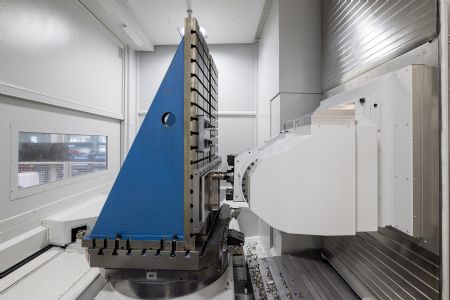
Starrag's robust 53 kW gear spindle is used as a work spindle, providing 1,600 Nm of torque and a speed of 4,500 rpm. A new feature is the HSK-B160 interface. "The large contact surface with a 160 mm diameter ensures high tool rigidity," argues Alexander Fitz. "This is important for large cutting depths – especially for tools with a wide overhang."
Added rigidityThe Starrag developers made a few modifications to the series-produced machine compared with the prototype, not only in response to the points suggested by the customer.
"Our aim was first and foremost to further increase the possible removal rates and reduce tool wear," says Rolando Senn, leading designer in hydrostatics. The most important factors in this context are the rigidity and damping of the machine.
"Therefore, we made the machine's structure, both the beds and the stands, even more rigid," reports Rolando Senn. "We also increased the contact surface of the hydrostatics, thereby increasing rigidity and damping. We were also able to make the automatic control system of the hydrostatic guides more robust and maintenance-friendly through a mechanical solution."
Initial testsThe initial tests of the series machine showed very promising results. Dr Markus Ess, Director of Technology at the Starrag Business Unit HPS, highlights one test conducted in Rorschacherberg in the presence of the titanium specialists from Airbus, Varel: "We made a so-called performance cut, performed with ideal clamping and tool ratios. Roughing with a short 80 mm Igel milling cutter, 68mm depth in the full cut, with 80mm/min feed and 160 turns. Then the tool capacity was exhausted. The machine ran very smoothly – the spindle power consumption was only roughly 60 to 70%."
Further performance cuts in titanium (Ti6Al4V) on the new Starrag S1250 HD yielded results that, according to Starrag’s milling specialists, indicated a world record in titanium machining: With the carbide cutter with Ø40 and 18 teeth, developed by Starrag and designed for heavy-duty machining, a titanium block was roughed using the following cutting parameters: cutting speed vc = 120m/min, tooth feed fz = 0.45mm, axial cutting depth ap = 98mm, and radial cutting depth ae = 2mm. The spindle speed was 955rpm, the feed speed vf was 7,735mm/min, and the average undeformed chip thickness hm was 0.101mm. The result: An unbelievable metal removal rate Q of 1,516cm3/min, which promises enormous productivity and demonstrates the advantages of coordinated systems with machining centres, tools, and technology for the customer.
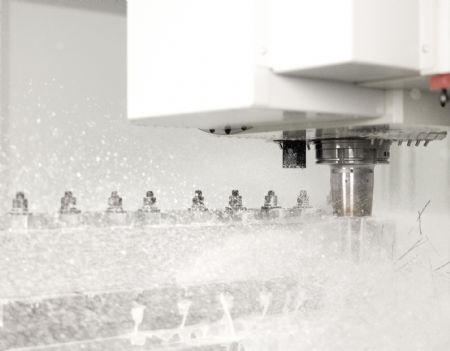
The previous tests also highlighted that, at present, it is the tool rather than the machine that is the limiting factor. Therefore, further joint tests are planned – with our own tools and with tools from leading tool manufacturers – to achieve more world records for the Starrag S1250 HD.
Long tools for deep cavitiesThe developers of the Starrag S1250 HD are already keeping an eye on future demands. This is because modern processes for producing near-net-shaped blanks are likely to reduce the amount of roughing performed in the coming years. The focus then shifts to the challenge of accessing complex, deep cavities with tools up to 500 mm long and achieving high performance there. But it also essentially comes down to the tool, where the large planar support of the HSK-B160 retainer offers the best support. Initial tests show that vibration-damped versions are far superior to monolithic tools.
"The structure of our HD machine is also ideally suited to this type of machining," says Markus Ess confidently. "We have built an extremely rigid, high-quality titanium machine, with which we can perform excellent roughing and work in complex cavities with very long tools – a future-proof mix."
Reduced tool wearOne of the biggest cost factors in titanium machining is tooling, which is subject to heavy wear. Good damping delivers significant improvements in this context, i.e. considerably longer life, even when speeds are increased. According to Rolando Senn, this represents huge savings potential: "During intensive machine use the savings put the additional costs of the hydrostatics into perspective."
Markus Ess also mentions another benefit companies gain with the Starrag S1250 HD: "Even though the machine's power consumption is higher than that of other machines, the user saves a lot of energy when measured by output, thanks to the significantly reduced machining time, and reduces their CO2 footprint. With regard to the component, the user requires less drive power overall and also saves base load, which comprises the power consumption of the cooling lubricant system, hydraulics, pneumatics and cooling."