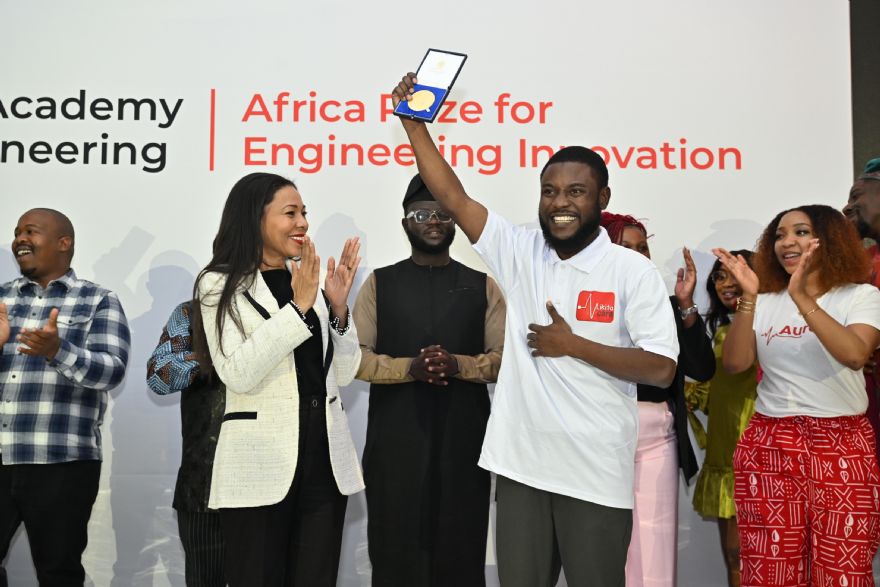
A locally manufactured medical monitoring platform developed to improve patient care in resource-constrained healthcare settings has won the 2026 Africa Prize for Engineering Innovation.
Mamane Kabirou Ousseini, chief executive and co-founder of
Likita Care, was named the winner of the continent's largest engineering innovation award, receiving £50,000 to support further development and commercialisation of the technology.
The Africa Prize for Engineering Innovation is delivered by the
Royal Academy of Engineering and part-funded by the UK Government's International Science Partnerships Fund. The award was presented at a ceremony hosted by former professional rugby union player and entrepreneur Bryan Habana.
Ousseini is the first engineer from Niger both to take part in and win the competition. Accepting the award, he said: "Winning the Africa Prize is a dream come true. We started this project five years ago, and to see how far we've come and receive this recognition today means more than words can express."
The idea for Likita Care emerged from Ousseini's experience maintaining and repairing medical equipment in hospitals across Niger. During that work he frequently encountered imported patient monitoring systems that had become unusable because replacement parts and specialist technical support were difficult to obtain locally.
With many healthcare facilities already operating under significant resource constraints, the failure of critical monitoring equipment could leave medical staff without reliable tools to assess and track patient conditions.
In response, Ousseini co-founded Likita Care to provide healthcare professionals with monitoring technology that is manufactured, maintained and repaired within Niger.
The platform combines connected hardware, clinical software and digital manufacturing capabilities into a single system. Its devices support patient, cardiac and prenatal monitoring, while a central dashboard allows healthcare professionals to supervise multiple patients simultaneously. An embedded artificial intelligence module also assists clinicians by interpreting vital signs in real time.
The technology has already gained traction within the country's healthcare sector. More than 70 monitoring units have been produced and deployed across Niger and are now being used in five medical centres. The system has also been tested on more than 100 patients, generating over 4,000 data points.
Ousseini intends to use the prize funding to accelerate commercialisation of the platform in Niger and support expansion into neighbouring West African markets.
Three other finalists were recognised as runners-up, each receiving £10,000. South African innovator Dyllon Randall was honoured for Pee-Cycling, a modular system that converts urine into fertiliser while recovering water and nutrients. A full-scale installation can process up to 3,000 litres of urine daily, producing approximately 300 litres of liquid fertiliser and 700 litres of treated water for reuse from every 1,000 litres processed.
Kenya's Alice Muhuhu was recognised for MoyoECG, a portable heart monitoring system designed to help frontline healthcare workers identify potential cardiac conditions and make faster referrals. Early trials reduced ECG interpretation times from around 30 minutes to less than five minutes.
Another Kenyan finalist, Naom Monari, received a runner-up award for Renal Roads, a mobile dialysis clinic that brings treatment closer to patients in rural and hard-to-reach communities. The service visits around three communities each week and is capable of delivering up to 400 dialysis sessions per month.
The competition's £5,000 One-to-Watch Award, determined by audience vote, was presented to Ghanaian innovator Johannes Amo-Aye for Fusion Wind Turbine, a hybrid wind and solar microgrid system designed to provide reliable renewable electricity to off-grid communities while reducing dependence on diesel generators.
The finalists presented their technologies before a live audience and judging panel at NH Johannesburg Sandton. They were selected from a group of 16 entrepreneurs who completed an eight-month programme of mentoring and training.
Entries were assessed on engineering excellence, evidence of impact, commercial viability, scalability and the strength of the teams behind the innovations. Judges also considered how effectively participants had applied lessons from the programme and articulated their future growth plans.
Rebecca Enonchong FREng, chair of the judging panel, highlighted the broader benefits of the initiative beyond the financial awards.
She said: "For all contestants, the Africa Prize is more than a financial reward. They all receive mentoring, communications support and access to networks that can accelerate growth, which is a critical part of the innovation ecosystem but is often missing. Alumni of the Prize consistently go on to secure funding, and many now lead ventures that create employment and deliver meaningful impact."
Pic: Africa Engineering prize winner Mamane Kabirou Ousseini with his Gold Medal