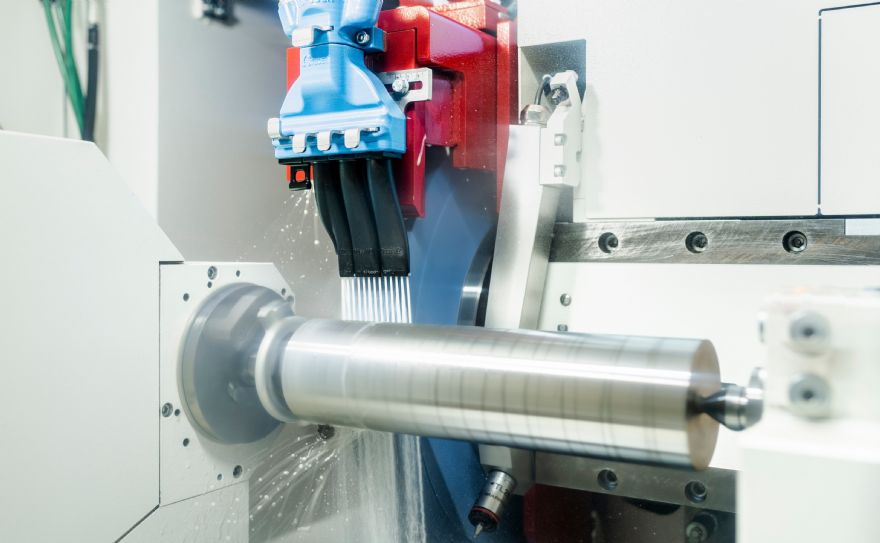
 The thread is the invisible backbone of our modern world. With Studer’s high precision universal cylindrical grinding machines and their intuitive software, customers can easily and efficiently produce threads of the highest quality, even for demanding industries.
Few engineered features are as commonplace, or as vital, as the thread. A simple helical form that converts rotary motion into linear force, threads have been fundamental to manufacturing and mechanical engineering for centuries. Today they are found everywhere, from standard fasteners and machine tool interfaces to ball screws, medical implants and robotic drive systems.
Producing these threads, however, becomes significantly more challenging as performance requirements increase. In many applications, thread profiles must be ground after the component has been hardened, eliminating the possibility of conventional machining operations such as turning or milling. Instead, manufacturers rely on highly precise grinding processes capable of achieving micron-level tolerances, exceptional surface finishes and consistent repeatability.
Meeting these demands requires a combination of machine accuracy, thermal stability and process control, areas in which Studer has invested heavily over the past three decades.
One machine, multiple processesOne of the key developments has been the integration of thread grinding capability into the company's universal cylindrical grinding machines.
“There are numerous advantages for customers in being able to perform grinding operations on a universal cylindrical grinding machine rather than having to rely on a specialised machine,” explains Daniel Huber, CTO of
Fritz Studer AG.
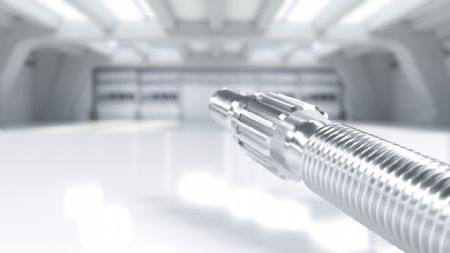
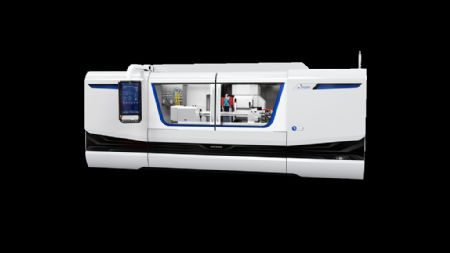
Studer began developing thread-grinding software and controlled C-axis technology during the mid-1990s. Today, every universal cylindrical grinding machine in the company's current portfolio can be configured for thread grinding through dedicated software modules.
The approach provides manufacturers with considerable flexibility. Cylindrical grinding, profile grinding and thread grinding can all be completed in a single set-up, reducing handling operations and eliminating potential positioning errors between processes. For companies previously relying on dedicated thread grinders or subcontracting work, consolidating production onto a single machine can also reduce floor space requirements and bring valuable expertise back in-house.
The popularity of the approach is reflected in market demand. According to Studer, one in every six machines it delivers is equipped for thread grinding applications.
The machines are capable of producing a wide range of thread forms, including ISO metric and fine threads, tapered threads, toolholder mounting threads, and internal and external thread gauges. Software-based profile correction combined with the C-axis enables the production of most standard industrial thread geometries.
Tackling complex geometriesAs thread forms become larger and more complex, additional machine functionality becomes critical.
“And for workpieces with a large lead angle, such as multi-start ball screws, worms, or extruder shafts, we introduced the A-axis as a swivelling grinding spindle axis in 2013,” says Mr Huber.
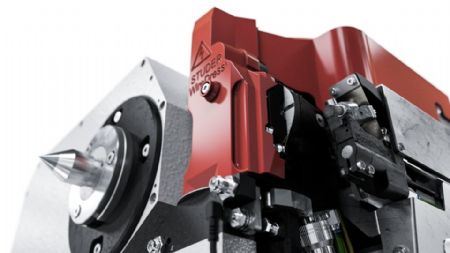
Available on the S41 and S22 models, the A-axis enables the efficient grinding of thread geometries that would previously have required dedicated specialist equipment. According to Studer, it represented a significant mechanical innovation for universal cylindrical grinding machines at the time of its introduction.
The technology is particularly relevant in sectors such as automation, precision motion control and robotics, where ball screws and lead screws often incorporate challenging thread profiles but must still meet demanding performance standards.
Sharper wheels, cooler grindingGrinding performance also depends heavily on wheel conditioning and thermal management, particularly when working with hard materials.
For this reason, Studer developed WireDress, a dressing technology based on the principle of electrical discharge machining. Available on the S41 and S22, the system enables contactless dressing and profiling of metal-bonded diamond and CBN grinding wheels directly on the machine at operating speed.
The result is an exceptionally sharp grinding wheel capable of maintaining profile accuracy while reducing the risk of grinding burn. The technology also allows threads to be ground directly from solid stock, delivering significant productivity benefits compared with conventional dressing methods.
Complementing WireDress is Studer's SmartJet coolant nozzle system, which has been specifically developed to improve coolant delivery during thread grinding operations. Effective cooling is essential for preventing thermal damage, maintaining dimensional accuracy and extending grinding wheel life.
Top pic: Studer SmartJET