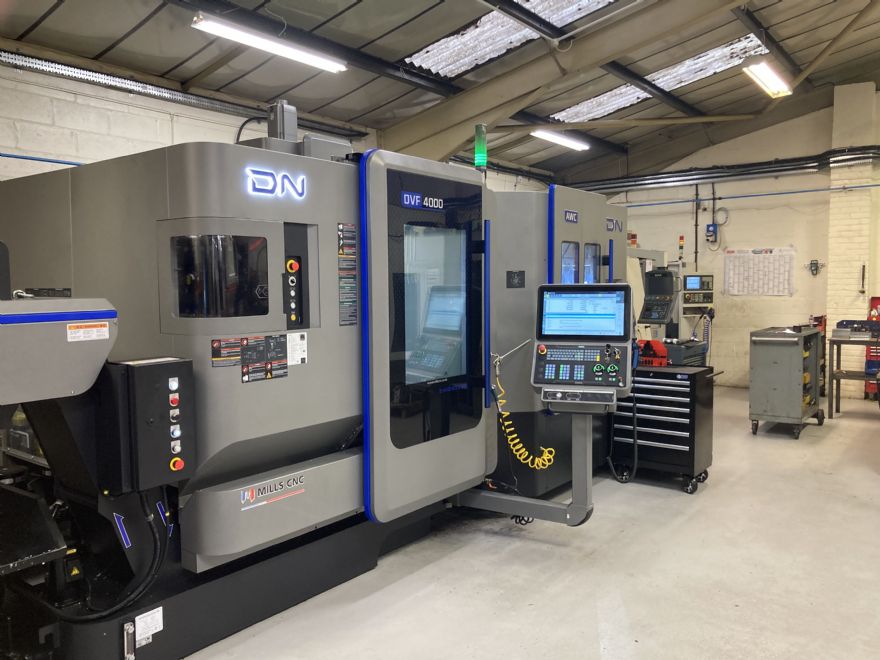
A new automated five-axis machining cell is helping
Bedford Engineering increase productivity, improve efficiency and support future growth.
Established before the Treaty of Versailles formally brought the First World War to an end, the independent fourth-generation family-owned precision engineering specialist has spent more than 108 years navigating economic upheaval, technological change and shifting political landscapes.
From post-war reconstruction and de-industrialisation through to Brexit and the post-pandemic manufacturing environment, the Bredbury, Stockport-based company has consistently adapted to meet new challenges. That willingness to evolve remains central to the business today and is reflected in its latest investment: a simultaneous five-axis machining centre integrated with an automated workpiece pallet-changing system.
Supplied by
Mills CNC, the exclusive distributor of DN Solutions machine tools in the UK and Ireland, the new DVF 4000 five-axis machining centre and eight-station automated workpiece changer (AWC) were installed at Bedford Engineering’s 8,000ft² facility in July 2026.
Since commissioning, the automated manufacturing cell has been processing a range of complex, high-precision components in small batches for customers across multiple sectors, delivering measurable gains in throughput, spindle utilisation and process efficiency.
Continuous improvement drives investmentThe latest investment is firmly rooted in Bedford Engineering’s long-standing commitment to continuous improvement.
The company regularly reinvests in its people, plant and production processes to strengthen its competitive position and support customer requirements. Over recent years, that strategy has seen the business expand its portfolio of advanced machine tools, including simultaneous five-axis machining centres, fourth-axis milling machines and CNC lathes equipped with Y-axis, C-axis and driven tooling capabilities.
A recent defence-sector project highlighted the potential benefits of introducing a new generation of five-axis machining technology combined with automation.
The company had been machining a series of precision aluminium components from solid billets using an existing three-axis machining centre. Although the process employed multiple vices to maintain production flow, parts still required numerous setups and repeated re-fixturing to complete top- and bottom-side operations.
Nick Boothby, Bedford Engineering’s director, explained: “Whilst this process did result in a continuous production flow to some extent, it wasn’t as time- or cost-efficient as it could be.
“Our experience led us to believe that we could manage this repeat job, and similar jobs, more quickly, efficiently and profitably by investing in a new one-hit multi-axis machine tool and automating the machining process.”
A first for Bedford EngineeringDespite its extensive experience with advanced machine tools, the project represented several firsts for Bedford Engineering. The company had never previously purchased a machine tool from Mills CNC and had also never invested in an automatic workpiece pallet-changing system. As a result, the decision-making process involved extensive research and careful evaluation.
“We are always looking to improve the performance of our machine shop,” explained Mr Boothby. “Our investments in multi-tasking and multi-axis machines in recent years have significantly upgraded our machining capacity and capabilities and have optimised machine utilisation and spindle uptime.”
Before approaching suppliers, Bedford Engineering developed a detailed specification outlining both operational requirements and longer-term ambitions.
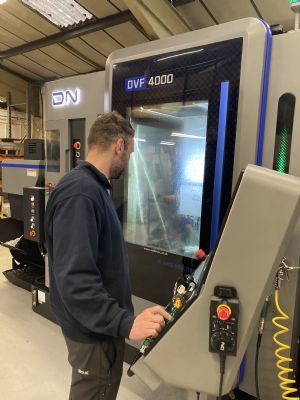
Control familiarity was a key consideration. The company wanted the new machine to feature a Siemens control platform, ensuring a smooth transition for operators and programmers. It also required a compact but flexible five-axis machine equipped with a high-speed spindle and substantial tool capacity.
“From an operational perspective that included our machine shop staff’s knowledge, experience and control familiarity, we needed the new machine to be equipped with an advanced Siemens control,” said Mr Boothby.
“Given the nature and size of parts we machine, our preferred option was to go for a flexible and compact five-axis machine with a high-speed spindle and a generous tool changer.
“Our search ultimately led us to Mills CNC and the company’s DVF-range of five-axis machines.”
The automation element was considered equally important. Bedford Engineering recognised that introducing pallet-changing technology would reduce non-cutting time, maximise productivity and create opportunities for unattended operation.
A visit to Mills CNC’s technology campus in Leamington Spa proved decisive. There, the company saw a DVF 5000 machining centre integrated with an AWC system operating in a real-world production environment.
“Mills has a good reputation in the market and the DN Solutions machines it sells and supports are highly regarded,” said Mr Boothby. “When we saw the DVF machine and integrated AWC automation system in action at Mills’ facility, it made sense, as long as the price was right, to go for a similar and proven single-sourced solution.
“As it turned out, Mills was able to offer the integrated solution at a competitive price which put them in the box seat and, as a consequence, we opted to go for the smallest DVF machine, the DVF 4000, and an 8-station automatic pallet changer.”
Automation delivers immediate benefitsThe DVF 4000 supplied to Bedford Engineering is equipped with Siemens’ latest Sinumerik One control, a 15,000rpm spindle, a 60-position automatic tool changer, 20 bar through-spindle coolant, Blum probing technology and a high-efficiency swarf conveyor.
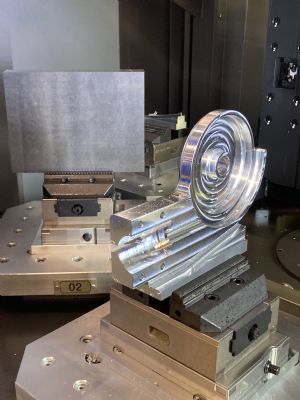
Integrated alongside the machine, the eight-station AWC system is designed specifically for high-mix, low-volume production environments. Workpieces are loaded onto standardised pallets and stored within a circular carousel, allowing seven jobs to be prepared while machining is underway on the eighth pallet.
A dedicated transfer mechanism automatically exchanges pallets, significantly reducing idle time and enabling continuous production.
For Bedford Engineering, the combined system has transformed the way many components are processed. The five-axis machining centre allows one-hit machining of complex parts, while the automation system keeps the machine cutting for longer periods without operator intervention.
Mr Boothby said: “The DVF 4000, with its five-side machining capabilities, can process parts in one-hit, and the AWC can be setup quickly and accurately for continuous production.
“Our DVF 4000/AWC cell has already had a positive impact on productivity. Throughput has increased, spindle up-time is being optimised and operator time has been freed-up. The machine can be setup and literally be left to run."
For a company that has continually evolved throughout more than a century of manufacturing change, the investment represents another important step forward. By combining advanced five-axis machining with integrated automation, Bedford Engineering has improved productivity and process efficiency while positioning itself for future growth. It also reinforces a clear strategic direction: that multi-axis machining and intelligent automation will play an increasingly important role in the company’s next chapter.