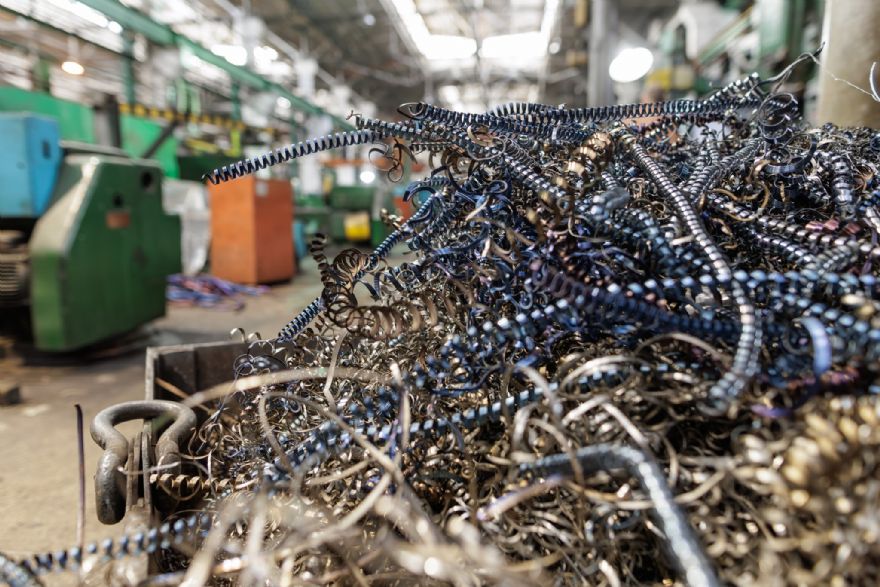
 In this article Stan Ray, director at Mammoth Attachments, a Hertfordshire-based supplier of forklift and plant attachments, discusses the best way of handling swarf in busy machine shop environments.
Swarf and offcuts build up fast in a busy machine shop, and getting them to the skip is a job that's easy to do badly. A bottom-emptying stillage collects waste where it's made and empties through a hinged base, so nothing has to be tipped. Here's how to choose one and use it safely.
Collect it where it's madeThe less swarf is handled, the better. A small dumping box on braked castors parked beside each machine catches chips and turnings as they're cleared, instead of leaving them on the floor or carrying them across the shop in buckets. Larger stillages work well at the end of a line or beside a saw, where offcuts pile up. Giving each metal its own container, or its own colour, keeps steel, aluminium and brass apart, so the scrap stays clean and easier to sell.
How the base opensThere are two common designs. On a pull-cord stillage, the forklift driver lifts the full stillage over the skip and lowers it onto the skip's edge, and the base is released with a cord. On an automatic stillage, the base opens when it's lowered against the skip, so the driver can empty it without leaving the seat. Both lock their base again when the stillage is set back down on firm ground.
Automatic stillages are best kept for dry waste. Wet swarf and coolant can leak through the base, and the extra weight can overload the release mechanism.
Size it by weight, not volumeThis is where most mistakes happen. Stillages are described by their volume, but the load rating is the figure that matters, and swarf, turnings and offcuts are dense. A stillage of steel offcuts can reach its rated load long before it looks full. Weigh a typical full load on a pallet scale, or ask your waste contractor what a cubic metre of your waste weighs, then choose a size that keeps a full load comfortably under the rating.
Then check the forklift. It has to lift a full stillage, plus the stillage's own weight, to the height of the skip edge. Check that against the truck's capacity plate at that lift height and load centre, not just its headline capacity.
Check the forks fitThe forks need to run the full length of the stillage's fork pockets, set to the spread the pockets are designed for, and the fork section has to fit inside them. Every lift should start with the forks fully inserted and the stillage's safety chain connected to the truck, so it can't slide off if the driver brakes hard or the load shifts.
Emptying it safelyBefore each lift, inspect the stillage carefully, checking the base, hinges, locking mechanism and release cord for signs of wear or damage. It is essential to ensure that the base is fully locked before moving the stillage. When lifting, the forks should be inserted fully into the fork pockets and the safety chain secured to the forklift truck to prevent the stillage from shifting during transport.
The stillage should be carried just clear of the floor and moved at walking pace, with care taken to keep the route clear of other personnel. To empty the load, raise the stillage above the skip edge, move into position and lower it so that it rests on the edge of the skip. The release mechanism should only ever be activated when the stillage is supported by the skip and never while it is suspended in mid-air.
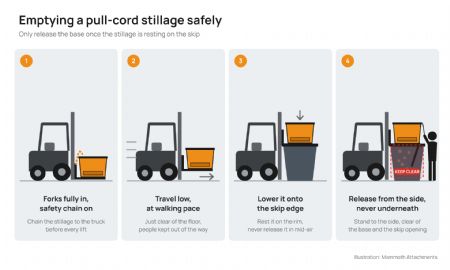
Where a pull-cord release is used, the operator should stand to one side of the skip, clear of both the opening and the base of the stillage, and never beneath the load. Once empty, the stillage should be lifted clear of the skip, reversed away and lowered onto firm ground so that the base can re-engage and lock securely. The locking mechanism should then be checked before the stillage is returned to service.
Coolant and wet swarfSwarf removed directly from a lathe, machining centre or other machine tool is often saturated with coolant. Allowing the material to drain over a suitable drip tray before it is placed in the stillage helps keep coolant off workshop floors and transport routes, while also reducing the amount of liquid disposed of with the waste.
Good housekeepingGood housekeeping practices can improve both safety and efficiency when handling swarf and offcuts. Stillages should not be overfilled, as material protruding above the sides can fall during transport to the skip. Empty stillages should be stacked wherever possible, as many designs are intended to nest safely when not in use, helping to free up valuable floor space. Workshops may also benefit from using a magnetic sweeper to collect ferrous swarf, fasteners and other metal debris that misses the container before it becomes dispersed around the shop floor.
Stan Ray’s guide to using a bottom emptying stillage for factory waste and swarf can be seen
HERE: