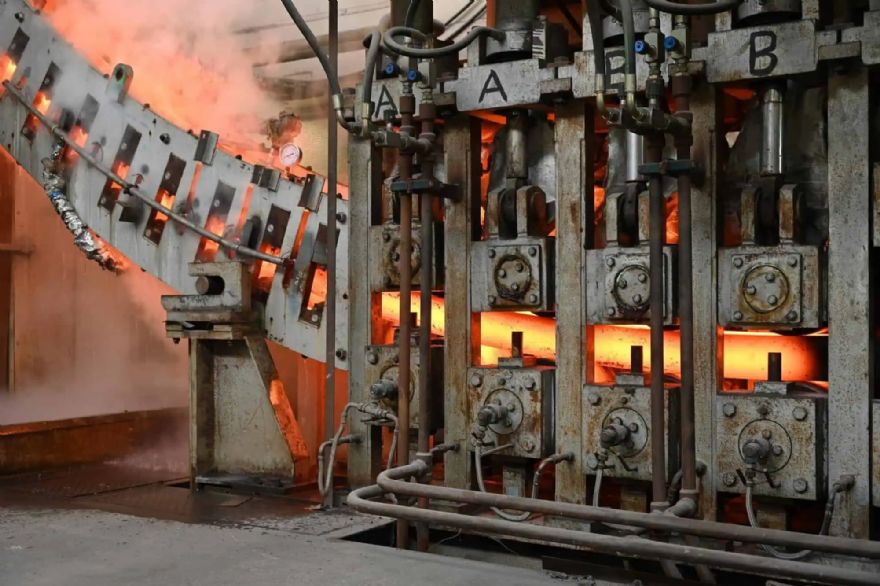
 NEURONE project billet leaving the caster and entering the product straightener - Photo: Materials Processing Institute
A
UK Atomic Energy Authority (UKAEA) working group has successfully demonstrated the industrial-scale production of fusion-grade steel which has the potential to dramatically reduce production costs and improve the efficiency of future fusion powerplants.
In just its first year, the NEURONE (Neutron Irradiation of Advanced Steels) consortium has successfully produced fusion-grade reduced-activation ferritic-martensitic (RAFM) steel on an industrial scale, using a seven-tonne electric arc furnace (EAF) at the
Materials Processing Institute (MPI) in Middlesborough.
David Bowden, Group team leader for materials science and engineering at UKAEA, and NEURONE programme lead, said: “One of the major challenges for delivering fusion energy is developing structural materials able to withstand the extreme temperatures (up to 650°C) and high neutron loads required by future fusion powerplants.”
The high temperatures and radiation levels caused by the high neutron loads arise as a result of the fusion reaction. The structural materials therefore serve an important role maintaining the integrity of the fusion powerplant under these conditions. Based on EAF technology, with enhanced purification and thermomechanical protocols, this approach has the potential to dramatically decrease production costs by up to 10-times compared to conventional RAFM counterparts, using existing and readily scalable infrastructure within the supply chain. MPI led the trials which enabled the manufacture, testing and analysis of specialist high-temperature steels initially at laboratory scale leading to industrial scale trials in their EAF.
Ground-breaking momentRichard Birley, NEURONE project lead at MPI, said: “As the only sovereign UK steel research facility able to produce RAFM steel at this scale, this is a ground-breaking moment for nuclear fusion R&D. The production of 5.5 tonnes of fusion-grade RAFM steel lays the foundation for cost-effective manufacturing of these types of fusion steel for future commercial fusion programmes.”
Dr Bowden added: “NEURONE plans to produce advanced variants of RAFM steel, capable of operating up to 650°C – a stretch target, given the solid-state physics of irradiated materials behaviour. Developing these types of steel could also benefit adjacent industries that require high-strength, high-temperature structural steels, such as nuclear fission or petrochemicals. The programme also intends to produce an optimised advanced RAFM alloy using the electric arc furnace at a similar multi-tonne scale to the best EU developmental fusion (RAFM) steel (EUROFER 97).”
The NEURONE Consortium is a £12 million collaboration between UKAEA’s Materials Division and academic and industry partners around the UK, as well as international partners that provide access to neutron irradiation facilities.
NEURONE was established to research, test and develop steels to operate at higher temperatures compared to conventional counterparts. This will maximise the capacity of fusion machines to extract heat, which is used to power turbines and create electricity, improving the overall efficiency of fusion powerplants.