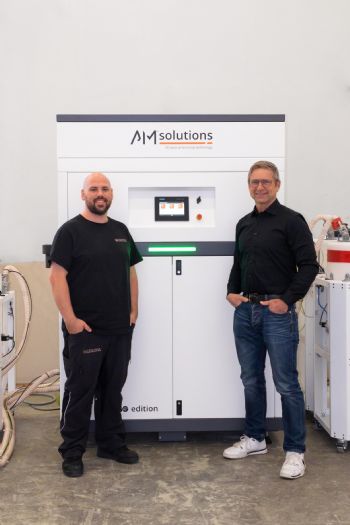
 AM Solutions – 3D post processing technology
 has taken a major step forward in automating key stages of the additive manufacturing (AM) process. At Formnext 2025, the company showcased the results of a year-long beta testing programme for its F1 powder preparation system and D1 unpacking solution, developed in close cooperation with EOS. Both systems have now proven their worth under real production conditions, delivering measurable gains in profitability, efficiency, process reliability, and operator convenience.
Formrise, based in Töging am Inn, was the first beta partner for the F1 system. The company needed a solution for powder preparation—a critical process that influences the quality of every subsequent step in additive manufacturing (AM). After each build job, used powder must be refreshed with 30 to 50% new powder, depending on material type. If this step is not carried out precisely, it can lead to machine downtime, part breakage, uneven surfaces, or colour deviations. Errors at this stage can affect the entire downstream process chain.
Previously, Formrise relied on manual weighing and mixing using sieve trolleys—a time-consuming method prone to incorrect mixtures or contamination. Assigning the wrong blend to a silo could render several hundred kilograms of powder unusable. The F1 eliminates these risks by fully automating the process. It combines powder sieving and mixing in one unit, with dosing accuracy of ±2%, ensuring consistent quality. Up to 45 kilograms of powder per hour can be processed automatically, increasing throughput by more than 30%. Mixing in small 1.5kg batches reduces both mixing time and static charge, cutting powder resting time from two to three days to just 12hr. Thanks to an integrated ultrasonic sieve, the proportion of new powder can also be reduced by up to 5%.
At Formrise, the F1 is connected to eight 3-D printers with different build volumes, handling around 380 kilograms of powder per week. Operator involvement is minimal: once the silos are filled, all steps run automatically. This allows production volumes to grow without additional labour. Reducing the proportion of new powder while maintaining quality lowers unit costs and supports sustainable resource use. The closed system also improves occupational safety by eliminating direct contact between operators and powder.
The D1 unpacking solution has also passed its industrial field test at a Swiss medical company operating more than 10 polymer 3-D printers. Before the D1, unpacking was entirely manual. Now, unpacking time for a full build job with high part density is cut in half, and operator labour time reduced by up to 80%. The operator now only needs to load and unload the system, freeing resources for other tasks. Productivity has increased, unit costs have fallen, and the D1’s gentle part-handling concept ensures the same low scrap rate as manual unpacking.
Parts unpacked with the D1 can move directly into subsequent post-processing steps such as blasting, with no manual rework required. The closed process protects operators from powder contact and reduces dust exposure. The system also allows individual adjustment of powder recovery rates for different build jobs. An intuitive HMI guides operators through the process, while a colour-coded status list shows progress at all times. Testing revealed that parts do not need to be fully cooled before automated unpacking, saving up to eight to ten hours of waiting time without affecting system components.
Close collaboration between AM Solutions and its beta partners was key to success. Weekly feedback rounds, software adjustments, and on-site technical support ensured smooth integration into existing production environments. Both partners were so impressed that they have permanently adopted the systems. The field tests confirm that the F1 and D1 automate critical steps, improve profitability and efficiency, and deliver greater safety and repeatability across the AM process chain—a significant move toward fully automated, serial-ready SLS production.