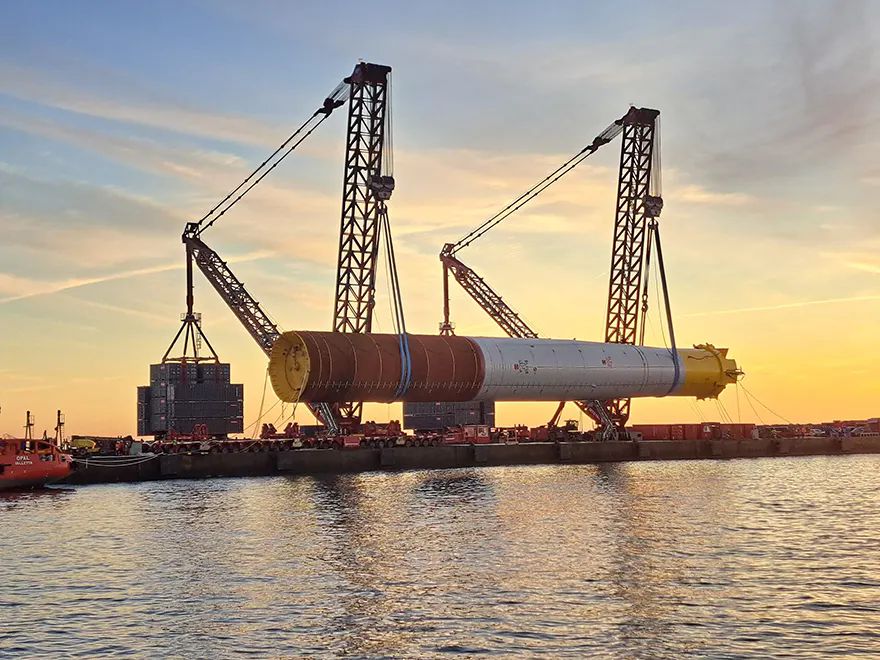
Wind turbine sizes are growing at an unprecedented rate, and for good reason: the larger the turbine, the more power it can generate, reducing the number required per wind farm. However, taller turbines demand bigger foundations to withstand stronger winds further offshore. As these foundations increase in size, lifting and transporting them has become a major challenge.
Mammoet, a global leader in heavy lifting and transport, has been ahead of the curve in developing solutions to move even XXL monopiles safely, quickly, and cost-effectively. While it is theoretically possible to place monopiles into the sea using large crawler cranes, those with the necessary lifting capacity would have been too big for the available port space and would have required extensive ground reinforcement.
To overcome this, Mammoet engineered an upgraded terminal crane capable of lifting mega monopiles into the water for offshore feedering, along with a patented jacking-and-cradle system for safe handling using its SPMTs (self-propelled modular transporters). This innovation transformed the port of Ronne, Denmark, into a seamless assembly line where monopiles were offloaded, stored, capped, and lifted into the water without the need for civil works to reinforce the quay.
This approach proved its value during the marshalling scope for Windanker GmbH’s 315MW offshore wind farm in the German waters of the Baltic Sea, where
Van Oord oversaw transport and installation of 21 monopile foundations, supported by Mammoet for onshore lifting and transport.
The monopiles arrived at Ronne from Spain in seven batches, with the heaviest weighing 2,150 tonnes and measuring approximately 87m in length. Using Mammoet’s XXL monopile transport system, 90 axle lines of SPMT lifted them off their grillages and cradled them securely for transport. They were then placed on sand bunds for temporary storage, ready for capping to make them watertight — the added stroke of Mammoet’s system allowed deeper storage bunds, improving support while reducing material use.
At the capping location, a large LR1750 crawler crane installed plugs on both ends of each monopile. Once capped, they were driven to the quayside in front of two MTC1600 cranes, developed by Mammoet specifically to lift XXL monopiles onto vessels and into the water. From there, tugs towed them to Van Oord’s heavy lift installation vessel, the Svanen, ready to install them into the seabed.
Stefan de Vries, project manager at Mammoet, said: “We made a completely new crane design for this project, which is not typical but something we felt was necessary with the growth of monopile foundations. Once everything was agreed, we needed to ensure the new MTC cranes would be ready. We collaborated with Van Oord to make sure they would suit their needs. Initially, it was planned that the cranes would lift 2,800 tonnes, but we suggested their maximum capacity match that of the Svanen, to ensure consistent limits across the project. So, we increased their combined lift capacity to 3,200 tonnes.”
With the ballast weight of the MTC crane positioned much further away from the pivot point of the boom compared to a large crawler crane, the load-bearing pressure was significantly reduced. This spread the load over a greater distance, eliminating the need for specialist foundations or temporary civil works. Thanks to the efficiency of crane lifting compared to Ro-Ro (Roll-on/Roll-off) operations, the Svanen could remain in the field and be constantly fed monopiles.