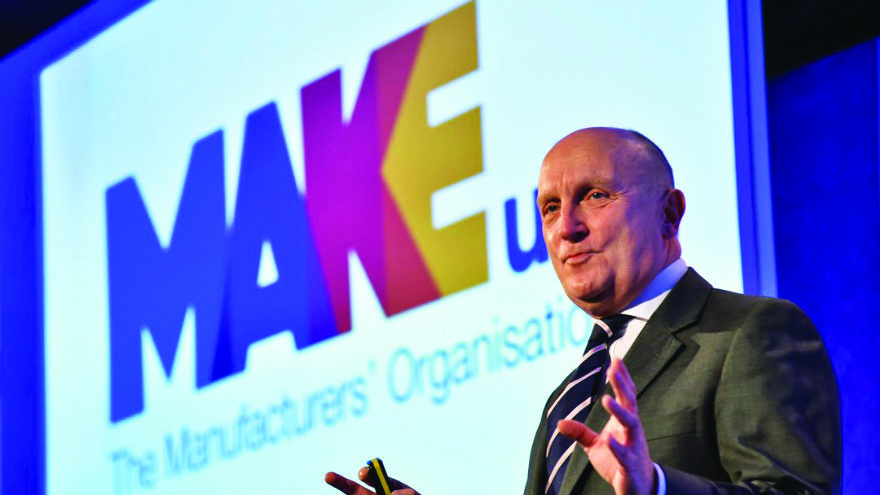
The head of Britain’s manufacturers will today call on the Government to work with business to set out a new national vision for resilience which combines both economic and defence security. Stephen Phipson, chief executive of
Make UK, will tell the
National Manufacturing Conference, taking place in London, that a scaling up of this vision is essential to meet the challenges the UK faces in the face of a rapidly changing geopolitical scenario and, accelerating technologies.
He will call on the Government to be far bolder in its ambition for change, in particular across its delivery on industrial strategy, energy, skills and defence saying this is essential not just to boost growth where there is ‘no evidence of the dial being shifted’ but also for our economic and, national, security.
Mr Phipson will also warn of ‘condemning a young generation of people which we cannot allow to happen’ and urge Government to take radical steps in reforming the Apprentice Levy which have yet to materialise. This must begin by releasing £1 billion of skills funding currently held by Government not being used for skills training so that industry can be part of the solution of addressing youth unemployment by creating a significant number of apprenticeships for young people.
Energy costs — an existential threatIn addition, he will warn of the existential threat to industry from the UK’s ‘hideously high energy costs’ and will call on Government to announce by the summer an extension of the proposed business energy support scheme across the whole sector and bring it forward from 2027.
Mr Phipson will also call on the Government to announce a roadmap for bringing defence spending up to 5% of GDP as soon as possible, arguing that the current timeframe of 2035 is too slow in the face of the UK’s NATO commitments and the changing international scenario.
On the need to boost growth and a new national vision based on resilience, Mr Phipson will say: “The ongoing uncertainty created by yet another announcement on tariffs last week is a prime example of this turbulence as we head towards a new world order. To date, the Government has done well to walk a delicate political tightrope in a complex environment between maintaining relations with the US, seeking to improve relations with the EU and, restoring a more positive relationship with China. All of these are critical for our trade and prosperity, and we are working closely with Government to maintain all our trading relationships.
“In particular, in the new world we are operating in, it is especially important to reset our relationship with the European Union (EU). This is not just a matter simply of removing trade barriers but, ensuring that we have a positive and, mutually beneficial, relationship at all levels. The world has shifted on its axis and Government, and business must be vocal in explaining why this matters for growth and jobs.”
The dial has shifted“We must increase the pace of delivering the change the Government promised. In particular, the Government stated that growth would be its number one mission but, we have yet to see evidence of the dial being shifted. As a result, business needs to see the Prime Minister and Chancellor being far bolder in the Government’s economic ambitions.
“As part of this bold new approach and, to meet the immense challenges we face, I believe we need a new national vision based on resilience and security, which embraces both Government and Business. This would combine both our economic security and, as a result, our national security.”
On the need for faster delivery on the Industrial Strategy, Stephen Phipson will add: “This is one of the most important commitments the Government has made and is key to boosting economic growth at national and regional level. Yet, while there has been progress in some areas, some departments are moving faster than others and, there is a danger that it is misfiring at a time when companies need to see evidence that Government is putting its foot on the accelerator.
“To step up the pace it is now essential that the Industrial Strategy Advisory Council is given a stronger role in holding Government to account and reporting back on progress and delivery. This will help ensure that the UK takes its place in the fast lane when it comes to attracting domestic and overseas investment at a time when both are so vitally needed to boost growth.”
On the pressing need to address the UK’s industrial energy costs, Stephen Phipson will say: “While the energy support scheme announced last summer is welcome, it is the equivalent of taking a peashooter to a gunfight. Since then, Government has been dragging its heels with a lack of action that does not reflect the fact that energy costs are an existential threat to the future of the sector.”
The clock is ticking fast“The clock is ticking fast and 2027 is far too late for the scheme’s introduction, while its scope must be widened to cover the whole of manufacturing. Make UK has provided independent modelling on how this scheme could be funded and I am now calling on the Government to announce an acceleration of the scheme and, a broadening of its scope, by the summer at the very latest.”
On the need for a skills revolution and reforms to the Apprentice Levy, he will say: “Currently, there is more than £1 billion of revenue raised from businesses for skills which is not being used to support employer investment in training, effectively hitting Business with an extra tax. By the summer, Government should commit to ring-fencing the funding for the Growth and Skills Levy and Immigration Skills Charge, creating thousands of new Apprentice starts.
“Many of you will remember when industry was told that the Apprenticeship Levy would be a win-win for those that were investing in Apprenticeships. Yet here we are, ten years later, with starts in manufacturing down forty per cent whilst shockingly, we have almost one million young people not in education, employment, or training. That’s a lose-lose situation which is in danger of condemning a generation of young people which we cannot allow to happen. We stand ready to work with Government as a sector to help offer a solution to this problem which will give young people tremendous career opportunities.”
On the need to boost defence spending to 5% of GDP as soon as possible with the current timeframe being too slow, Mr Phipson will say: “Defence spending is a key driver and accelerator of growth and provider of high skills, especially in areas of the UK that need to see them. The much-delayed Defence Investment Plan is already damaging confidence in the sector, delaying investments and the provision of private capital. This must be announced as soon as possible whilst, at the same time, Government must explore alternative financial options to boost defence spending.
“The Prime Minister was right at the recent
Munich Conference to also commit to working with European partners on joint procurement to help build its defence industrial base. European countries spent 380 billion pounds on defence in 2025 and are increasing spend rapidly, yet less than one-fifth of procurement is conducted jointly.”