Established in 1979 and located in Plymouth,
PTG Precision Engineers Ltd has established a reputation for delivering high-precision components for industrial sectors that include nuclear, oil and gas, OEM special-purpose machinery, and aerospace; for the latter it specialises in producing jigs and fixtures rather than airborne components.
Jim Adkins, PTG’s production manager, said; “PTG Precision Engineers has been operating for over 40 years, and the company’s capabilities extend well beyond standard sub-contract machining. PTG manufactures its own range of workholding products, including expanding mandrels in sizes ranging from 12 to 400mm in diameter. This focus on both contract manufacturing and proprietary products requires considerable manufacturing flexibility and capacity.
“Over the past 12 months, we have experienced a significant increase in demand, a demand that our existing production capacity struggled to accommodate. Indeed, we haven’t been able to fulfil as many orders as we would like — a situation compounded by struggling to recruit skilled staff. However, this challenge is far from unique to PTG; indeed, the UK’s manufacturing sector continues to face a well-documented skills shortage, with experienced machinists in particularly short supply.”
Automation optionsPTG considered various options, including getting a semi-automated machine, and subsequently contacted East Sussex-based
Dugard CNC Ltd. Paul Roberts from Dugard said: “I have been working with PTG for quite a few years. Our recent meetings have all been about their fantastic order book, and how can we help them take that next step. The relationship we have established proved invaluable when PTG began exploring automation options; and being familiar with the company’s work meant I could recommend a solution tailored to its specific requirements.”
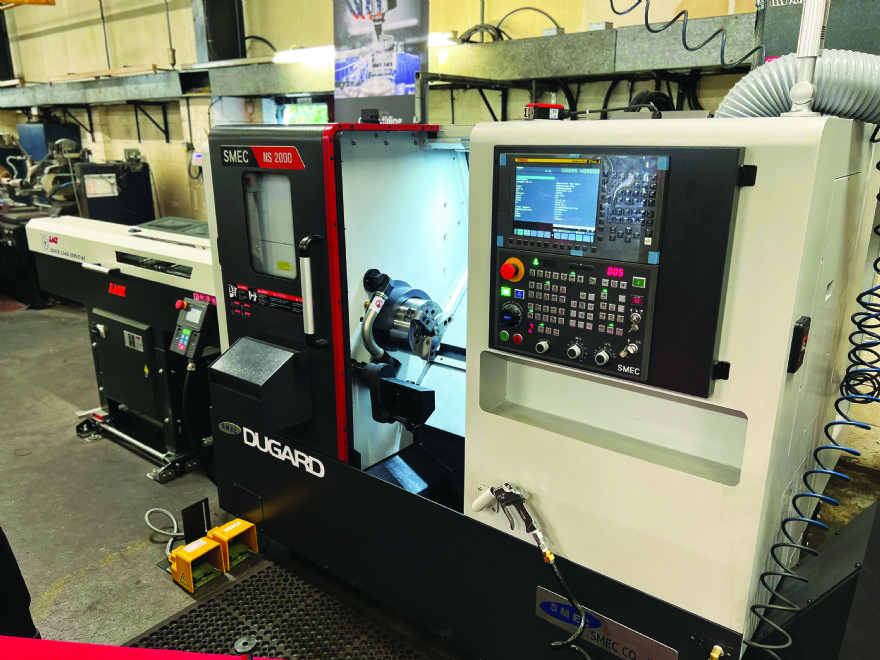
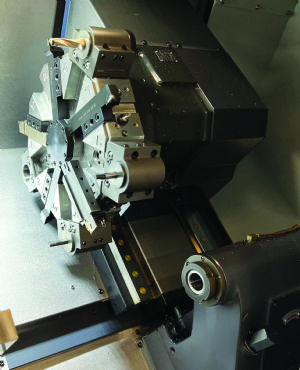
PTG selected an SMEC NS2000A from Dugard. A bar-fed turning centre, it features a 6in chuck, a maximum turning diameter of 310mm, a swing over the bed of 565mm, and an 18.5kW 6,000rev/min spindle. Mr Roberts says a particular feature of the SMEC NS2000 is its LM (linear motion) roller guide system. He added: “Unlike traditional box ways, LM guides use precision-ground linear bearings that run on hardened steel rails, thereby providing several key advantages for precision work. The roller guide system reduces friction significantly, enabling faster traverse rates that the norm while maintaining accuracy. Indeed, the X-axis and Z-axis achieve rapid-traverse rates of 36m/min, which reduces non-cutting times and improves overall efficiency.”
Regarding the machine’s structural integrity, Mr Roberts explained: “We chose SMEC because PTG were looking for high levels of quality and repeatability, especially when running automation, as they need to know that the first part in a batch, of say 300, will be the same as the last. The products PTG sells must be right and be the same every time.
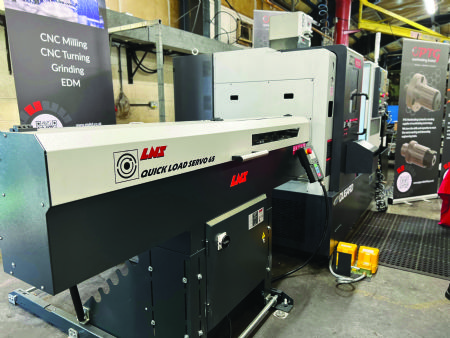
“The SMEC NS2000 has been integrated with an LNS bar feeder, which provides a significant boost to PTG’s production capabilities as its magazine capacity enables extended unattended operation, which is essential for maximising productivity with PTG’s limited operator availability.”
Mr Adkins confirms that the transformation in production has been dramatic. “Previously, we were processing batches of 25 expanding mandrills at a time on conventional equipment. With the SMEC NS2000 and LNS bar feeder combination we now run batches of 350-off — a dramatic increase in batch size that has fundamentally changed stock availability and production scheduling.”
Key advantagesHe continued: “However, one of the key advantages of the installation has been its minimal impact on operator workload, as once set up the machine requires relatively little supervision, allowing our machinists to focus on other equipment. In the morning, we may spend an hour just loading and setting the bar feeder and running the programs through again, thereby allowing our operators to go back and run the machines that they are operating on a daily basis and just come back to the SMEC to take components out of the parts catcher every half an hour and check them.”
Mr Adkins confirmed that this operating model maximises the productivity of PTG’s current workforce, as skilled machinists are not tied to the bar-fed lathe but can attend to other machines while the NS2000 runs largely unattended, only requiring periodic checking and part removal. “The machine is generally used for our workholding sleeves. Essentially, it is a similar program for all these parts, simply adjusted to suit the just different sizes, so it makes sense to keep the programs in the machine.
“Being our first automated machine tool, we wanted to pay particular attention to installation and training, and Dugard’s support throughout this whole process proved exemplary. Our operators had two days of training; and thanks to the intuitive design and operation of the SMEC NS2000, within that time they had gained the confidence and ability to run the machine at full capacity — a crucial factor in ensuring the investment began delivering returns quickly. Indeed, after just a few months of operation the SMEC NS2000 was delivering tangible benefits — rattling through parts and reducing our lead times.”
Mr Adkins concluded: “With our order book growing steadily, this capacity injection has been crucial to maintaining customer satisfaction and capturing opportunities that might otherwise have been declined. The ability to maintain stock levels of expanding mandrels — products that certain customers rely upon for immediate availability — has strengthened PTG’s competitive position in the workholding market.”