 MGS Technical Plastics
 has expanded its additive manufacturing (AM) and machining capability with the installation of a new 3-D printer and a fourth CNC machine. The Lancashire-based company says the investment strengthens its ability to provide OEMs and product developers with practical, hands‑on support at any stage of their project, from early concept through to production.
The business, jointly owned by three directors, continues to shape its strategy around the evolving requirements of its customer base. MGS maintains a clear commitment to sustainable growth within the UK plastics manufacturing sector, with ongoing investment in factory modernisation and workforce development. These measures ensure the company remains adaptable to changing market demands while delivering innovative, reliable support throughout the full manufacturing cycle.
Recent internal improvements include consolidating existing operations to streamline efficiency, introducing a second site to enhance real‑time deliveries, installing four CNC machines within the toolroom and implementing
Intouch Monitoring to track machine performance.
Externally, the company’s approach mirrors this commitment, ensuring OEMs can access all in‑house services regardless of where they are in their design or production journey. With re-shoring momentum increasing, OEMs are seeking closer, more collaborative UK‑based partnerships that provide greater control and agility.
Chloe Maine, MGS’s business development manager, said: “Manufacturing any component is a multi-stage process where success depends on matching specific, often highly technical skills to each phase. Every stage of the journey is different and in-house support for each element is an enabling factor to reduce risk and get products to market faster.”
MGS acts as a technical plastics partner for OEMs, supporting smooth project progression from initial design through to production-ready components. Managing director Judson Smythe said: “In lots of plastics processing there is rarely a universal approach to every project. There are usually at least several competing priorities. Early engagement with customers enables us to provide appropriate technical insight, from process options to material selection. This kind of partnership leads to better-engineered, more compliant and more commercially viable products.”
Fail fast, learn fastOffering 3-D printing capabilities supports a dynamic “fail fast, learn fast” product development culture. This is fundamental to early stage innovation and rapid prototyping for feasibility studies. With the recent acquisition of a new 3-D printer, the MGS team can produce highly accurate prototypes in-house, often within days. This capability enables OEMs to validate form, fit, and function earlier in the process and quickly adapt design iterations. Commercial director Mark Preston said: “This service is increasingly being used by our customers to reduce project risks before committing to full-scale tooling or production. In some instances, it can reduce development times and prototyping costs by 70%.”
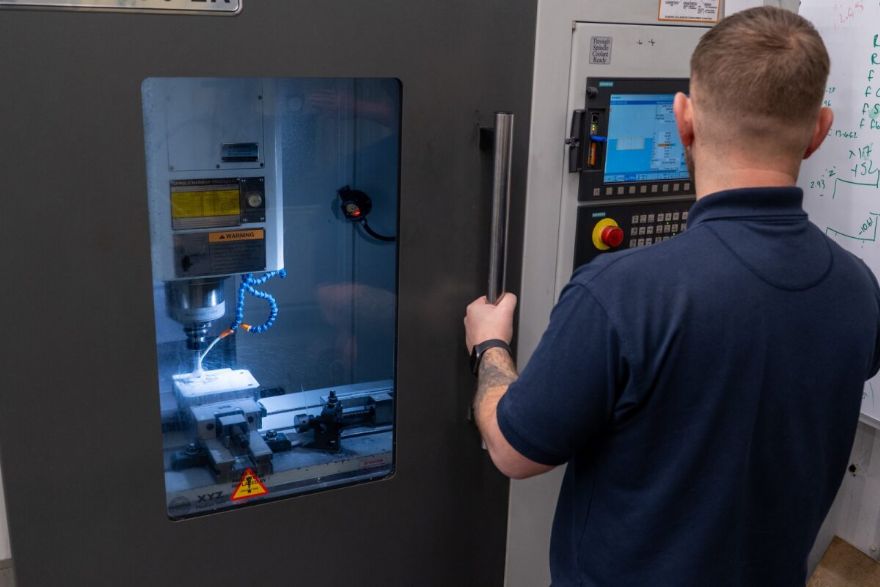
While not all projects move quickly into mass production, many require low‑volume runs, technical modifications or bespoke components. CNC machining continues to bridge this gap. Reflecting strong demand, MGS has now installed its fourth CNC machine.
Chloe Maine added: “CNC machining gives OEMs more flexibility than 3-D printing. It is a precise, repeatable and controlled manufacturing process that supports the manufacturing of parts and tools from a wider range of materials, including metals, advanced composites and polymers. This is especially valuable for OEMs at the next phase of their manufacturing journey that require small batch production, highly technical customisations, or pre-production samples.”
Mr Smythe explained: “This is precision engineering for the automotive, aerospace and defence industries at its best. Making technical parts using precision programmes that eliminate errors and reduce material waste. We regularly utilise CNC machining to make robust moulding tools as well.”
MGS now offers multi‑axis CNC milling, precision turning and tight‑tolerance prototyping, all delivered by an experienced in-house engineering and quality team. As projects scale, injection moulding becomes the most cost‑effective route into high‑volume production. Although tooling investment can be significant, the approach rapidly reduces cost per part as quantities increase.
Mr Preston said: “Injection moulding is especially beneficial for delivering precision and consistency at speed and volume. Compared to 3-D printing, it is a much faster cycle time, and moulded components can achieve tighter tolerances, higher tensile strength and better surface finishes. All of which can be critical for interlocking components and functional parts.”
The company’s fully equipped in‑house toolroom supports the design, development and modification of tooling concepts without external delays. Mr Smythe concluded: “From prototype to production, these capabilities ensure speed, efficiency, and quality at all stages of every customer’s journey. At MGS we don’t just make parts, we provide technical support and solutions — that is the unmatched value.”