 FANUC UK’s
 vice managing director, Andy Armstrong, recently underlined the critical role that sustainability and automation will play in strengthening the resilience, productivity and international competitiveness of the UK’s manufacturing base.
Speaking on the opening day of
The Future of Precision Engineering event, held at the company’s Coventry headquarters from 27–29 January, Mr Armstrong said the plastics sector in particular is experiencing a marked shift toward the use of bio‑based and recyclable materials, alongside a growing demand for sustainable production methods.
He added: “It is no longer just ‘good to be green’ – it’s now a business necessity. Against a backdrop of rising operational costs, regulatory changes, supply chain challenges and an ongoing skills shortage, every penny counts. The use of automation and AI to effect cost-saving measures such as energy efficiency, increased productivity and better use of human employees is essential if UK manufacturers are to remain competitive in both the domestic and global markets.”
Fanuc’s three-day Open House brought together leaders from across automation, plastics and the wider precision engineering landscape to discuss the key issues shaping industry. While the opening day centred on sustainability, subsequent sessions turned their focus to AI, connectivity, education and workforce development. Each day combined presentations and panel debates with access to an extensive exhibition area featuring live demonstration cells and technical displays from more than 30 partner companies, including Hi‑Tec, Piovan, Mold Masters, Ultrapolymers and Solinatra.
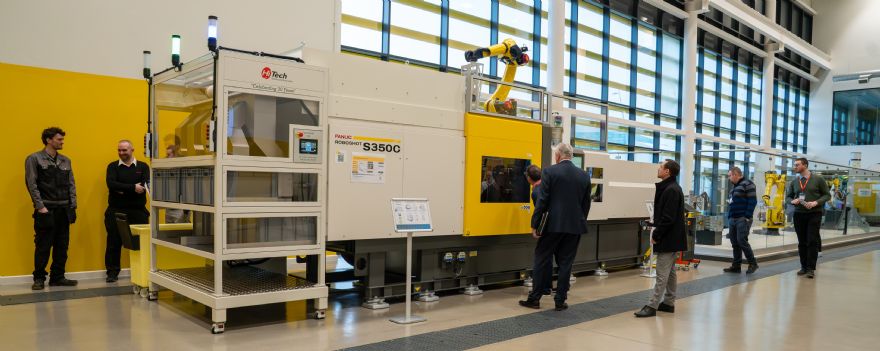
Alongside its partners’ exhibits, Fanuc showcased a range of its own technologies, from six‑axis robots and automated drilling systems to the latest injection moulding machines. A major draw for visitors was the European debut of the newest addition to the Roboshot line up — the 350‑tonne S350C all-electric moulding machine, designed to deliver faster cycle times and equipped with AI‑supported energy‑saving capabilities.
Following Mr Armstrong’s keynote presentation, Stephen Hunt, the British Plastics Federation’s member services director, presented early findings from the BPF’s January 2026 Business Conditions Survey. The results point to an improving landscape for the plastics industry after a prolonged period of decline. Mr Hunt said: “The decline we have seen over the last 18 months is definitely slowing.” He also reported that sustainability continues to gain momentum among BPF members, with 64% confirming they already have an ESG policy in place while 21% say they working on one. Furthermore, 36% of respondents have a ‘net zero’ strategy, while 31% are actively developing one.
Mr Hunt’s presentation was followed by a panel discussion featuring Jamie Riley of Robinson PLC, Fanuc’s Sam Carr, Bloom‑in‑Box’s Tom Reardon and Stephen Rundle from Solinatra. The panel shared practical approaches to embedding sustainability across production processes, drawing on real-world examples of how automation solutions can deliver both environmental benefits and measurable cost savings. Audience participation was enthusiastic, with many visitors contributing their own experiences and challenges.
The Future of Precision Engineering was hosted by
MTDCNC's Lyndsey Vickers and continued with further debates, demonstrations and technical sessions.