 BEP Surface Technologies
 recently strengthened its commitment to skills development and early‑careers engagement with a hands‑on visit to Hazel Wood High School in Bury, Greater Manchester, ahead of
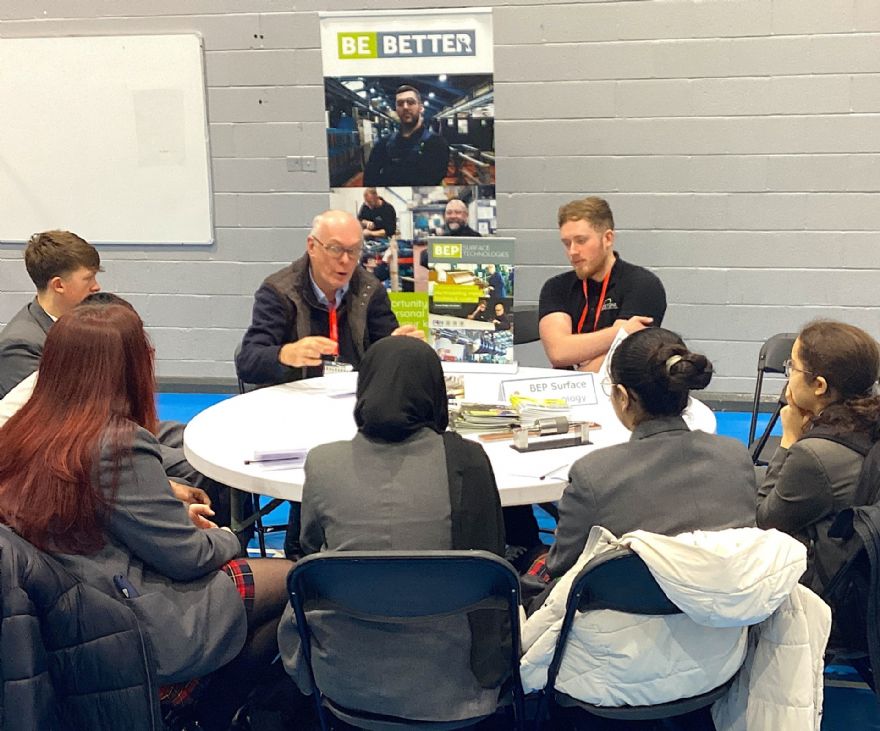
National Apprenticeship Week, which took place last week. Managing director Andrew McClusky and design engineer Callum Taylor delivered a series of structured sessions to Year 8 and Year 9 pupils during the school’s careers fair, organised by pastoral manager for Year 11 and aspiration co‑ordinator Amy Edwards.
To support engagement, BEP introduced an illustrated storybook designed to explain its work in electroplating and surface finishing in a way that avoids technical complexity while highlighting the importance of reliability and the potential consequences of engineering failure. The aim was to show how engineering underpins national security, industrial resilience and everyday life.
Across the day, the company delivered 10 small‑group sessions of 12min each, discussing engineering careers, apprenticeships and technical pathways into manufacturing. A clear difference emerged between the two year groups, with Year 8 pupils showing broad curiosity while the Year 9 groups demonstrated more focused questioning and a stronger interest in future subject choices.
Mr McClusky explained: “There was a clear shift in the way Year 9 students interacted. You could see students already thinking about subject choices and future careers. That’s why this age group matters. Early, informed exposure helps young people make confident decisions and understand the real-world relevance of STEM subjects.”
A focus on precision engineeringMr Taylor, now 26, shared his own experience of entering the sector. He joined BEP in 2020 as a maintenance apprentice after completing a Level 3 Extended Diploma in Engineering at Bury College, later progressing into design engineering with a focus on precision manufacturing, equipment development and process improvement.
He said: “Not everyone learns best in a classroom. Apprenticeships allow people the chance to develop real skills in a real working environment, while still building qualifications and confidence. I was in their position not that long ago, unsure of the direction to take. Engineering gave me structure, purpose and a clear path forward. It is great to show students that there are strong alternatives to purely academic routes and that those routes can lead to exciting, well-paid careers.”
Ms Edwards continued: “Also, students gained insights they cannot get from textbooks. Meeting young engineers who began as apprentices enabled honest questions and a practical understanding of career paths. The contrast between Year 8 and Year 9 engagement showed how critical this stage is in shaping informed choices and building confidence, aspiration and motivation.”
The outreach forms part of BEP’s wider work to help strengthen the UK’s engineering skills pipeline. The company emphasises that skills shortages remain a significant long-term challenge for manufacturing competitiveness, particularly in the surface engineering sector. Mr McClusky has consistently supported closer collaboration between industry and education across apprenticeships, T‑levels, the recently introduced V‑levels and other technical qualifications.
He concluded: “Manufacturing must take ownership of the skills agenda. We cannot rely on education alone to solve the talent challenge. Employers must be visible, accessible, and proactive in engaging with young people, parents, and teachers. T‑levels, V‑levels and apprenticeships are high-quality technical routes, but awareness remains patchy. Direct engagement at secondary school level is essential if we are serious about rebuilding the UK’s technical capability.”