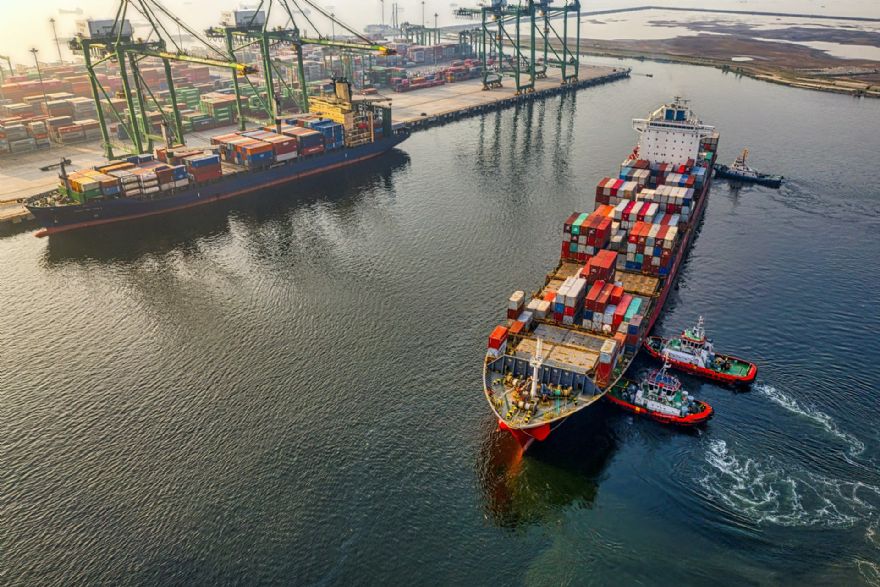
 Photo couertesy of William William on Unsplash
An ‘apprehensive’ 12 months is expected for the manufacturing industry in 2026, according to
Interact Analysis. the market intelligence specialist. The organisation says that the year could swing positively or negatively, depending on global events and tariffs. Its latest manufacturing industry output forecast suggests that, while the Americas and Asia regions experienced growth in 2025, 2026 is likely to see inventories normalise and global investment conditions improve, with modest recoveries anticipated in regions emerging from downturns. Interact Analysis predicts 2.9% growth for 2026, up from 2% in 2025. Longer-term, an average annual growth rate of 3.1% is forecast from 2025-2030, with total production reaching $48.1 trillion in 2030.
Better outlook for 2026 driven by technology, trade and investmentThe manufacturing output [AS1] forecast for 2026 is slightly better than previous predictions, with trade, technology, and investment the key drivers behind the improvement. However, manufacturing still faces headwinds caused by global political tensions and conflicts, and the continuing risk of further tariffs and protectionist policies.
In terms of investment, industrial demand remains resilient, as manufacturers attempt to offset the impact of tariffs, bringing cost pressures forward and reshaping the timing of investments. Meanwhile, adopting of technology is increasingly acting as a counterweight to structural weakness in other parts of the industrial base.
For example, AI-based industries, like automation, HVAC, semiconductor equipment, and data centres, are providing pockets of growth that support weaker industry sectors. Nevertheless, while near-term AI investment is supportive, legitimate concerns continue to surround long-term profitability and the scalability of returns, its applicability to broader industry and wider adoption, and the potential risk of over-capacity.
In terms of trade tariffs, there is now more clarity about what they will be and the subsequent short-term impacts, although the risk of further retaliatory measures remains. A resilient US economy could reduce the perceived economic cost of tariffs, increasing the likelihood of tariffs being introduced by other territories.
Asia leads the way in outlook, average annual growth and outputInteract Analysis expects all regions to experience long-term growth through 2026 and out to 2030, with smaller territories having more headroom for strong growth. Asia leads the way with projected 2026 growth of 3.2% to $30.1 trillion and a 2025-2030 average annual growth rate of 3.3%. India and South Korea look particularly strong, with respective 2026 forecasts of 5% and 3.5% growth in 2026. Meanwhile, for the Americas, the growth outlook for 2026 is lower than in 2025 at 2.2% to $9.6 trillion, with a 3% average annual growth rate. Europe is anticipated to hit 2.5% growth in 2026 and total production of $8.4 trillion, following a challenging few years, with a growth rate of 2.2% forecast for 2026-2030.
Jack Loughney, Interact Analysis senior data analyst (UK), said: “The primary sentiment going into 2026 could best be described as apprehension. Escalating geopolitical strife, punitive and retaliatory tariffs, and companies placing large bets on a golden goose whose profitability long-term is currently in question all lends itself to a year which could swing positively or negatively on a whim. Our current position is to expect modest growth but be prepared for this positivity to erode relatively quickly if global events start taking a turn for the worse.
“One underlying cause of this weakness is the uncertainty which accompanies the protectionist actions many regions are taking. The USA did manage to grow in 2025 even in the face of tariffs, however, whether they were simply burning through buffer and will enter a much slower period this year should become quickly apparent as the year continues.”