Photo by
Garett Mizunaka on
Unsplash Something has shifted in the engine conversation. It is no longer about more power and less fuel. Rather, it is about compliance and uptime. Also, it is about the awkward reality that jobs still need to be done even when emissions rules tighten. Meanwhile, urban sites are getting particular about air quality.
In the UK context, non-road mobile machinery is closely tied to Stage V type-approval requirements. These have pushed manufacturers and fleets toward smarter exhaust control, cleaner combustion strategies, and alternative fuel options that can be adopted without ripping everything out.
The Stage V effectStage V compliance changed what a good engine looks like. It is not only the engine block anymore. Rather, it is about the whole emissions system behaving properly in complex, real-world cycles.
After-treatment now sits at the centre as Diesel Oxidation Catalyst (DPF), Diesel Particulate Filter (DOC), and Selective Catalytic Reduction (SCR) are not side accessories.
In fact, they are part of what keeps the machine employable. Sites in places like London also lean on NRMM (Non-road mobile machinery) controls through planning and reporting. So, compliance is not just a manufacturer's problem. Rather, it becomes a contractor-and-operator habit, whether people like it or not.
Diesel has evolved significantlyNowadays, modern diesel is not old tech. Rather, it is refined, sensor-heavy, and paired with aftertreatment that actually works when properly maintained. Also, there is still a place for well-regarded platforms like
Detroit or Cummins diesel engines. This holds especially when the priority is predictable torque, service familiarity, and parts ecosystems that keep downtime under control. That said, the new reality is that diesel performance is judged by the whole system. It includes calibration, exhaust temperatures, regeneration behaviour, and operator discipline.
The need for fuel flexibilityMany fleets are not jumping straight to a brand-new powertrain. Rather, they are looking for drop-in steps that reduce lifecycle impact without derailing operations. In fact, Hydrotreated Vegetable Oil (HVO) sits right in that lane because it is broadly positioned as compatible with existing diesel infrastructure. Also, depending on the feedstock, it offers meaningful lifecycle CO
2 (carbon dioxide) reductions while keeping the machine essentially the same to run and maintain.
The catch is that sustainability claims hinge on the quality of the supply chain. It is not merely the label on the bowser. Still, it is an easier lever than wholesale replacement.
Hybrids and electrificationOf course, electrification is important, but it is not uniform. If there is more stop-start, it leads to more power-on-demand. Hence, more hybrids start to make sense. In fact, some manufacturers frame mild-hybrid systems as a bridge. This is because they can recover energy and smooth transient loads. It matters on machines that constantly spike hydraulics and then idle again.
Meanwhile, connectivity and automation ideas also go hand in hand. Now, electric components and smart controls tend to arrive together. The limiting factors remain duty cycle, charging logistics, and job-site practicality.
Hydrogen combustion — from concept to machinery planHydrogen internal combustion is showing up as an option precisely because it looks familiar to the off-highway world. It keeps an engine architecture that many teams already understand. Also, some manufacturers have pushed towards approvals and commercial use cases.
For instance, JCB has publicly discussed the progress of hydrogen engine certification with multiple European authorities. Meanwhile, Cummins has been developing enabling components, such as turbochargers, tailored for hydrogen combustion conditions. None of this makes hydrogen easy overnight. However, it does signal a pathway that fits heavy equipment rhythms better than some people expected a few years ago.
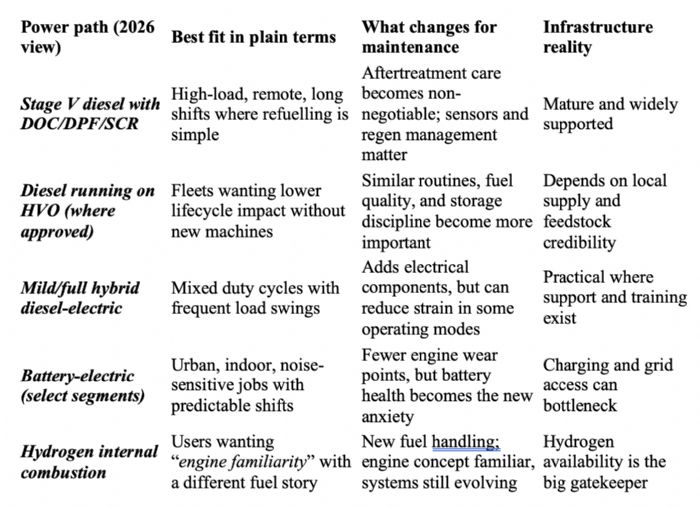
Major types of power paths in 2026The future is not one engine type winning everywhere. Rather, it is a patchwork based on site rules, refuelling reality, and risk tolerance. The following are the most common power paths in 2026:
Power path (2026 view) Best fit in plain terms What changes for maintenance Infrastructure reality
 What actually shapes adoption?
What is driving the next wave is less about shiny announcements and more about operational logic. The following are a few forces that keep repeating:
• Regulation sets the minimum bar, especially around Stage V compliance and NRMM expectations.
• Engines are becoming data-generating assets. This nudges maintenance from reactive to predictive when fleets take it seriously.
• Fuel choices are becoming portfolio decisions rather than moral positions. This is because availability and risk decide the rollout speed.
The change is layeredEngine technology is shaping heavy industrial machinery in 2026. However, it is doing it in a slightly untidy way. Still, cleaner diesel systems are foundational. Meanwhile, alternative fuels are being trialled in the real world. Also, hybrids are quietly practical, and hydrogen combustion is edging closer to credible deployment.
Now, the future feels like layered change rather than a clean break. That is how industry usually moves when it cannot afford downtime.