Innovation has become essential for tool manufacturers striving to remain competitive in an environment marked by rising carbide costs, geopolitical uncertainty and a cautious investment climate. With customers under pressure to improve productivity from existing assets rather than expand capacity,
ANCA is continuing to invest in practical production technologies that reduce scrap, increase precision and protect margins without compromising performance.
Across Europe and worldwide, toolmakers are navigating shorter lead times and more complex geometries while labour, energy and material costs continue to increase. Operations are expected to deliver higher throughput from the same floorspace, and escalating tungsten carbide prices make scrap and re-work an immediate financial burden.
At
GrindingHub 2026, taking place 5-8 May, ANCA will demonstrate how manufacturers can convert these challenges into measurable production gains by optimising the entire manufacturing workflow rather than focusing solely on the grinding pass (Hall 7, Stand A70). Visitors will see an integrated approach that connects machine capability, automation and software-driven control to boost utilisation, shorten setups, reduce handling and maintain consistent process performance across all shifts.
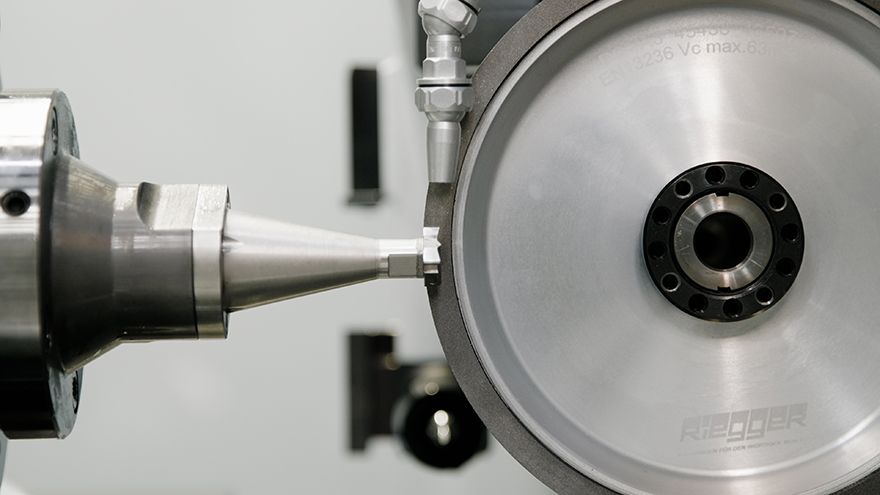
A major focus will be the MX7 ULTRA configured with InsertsPRO, designed for high-precision grinding of profile inserts where setup variation often limits consistency. InsertsPRO enables rapid creation of accurate grinding operations using parametric profile and relief definition supported by integrated simulation.
Its new Profile Insert Wizard guides operators through blank definition, profile import and wheel selection, automatically generating the appropriate grinding strategy. By bringing measurement feedback and correction closer to the point of manufacture, ANCA enables toolmakers to reduce handling, compress workflows and maintain stable results throughout the batch — an advantage for mixed production environments where geometry changes are frequent.
Full traceabilityANCA will also highlight the EPX Stream Finish (EPX‑SF) machine, engineered for controlled edge preparation, surface finishing and deburring in production settings. Unlike laboratory‑style approaches, EPX‑SF delivers recipe‑based processing with full traceability. This is increasingly important for manufacturers seeking predictable coating results and extended tool life. At
GrindingHub, ANCA will show how a structured, traceable finishing workflow supports consistent outcomes while preserving in‑house process knowledge.
Another key exhibit will be the FX7 ULTRA featuring the new 3,000rev/min S1 headstock spindle. Offering up to five times the rotational speed of traditional 600rev/min units, the high‑speed headstock tackles the common bottleneck of insufficient surface speed on smaller cylindrical features. By achieving the necessary surface speed where it matters most, the upgrade delivers improved finishes and shorter cycle times.
It also expands the range of operations possible within a single setup — including peel grinding alongside conventional tool grinding — reducing handling, minimising re‑clamping and enabling manufacturers to increase output from the same machine footprint.
Visitors will also see results from ANCA’s MicroX ULTRA platform, purpose‑built for micro‑tool production. Featuring nanometre‑resolution control, ANCA Machine Intelligence and optimised kinematics that shorten grind paths in five‑axis interpolation, MicroX ULTRA is engineered to improve surface quality and cutting‑edge consistency in micro end mills and drills. A dual‑ended grinding spindle supports faster wheel changes, further reducing cycle time.
Enhanced thermal and vibration stabilityToolRoom standard offers a broad selection of micro geometries while CIM3D provides on‑machine program verification. In‑process measurement and compensation, Motor Temperature Control (MTC) and an isolated grinder design all contribute to enhanced thermal and vibration stability — helping to reduce scrap, shorten warm‑up times and deliver predictable results in demanding micro‑tool applications.
As manufacturers contend with shrinking batch sizes and more diverse tool catalogues, rapid changeover and flexible automation become critical. ANCA addresses this with RFID-enabled loading, collet‑changing systems and intelligent cell‑control solutions that reduce operator intervention and unnecessary work‑in‑progress.
These capabilities are amplified by AIMS, ANCA’s integrated manufacturing platform connecting planning, operator guidance and compensation workflows into a unified digital system. By centralising production data and reducing manual file handling, AIMS strengthens traceability, improves decision-making across shifts and enhances practical OEE by cutting downtime contributors such as repeated checks, excessive handling and unnecessary setup activities.
Software optimisation will also be a major theme at the show. ToolRoom RN35 with Performance+ will be demonstrated with a focus on feedrate optimisation and simulation-driven verification, giving manufacturers the ability to reduce cycle times without compromising material removal control. As carbide costs continue to rise, simulation‑first workflows help manufacturers achieve right‑first‑time production and reduce the financial impact associated with scrapping high‑value blanks.
Visitors will be able to see how ANCA’s connected approach — spanning machine capability, automation, software and process control — functions as a unified production system. The aim is clear — to help tool manufacturers reduce scrap, improve efficiency and safeguard profitability at a time when market conditions demand resilience, precision and smarter utilisation of existing assets.