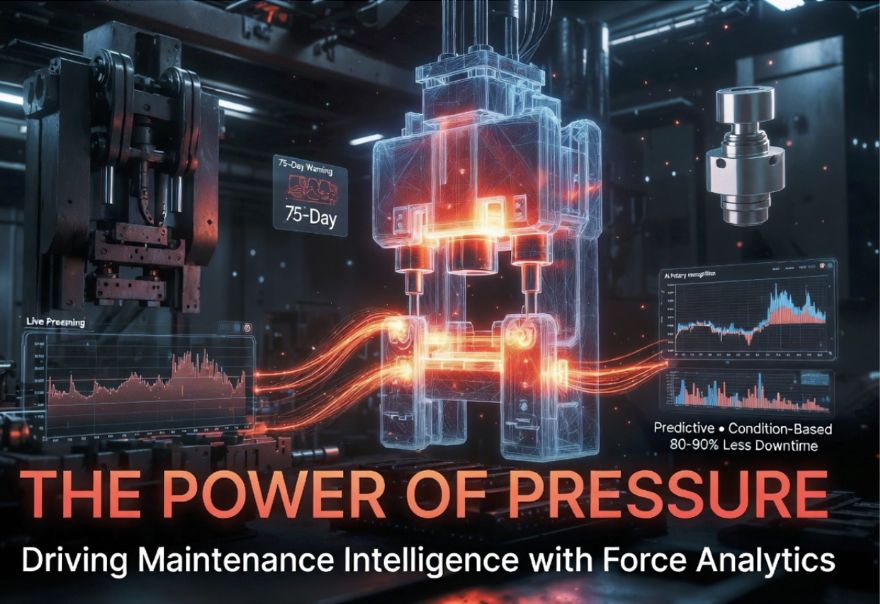
For decades, maintenance strategies in heavy industry have consisted of two options — either repair machinery only after something breaks or replace components according to a calendar that rarely reflects their true condition — both approaches are blunt instruments.
Reactive maintenance invites costly downtime and unnecessary risk, while time‑based preventive maintenance often removes components that still have years of service left. Today, however, a new approach is rapidly becoming the benchmark for forward‑thinking operators. Force analytics — powered by high‑precision sensors and advanced data intelligence — is enabling maintenance teams to hear the internal stresses of machinery long before failure becomes visible.
Traditional monitoring tools such as vibration and temperature have served industry well, but they typically reveal symptoms rather than causes. By the time a bearing runs hot or a gearbox vibrates excessively, structural compromise is often already underway. Force analytics, in contrast, captures the earliest signals that something is changing inside a machine.
Every failure, regardless of scale or mechanism, begins with an alteration in load distribution. Friction increases, alignment shifts, material fatigues — long before the secondary effects emerge. This is why force has become recognised as one of the most powerful leading indicators in modern maintenance.
The benefits of transducersThe shift has been made possible by load cells, strain gauges, and piezoelectric transducers that sit directly within the load path. These sensors effectively give machinery the ability to feel. When used for
strain monitoring, they can detect microscopic stretching in metal structures, identifying fatigue cycles far earlier than visual inspections ever could.
In industrial presses and moulding machines, even a 2% deviation in compression force can signal a misalignment that may eventually result in failure. In logistics, where conveyors, automated guided vehicles, and bulk handling equipment are constantly in motion, unexpected weight fluctuations can flag blockages or mechanical resistance long before a motor stalls.
Where the
IoT-connected force sensors gather data, analytics systems provide insight. Real‑time force mapping reveals how machines behave under different loads, allowing anomalies to be swiftly detected in a matter of seconds. If a crane’s load cell shows an unusual oscillation during a standard lift, it may point to issues with hydraulic damping or structural flex that would otherwise go unnoticed. Hydraulic systems, in particular, benefit from this level of precision. Minor seal wear or valve sticking produces distinct pressure signatures. Many operations now report that force‑based analysis can detect these imperfections between 45 and 75 days before failure becomes critical, giving maintenance teams a wide planning window instead of a last‑minute crisis.
This evolution is redefining maintenance timing. Instead of replacing parts on fixed intervals, organisations are increasingly turning to just‑in‑time maintenance, replacing components only when the data shows that they are approaching their true functional limit. The result is longer component life, reduced spare‑parts inventory, and lower labour demands. Force analytics also exposes operational inefficiencies that contribute to premature wear.
Understanding load profilesA machine consistently operating near its maximum load rating will deteriorate far faster than one kept at a more moderate level. Understanding these load profiles allows operators to make small but meaningful adjustments to feed rates, operating speeds, or load balancing that extend equipment life.
Establishing a force‑based maintenance system follows a clear progression. High‑grade sensors are installed at critical stress points. Over two to four months, the system captures baseline data, learning what normal looks like across different shifts, seasons, and production cycles. Engineers then set thresholds, while modern AI models interpret the patterns, distinguishing between routine operational fluctuations and genuine early‑stage faults.
Once deployed, these systems significantly reduce emergency repairs—many operations cite reductions of eighty to ninety percent—and typically achieve full return on investment within eight to eighteen months. Perhaps most importantly, early force detection enhances safety. Unexpected mechanical failures are not only disruptive but dangerous, releasing enormous amounts of stored energy. By identifying anomalies early, operators can perform controlled shutdowns and avoid hazardous conditions.
As the technology matures, industry is moving toward a future where machines diagnose and adjust themselves automatically. A bearing showing early friction could trigger its own lubrication cycle, reduce motor speed, order a replacement, and schedule maintenance during a low‑production window. The future of autonomous maintenance will rely on this deep understanding of force — the fundamental language of machinery.