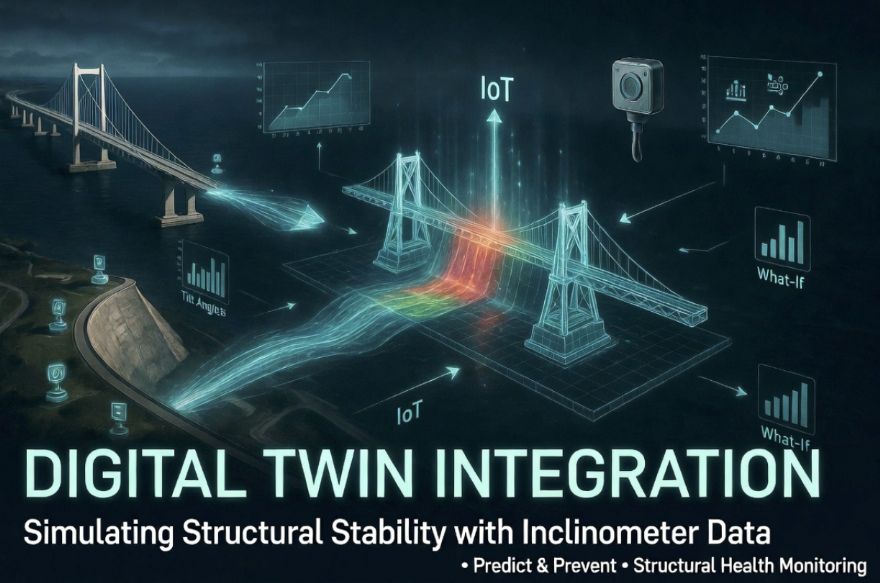
In the world of heavy infrastructure, the old pattern of inspecting, repairing, and hoping for the best is giving way to a far more sophisticated philosophy. Ageing bridges, tailings dams, and urban excavation sites can no longer rely on occasional visual checks when climate volatility and rising load demands leave no slack in the system.
Across engineering disciplines, the shift is unmistakable — the future lies not in finding and fixing defects, but in predicting and preventing them. Driving this change is the rapid integration of digital twin technology, a fusion of real‑time sensing, advanced simulation, and machine learning designed to give physical assets something they have never had before — a continuously updated digital counterpart that thinks, calculates, and warns.
At the centre of this transformation is a humble but remarkably powerful instrument: the
inclinometer sensor. Often described by engineers as the “inner ear” of a structure, this sensor measures tilt, slope, and the microscopic angular changes that often signal the earliest stages of sub-surface movement. When fed directly into a digital twin, inclinometer data becomes the backbone of a predictive system capable of anticipating structural distress long before it becomes visible.
Contrary to the common assumption that a digital twin is just an advanced 3-D model, true digital twinning is defined by its live, bidirectional link with the real asset. The physical structure —whether a bridge pier, a dam embankment, or a retaining wall — is embedded with IoT instrumentation. The virtual model is not a static drawing but a full computational engine built on finite element analysis, continuously running physics‑based simulations. Between these two worlds sits the data connection layer, the nervous system that streams inclinometer readings into the model and, when necessary, pushes alerts or automated responses back into the physical environment.
Living diagnostic toolThis constant conversation allows the twin to behave like a living diagnostic tool. Every thermal cycle, load surge, and rainfall event is reflected digitally with a fidelity that was impossible only a decade ago. For stability analysis, inclinometer data is especially valuable because it reveals what other sensors cannot. In dams or mining embankments, for example, internal failures usually begin deep within the soil where no camera or surface gauge can reach.
A shift of half a degree at depth might appear insignificant, but when interpreted by a digital twin, it can trigger simulations predicting whether that shift is likely to remain localised or cascade into a full‑slope failure. On bridges, surface‑mounted inclinometers track the tilt of piers subjected to scour or fluctuating traffic loads, allowing engineers to see how the entire deck redistributes stress as the ground beneath subtly changes.
The true power of this technology lies in its ability to look forward. Instead of capturing what has happened, the digital twin becomes a what‑if engine capable of simulating thousands of future conditions. When an inclinometer begins to show increased tilt during heavy rainfall, the virtual model can immediately test how the structure would respond if the water level rises further or if a moderate earthquake occurs while the slope is already compromised. Over time, machine‑learning components learn the normal daily, seasonal, and thermal movement patterns of each asset, filtering out harmless behaviour and eliminating false alarms. Anomalies stand out clearly and early.
The applications are spreading quickly across the heavy‑engineering sector. In mining, tailings dams — among the world’s most hazardous structures — are now monitored around the clock through networks of inclinometers and piezometers that feed digital twins capable of calculating real‑time safety factors.
Digital twin analysisBridge operators use twins to understand precisely which components are ageing fastest, enabling targeted maintenance rather than blanket repair programmes. In dense cities, excavation for new transport tunnels is now managed with digital twins that track millimetre‑level subsidence around neighbouring buildings, reducing risk and liability. Even heritage conservation is benefitting, with historical stone structures monitored for slow, decades‑long movements that would be impossible to detect through manual surveying alone.
For asset owners, the advantages are immediate. Continuous, high‑resolution monitoring replaces the uncertainty of infrequent inspections. Maintenance becomes proactive rather than reactive, cutting both downtime and cost. Automatic alarms reduce reliance on subjective judgement during emergencies. Most importantly, the digital twin reduces engineering uncertainty by providing a single, data‑driven source of truth grounded in both real measurements and sophisticated physics.
As infrastructure grows older and environmental forces grow stronger, the industry is moving toward a future where structures are no longer silent and inscrutable. Through real‑time inclinometer data and digital twin intelligence, they are becoming communicative, self‑reporting, and fundamentally safer. The machinery that shapes our world is finally gaining the digital awareness needed to stand strong for the next century.