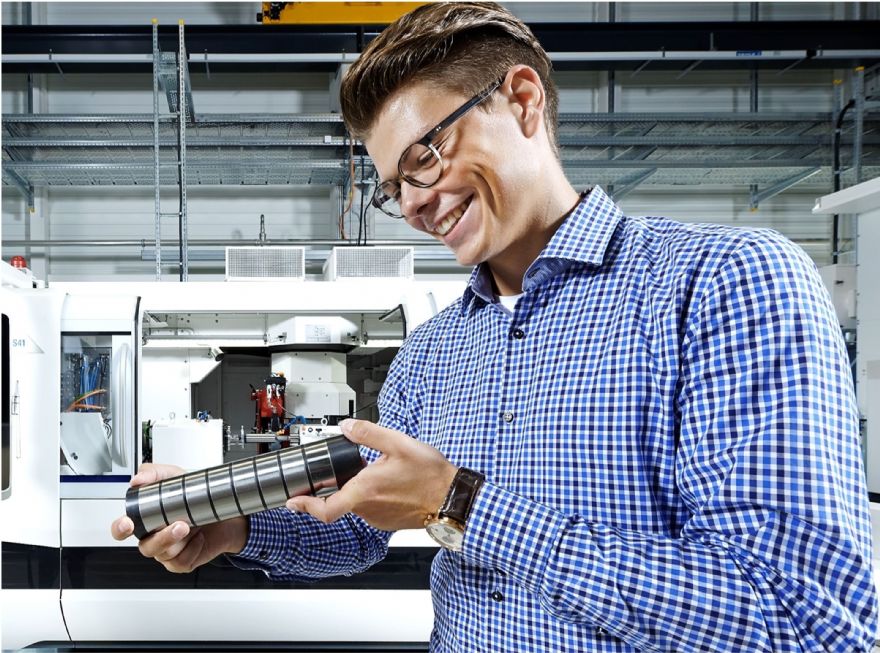
The growth of electric vehicles (EVs) is changing not only what vehicles sound like on the road, but also how they are made. Without the familiar clatter of an internal combustion engine, electric cars expose every imperfection in their mechanical components. What once went unnoticed is now audible and measurable.
In this environment, grinding has become one of the most critical manufacturing technologies, with differences of only a few hundredths of a micron often deciding whether a drivetrain is efficient, quiet and durable. Many of these developments will be on show at the upcoming
GrindingHub exhibition in Stuttgart. At the heart of the EV grinding challenge is noise, vibration and harshness (NVH), is an acronym that has taken on renewed importance for the process.
“With electric vehicles, there are no engine noises to mask the sound. This makes vibrations from other components, such as those from the transmission, much more noticeable,” explains Professor Thomas Bergs, head of the manufacturing technology institute (MTI) at RWTH Aachen University and director at Fraunhofer IPT.
According to the professor, precision can no longer be viewed in isolation. “What is crucial, therefore, is not only the precision of the tooth flanks, but also the control of system tolerances,” he says. Particularly at the high rotational speeds typical of electric drives, even small deviations along the tolerance chain can have amplified effects. “For example, the microstructures of conventionally ground shaft seal surfaces can cause unwanted leaks.”
Grinding for silenceIn electric drivetrains, the transmission becomes a primary source of noise. Any geometric deviation in a tooth flank is immediately transferred into rotational distortion.
“In the case of tooth flanks, geometric deviations are immediately transmitted to the drivetrain as rotational vibrations,” Professor Bergs explains. “A high-precision grinding process with minimal deviations is therefore crucial for precisely tuning the desired NVH behaviour and effectively reducing unwanted noise.”
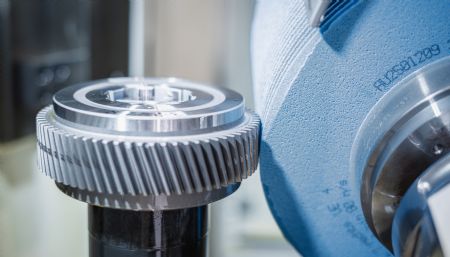
But NVH is only one part of the equation. Electric vehicles also place extreme demands on efficiency and durability, both of which are closely linked to surface integrity. For heavily loaded components such as gears, grinding defects in series production can have a decisive impact on service life. Surface integrity is particularly crucial because it has a significant impact on service life,” says the professor.
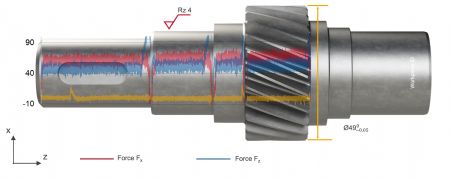
To address this, researchers at MTI and Fraunhofer IPT are developing new approaches that move quality assurance directly into the process. “We are therefore developing new methods to predict surface roughness and residual stresses using data-driven approaches and a digital twin. The aim is to identify critical issues early and enable targeted optimisation before defects become systemic.”
Data-driven precisionLinking real-time sensor data from the grinding machine with physical process models creates a virtual ‘digital twin’ of the grinding operation. This allows the quality of each component to be assessed during production, rather than after it. If deviations arise, process parameters can be adjusted immediately.
“Model-based digital methods make it possible to incorporate the highest quality requirements as early as the process design phase,” Professor Bergs says. “This creates the conditions for implementing precision in a cost-effective and reliable manner.”
Such approaches are becoming increasingly important as manufacturers scale up production for e-mobility. The challenge is no longer just to grind one perfect component, but to reproduce that perfection reliably in series production.
The level of precision required highlights how far grinding technology has advanced, and how far it must still go. “Ultra-smooth surfaces are a key factor in further improving the efficiency of components in e-mobility,” says Professor Bergs. He points to optimised process chains that combine polishing with generative grinding, particularly for gears in electric gearboxes.
The orders of magnitude involved are striking. A human hair has a diameter of around 50 to 100µm. Ultrafine dust particles are about 100 nanometres (Nm) in size – up to a thousand times smaller. Grinding machines for e-mobility must reliably operate in this micro- and sub-micrometer world.
Machine tool builders are responding.
United Machining Solutions, exhibiting in Hall 9 at
GrindingHub 2026, is positioning itself squarely in this high-precision segment.
“As a provider of high-precision grinding technologies, we play a crucial role in meeting the growing quality requirements in the field of e-mobility,” says Christoph Plüss, chief technology officer of the Bern-based company. “Our solutions enable surfaces in the micro- and sub-micrometer range, ensuring minimal noise, reduced friction, and maximum efficiency.”
Less friction, longer lifePrecision has immediate commercial relevance. “In addition to acoustics, efficiency and service life are particularly important,” Mr Plüss notes. “High-precision ground components reduce friction losses and thus directly contribute to optimising the range.”
Durability is equally critical. Electric and hybrid drives introduce new load cases, including frequent torque reversals due to regenerative braking. “The increasing complexity of modern drive systems significantly raises the bar for precision, process reliability, and flexibility in machining,” Mr Plüss explains. Different materials, novel geometries and combined functions must all be machined to the same consistently high quality.
For component manufacturers, the shift to e-mobility is not a sudden break, but a long transition. Product portfolios will evolve gradually over years, if not decades. The strategic challenge is to invest in production technology that remains productive throughout this period of change.
According to Mr Plüss, this is where flexibility becomes decisive. United Machining Solutions focuses on modular machine concepts and adaptable production solutions, supported by digital tools for data-driven process optimisation. “This is how we lay the groundwork for economically viable and future-proof manufacturing throughout the entire transformation period,” he says.
Despite the momentum behind battery-electric vehicles, Mr Plüss does not expect a single dominant drivetrain technology. “It is expected that various types of drive systems will coexist in the coming decades,” he says, citing battery-electric, hybrid, hydrogen combustion and fuel cell technologies, alongside optimised internal combustion engines. Each has its own manufacturing challenges and quality requirements, sustaining demand for high-precision grinding.
Autonomous driving could add further impetus. Increased system integration, safety requirements and reliability demands all point towards even tighter tolerances and higher manufacturing standards. “Overall, this development opens up opportunities for sustainable growth in manufacturing
technology,” Plüss concludes.
GrindingHub: ideas meet machinesThese manufacturing developments will be on display at
GrindingHub 2026, organised by the VDW in Stuttgart from 5 to 8 May. In Halls 7 and 9, visitors will find generative grinding machines designed for ultra-smooth running in electric drives, alongside systems delivering near-perfect concentricity at high speeds to minimise vibration.
Meanwhile, the
GrindingHub Forum in Hall 10 will bring together experts from industry and research to discuss practical solutions to today’s manufacturing challenges. As electric mobility exposes every nanometre of error, grinding is proving to be one of the quiet, but decisive, enablers of the automotive future.