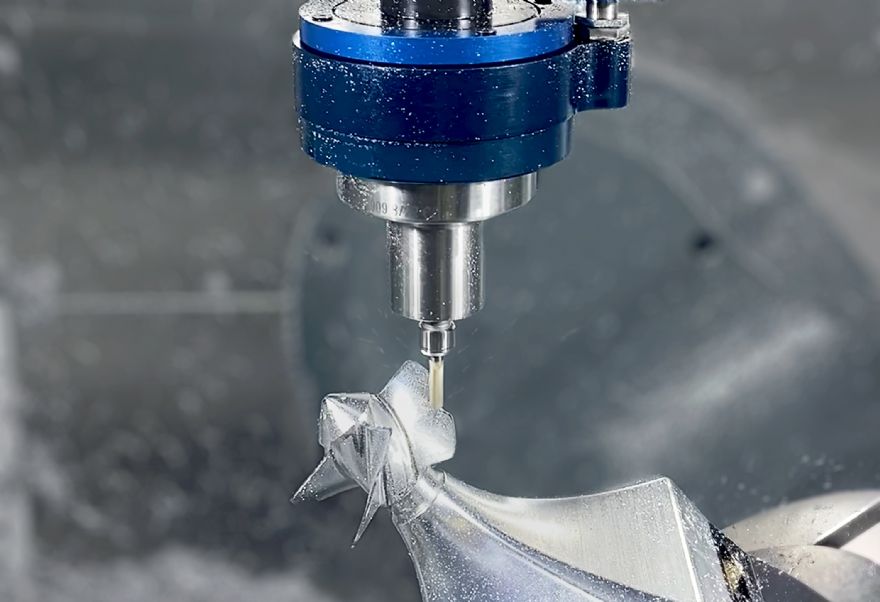
 High-speed add-on spindles are helping manufacturers extract more productivity, accuracy and value from 5-axis CNC machines, without the cost of new equipment. Mike Blanchard, technical advisor, Air Turbine Tools writes more.
5-axis CNC machines are now indispensable in sectors such as aerospace, defence and medical manufacturing, where complex geometries are the norm. Their ability to reach multiple faces of a component in a single set-up reduces repositioning, removes secondary operations and improves overall accuracy.
However, despite their sophistication, many machines are held back by a simple constraint: spindle speed. To truly unlock their capability, particularly in finishing and micro-machining, much higher rotational speeds are required.
Conventional 5-axis spindles typically operate between 6,000 and 15,000rpm. While sufficient for heavy roughing with large tools, these speeds fall short when working with small-diameter cutters used for fine features, micro-drilling or engraving.
Such tools often require 40,000 to 90,000rev/min to maintain correct surface speed. Below this range, problems quickly arise: poor surface finishes, excessive tool wear, breakages and prolonged cycle times.
Rethinking investmentOne option is to invest in a dedicated high-speed machine, often at a cost exceeding a million US dollars. Yet these machines are not suited to heavy material removal and can suffer accelerated spindle wear when pushed to their limits.
Alternatively, some manufacturers split operations across multiple machines, one for roughing and another for finishing. While effective, this approach introduces inefficiencies in programming, labour and floor space.
A more practical solution is the use of add-on high-speed spindles.
Add-on advantageGoverned air-driven spindles can be automatically loaded into the main spindle via the existing tool changer. This allows the machine’s native spindle to handle low-speed, high-torque roughing, while the auxiliary spindle performs high-speed finishing and drilling.
Costing a fraction of a new machine, often under US$6,000, these units deliver rapid return on investment. In many cases, payback is achieved within weeks, particularly in high-volume or time-sensitive production environments. Crucially, they also enable workshops to accept previously unviable jobs.
Faster, cleaner cuttingThe benefits of high-speed machining extend beyond increased rev/min. When tools operate at their intended surface speed, cutting becomes more efficient and predictable.
For example, increasing spindle speed from 10,000 to 40,000rev/min allows feed rates to rise proportionally. The result can be cycle time reductions of up to 75%, alongside improved surface integrity.
Air turbine spindles maintain constant speed under load, unlike conventional “speeders” that can slow and compromise results. They also generate minimal heat, eliminating thermal growth issues and enabling tolerances down to around 2µm.
Simple integrationA key advantage of these systems is their ease of implementation. Most modern 5-axis machines already feature through-spindle air, enabling seamless operation without additional wiring or control integration.
Where this is not available, external air delivery systems using block-and-collar arrangements can be fitted. Manual options are also viable for simpler applications. In all cases, installation is straightforward and does not disrupt existing workflows.
Built for complexity5-axis machining excels in producing intricate geometries: deep cavities, undercuts and multi-angle features. These often demand smaller tools and fine finishing operations—areas where standard spindles struggle.
High-speed attachments enhance the machine’s capability in these tasks, reducing bottlenecks and allowing complete done-in-one machining. This minimises manual intervention, improves consistency and reduces scrap.
Specialist solutions, such as those from Air Turbine Tools, maintain speed even when cutting composites, hardened steels or exotic alloys. Their slim profiles, down to 19mm diameter with extended reach, provide access to confined features, supporting more efficient toolpath strategies.
Maximising machine utilisationBy enabling both roughing and finishing in a single set-up, high-speed spindles significantly improve machine utilisation. Parts no longer need to be moved between operations, reducing handling time and preserving accuracy.
At the same time, wear on the main spindle is reduced, cutting maintenance costs and downtime. Production flows become more streamlined, predictable and scalable.
A strategic upgradeWith capital budgets under pressure, modular upgrades are becoming increasingly attractive. Rather than investing in new machinery, manufacturers can enhance existing assets quickly and cost-effectively.
High-speed spindles represent one such upgrade: boosting productivity, improving surface quality and extending the capabilities of 5-axis machines.
For industries working with tight tolerances, small tools or advanced materials, the case is compelling. By combining five-axis flexibility with sustained high-speed performance, manufacturers can redefine what their current equipment can achieve, and do so with speed, precision and confidence.