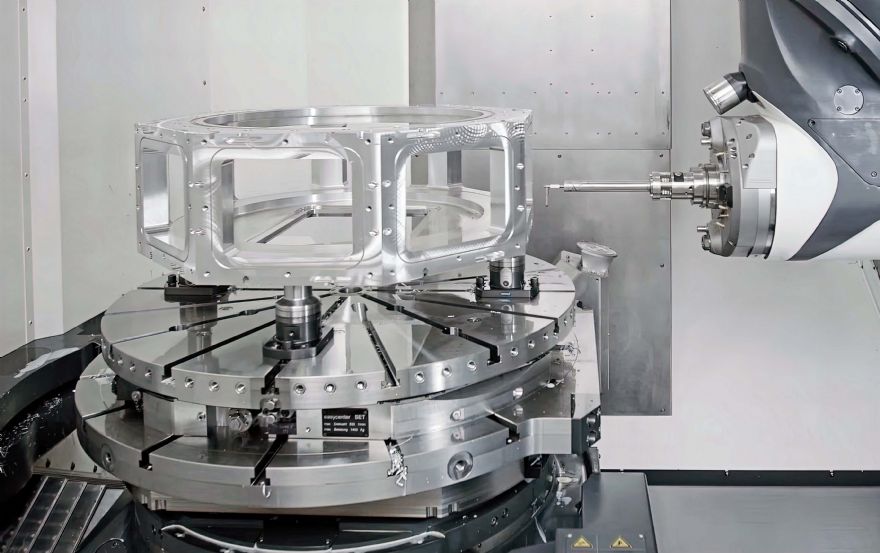
 Pic: An octagonal aluminium alloy housing on the rotary table of the DMG MORI DMC 125 FDS mill-turn centre
The semiconductor industry is one of the most dynamic global growth markets, opening up an attractive field of opportunity for contract manufacturers. At the same time, demand for precision components and quality to cleanroom standards is becoming ever more stringent.
With its machining transformation technology framework,
DMG MORI has demonstrated how these requirements can be met cost-effectively and sustainably. The key is to achieve precision that is reliable, reproducible and scalable under industrial conditions.
Components for the semiconductor industry, such as housings for the many production steps involved, are a prime example of the increasing complexity of modern manufacturing. Long cycle times, tolerances down to microns and strict requirements for high surface quality and cleanliness necessitate stable and consistent machining processes.
Traditional manufacturing involving multiple separate operations and manual handling are increasingly approaching the limit of their effectiveness. To counter this it is crucial to adopt an integrated approach that brings as many manufacturing processes as possible together in an integrated, controlled process. For example, by combining milling, turning, grinding and measuring in a single machine, the number of setups can be reduced and sources of error minimised. The result is high component quality, less scrap and shorter lead times.
Automation is another key factor for success, as it significantly increases machine uptime without requiring additional staff. Automated pallet handling systems and automated guided vehicles are fundamental for unattended shifts and flexible production of different variants of a component. It increases capacity utilisation and planning reliability, while simultaneously reducing costs.
As process integration and automation increase, digital transformation is becoming ever more important. End-to-end data chains, simulations and digital twins enable proactive planning and continuous optimisation of manufacturing processes. Real-time data from the shopfloor provides transparency regarding capacity utilisation, lead times and quality, making manufacturing more efficient and controllable.
In addition to precision, cleanroom quality of components is important. Even the smallest particles can impair the function of sensitive components. DMG MORI consistently integrates such quality requirements into its machine designs and process solutions. Additionally, coolants play a key role, as they ensure thermal and tribological stability during machining.
However, they must be formulated in such a way that particle transport, residue behaviour and subsequent cleaning remain manageable. With coolant developer FUCHS SE as a DMG MORI Qualified Products partner, the machine tool manufacturer integrates this supplier’s technology into its solutions.
Meanwhile, demand in the semiconductor market continues to rise and significant growth opportunities are emerging for companies that consistently optimise their manufacturing processes. With its comprehensive machining transformation solutions, DMG MORI provides the technological and strategic foundation needed to tap successfully into these opportunities.
As a practical example of an application that leverages this manufacturing philosophy, DMG MORI cites the production of a housing for the semiconductor industry.
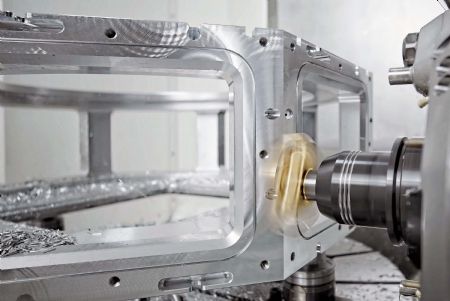 Pic: High-gloss milling of the vertical external faces of the housing
A sequence of milling and drilling operations is first completed on a DMG MORI DMC 125 FDS µPrecision five-axis, horizontal-spindle mill-turn centre. Before any further cutting begins, the part is centred and aligned using the machine manufacturer’s easycenterSET, an adjustable plate positioned between the pallet and the component fixture. Its primary purpose is to automatically correct radial runout and eccentricity of pre-centred workpieces, achieving alignment accuracy within 5µm.
Two deep flange turning operations are then performed, followed by inspection of the features with a touch probe carrying an L-shaped stylus. The next operation is to turn a face groove on the top of the component to a mirror finish. This is followed by extensive deburring and chamfering around the workpiece to ensure perfect edge quality.
Semiconductor manufacturing equipment requires finishes with virtually zero roughness so that gas molecules or microscopic contaminants cannot physically grip onto the walls. So high-gloss milling using specialised tooling is employed to achieve an ultra-smooth, reflective surface finish on the external vertical faces of the housing.
Next come shaping operations to open out and finish a groove machined into each of the eight faces. Finally, a drill held in a 90° angle head produces holes in the vertical sides of the apertures in the faces. A high-pressure internal coolant supply flushes out microscopic chips and controls the heat at the cutting edge.
While on-machine checking happens throughout the machining cycle, the part subsequently undergoes GD&T inspection on a Zeiss coordinate measuring machine to reveal impressive flatness and perpendicularity tolerances measured in single-figure microns and positional tolerances of 15µm total.
Machining of the 800mm diameter, EN AW-5083 aluminium alloy component can be seen on:YouTube.https://youtu.be/A0XCn-MFOe4?si=k7pW8C_nhS_TkloI