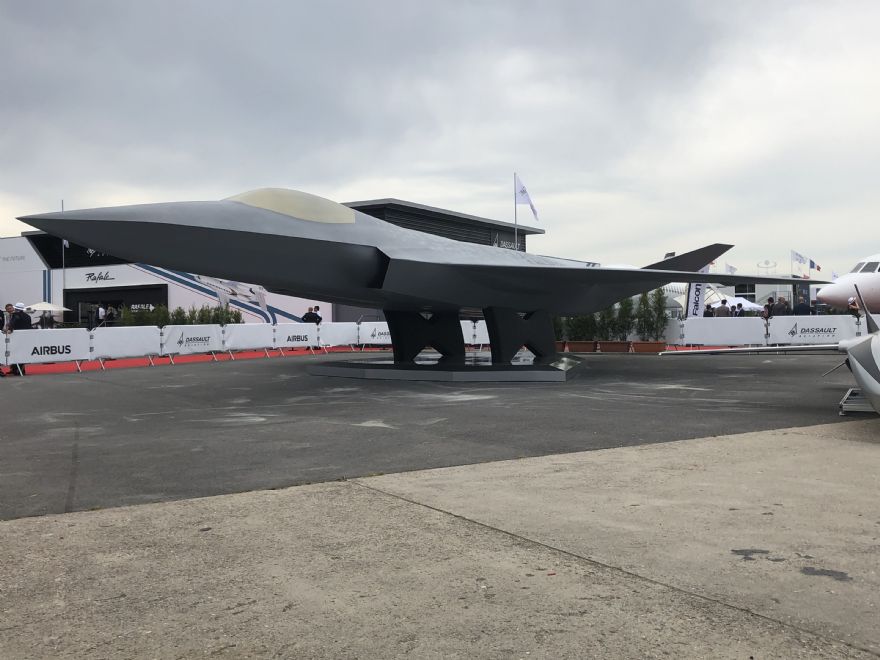
 A mock-up of the FCAS concept at the Paris Airshow
The flagship Franco-German Future Combat Air System (FCAS) fighter programme has effectively been brought to an end after Berlin and Paris concluded that industry partners were unable to resolve long-running disputes.
Government officials have confirmed that German Chancellor Friedrich Merz and French President Emmanuel Macron had accepted that the companies involved could no longer reach agreement on the development of a joint next-generation combat aircraft.
The decision marks a major setback for one of Europe’s most ambitious defence-industrial collaborations, originally launched in 2017 with the aim of delivering a sixth-generation fighter to replace the Eurofighter Typhoon and Dassault Rafale from around 2040.
At the heart of the collapse lies a protracted disagreement between
Dassault Aviation and
Airbus Defence and Space over leadership, workshare and intellectual property. The two sides repeatedly failed to bridge differences over who would take primary control of the aircraft’s design and how sensitive technologies would be shared.
According to officials cited by Reuters and AFP, Merz advised Macron not to pursue the joint fighter project further after months of unsuccessful mediation efforts. The Élysée subsequently acknowledged that it had not been possible to put further pressure on the companies to reach a deal, while expressing regret over the outcome.
The programme’s difficulties were compounded by differing national requirements. France sought a nuclear-capable aircraft suitable for carrier operations, while Germany’s needs were more limited, adding further complexity to an already strained industrial partnership.
Although the manned fighter element — known as the New Generation Fighter (NGF) — is now widely regarded as cancelled, officials on both sides have indicated that parts of the wider FCAS concept may continue. These include the “system of systems” architecture, encompassing unmanned platforms and a combat cloud designed to link aircraft, drones and sensors across the battlespace.
A German government source described this as the “core” of FCAS, characterising it as a digital backbone that could still form the basis of future European defence cooperation.
However, the collapse of the fighter component represents a significant blow to efforts to strengthen Europe’s strategic autonomy in defence manufacturing. The project had been valued at more than €100 billion and was widely seen as a symbol of closer Franco-German industrial integration.
Analysts say the outcome underscores the persistent challenges facing multinational defence programmes, where competing industrial interests and national priorities can prove difficult to reconcile. The failure also raises questions about Europe’s ability to develop complex next-generation systems without fragmentation or duplication of effort.
Both governments have signalled a willingness to pursue future joint initiatives but the effective termination of the FCAS fighter marks a defining moment for European aerospace cooperation.