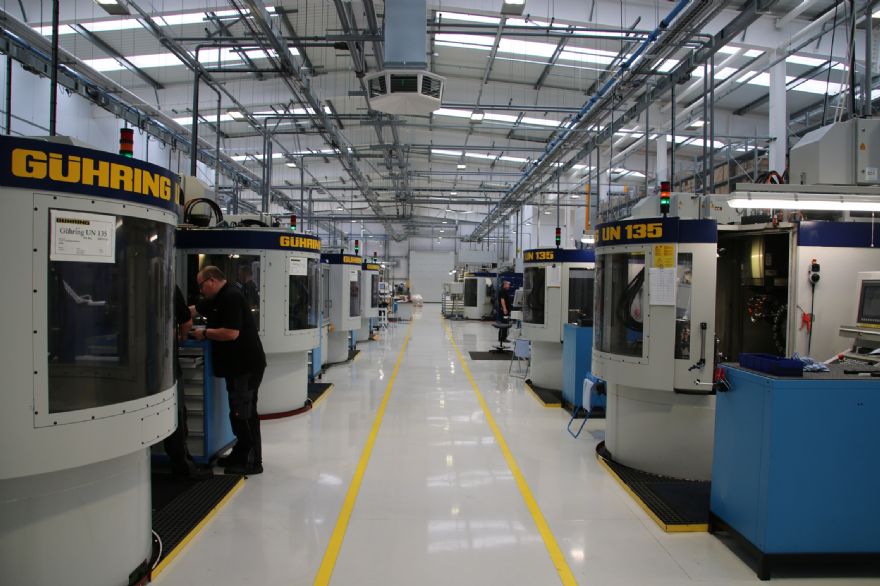
 With carbide prices climbing and no sign of where they will settle, Guhring is urging manufacturers to take a harder look at regrinding their cutting tools. In this article, Guhring UK’s National Sales Manager Chris Bush explains how the company's UK facility restores worn tools to new-tool performance, and why the maths increasingly speaks for itself.
The rising cost of carbide has forced manufacturers across every sector to re-examine how they buy, use and dispose of cutting tools. For Chris Bush of
Guhring UK, the answer is one that many workshops have underused for years.
"It's something people need to focus on a bit more given the current carbide crisis," he says. "We do it all in our UK facility. We regrind tools on the same machines used to manufacture our new tools. We have an in-house coating and de-coating facility, so it's all done under one roof to an ‘as-new’ quality."
That single-site capability is central to Guhring's offering. The company's purpose-built operation in Birmingham runs 20 CNC cutter grinders, every one of them Guhring-made. "We can do small batches and big batches," Mr Bush explains. "We can regrind Guhring-made tools, and we can do other manufacturers' tools as well. With our facility, we've got everything from regrinding through to inspection. So, we can guarantee the same quality regrind as we have on a new tool."
More than end mills“The regrind service covers almost any tool with a cutting edge. We can regrind gun drills, normal twist drills, thread mills, end mills, and we can re-tip PCD tools as well." The PCD re-tipping work is a reminder that high-value tooling is exactly where the savings make the biggest impact.
The service is also available to small job shops. Guhring can easily handle mixed batches, asking only for a sensible minimum to justify the machine set-up.
"We do a minimum order of three of the same tools, as we need to set up. This perfectly suits smaller to medium-sized manufacturers with smaller tool inventories," Mr Bush says.
Coatings that match the originalWhere many regrind facilities end with regrinding the geometry, Guhring treats the coating as integral to restoring performance. "With the coating in the UK, we offer 10 different coatings, and it's all application-specific," Mr Bush explains.
"Depending on what was on the new tool, we mirror that onto the regrind. Crucially, the team strips the old coating before regrinding rather than simply layering over it. We de-coat before we regrind, so that we don't over-coat the tool. An excess build-up of layers becomes unstable and gives a difference in performance that will prevent the tool from performing like new. With a de-coat and complete coating facility in-house, Guhring UK has the entire process managed under one roof."
That discipline to de-coat, regrind to specification, then reapply the correct application-specific coating enables Guhring to restore tools to OEM-level standards, maintaining tight tolerances, concentricity and edge preparation in the process.
Counting the costThe financial logic is where Mr Bush is most direct in his assertions, and it hinges on a simple point about how regrinding insulates a tool from the challenges of the carbide market.
"Once you've bought the new tool and paid for the carbide, the regrinding cost is independent of whether the carbide cost goes up or down,” he affirms. “So you can extend your tool life cycle and use it two, three, or more times. Each additional life is won at a fraction of the price of a new tool, and at a price unmoved by the volatility now rippling through the carbide supply chain.”
Stretched across a production run, that saving compounds quickly. “The ultimate aim of this reconditioning service is that your cost per part is going to come down if you keep recycling the tool,” Mr Bush confirms.
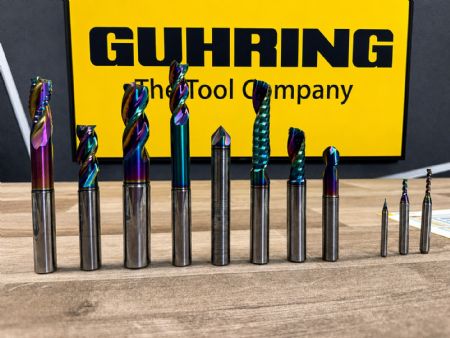 Pic: A selection of Guhring's reground tools
For manufacturers watching their tooling budgets, regrinding is one of the fastest ways to generate significant savings without introducing risk into a proven process.
Quality without compromiseThe value of a solid carbide reground tool is maintained only if it performs like a new tool. This is where Guhring UK’s manufacturing infrastructure helps to underpin the service. “Because we process tool regrinds on the same machines as our new tools, they go through the same processes. The regrinds also go through the same inspection processes and equipment as a new tool, so we can guarantee the same quality, the same performance, and the same repeatability.”
Closing the loopWhen a tool finally reaches the end of its regrind life, Guhring keeps it out of the bin and within the sustainable ecosystem.
“Once a tool has reached the end of its regrind life, we also offer a carbide recycling programme. We've got a new facility in Germany that's expanding all the time, so once the usable life of a tool has been reached, we can recycle it.”
This sustainable layer, on top of the cost savings, reduces raw carbide consumption while maximising the value of every tool a customer buys.
For manufacturers feeling the squeeze, Guhring UK says it will be happy to review customers current tool usage and flag which items are suitable for regrinding, along with the potential savings.