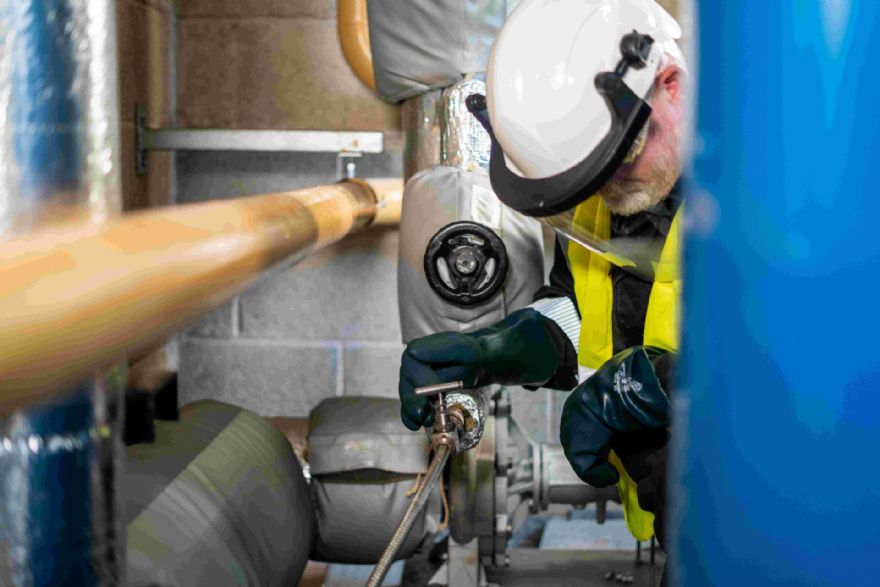
 As manufacturing facilities look to reduce emissions, many focus on large-scale changes such as switching energy sources or installing new equipment. Those steps can be effective, but manufacturers should also examine how existing operations can be adapted to cut energy use, lower emissions and improve productivity. Here, Dave Dyer, technical sales engineer at thermal fluid specialist Global Heat Transfer, explores how waste heat recovery can support industrial efficiency and where heat transfer fluids can play a role.
Most industrial processes produce heat as a by-product, whether from mixing and blending, combustion, drying, refrigeration or compression. In many cases, only part of that heat is used, while the rest is released to the surrounding environment. According to the European Commission, the EU's industrial sector has a theoretical excess heat potential of around 920 TWh per year, representing a significant opportunity to improve energy efficiency, reduce wasted energy and support lower-emission, more cost-effective operations.
When improving waste heat recovery, manufacturers should first assess the efficiency of the existing process. One question is whether heat and power are being generated in the most effective way. Where a site has a simultaneous demand for electricity and useful heat, Combined Heat and Power (CHP) can be more efficient than producing heat in a boiler and buying electricity separately.
Manufacturers should also consider how heat is distributed and stored across the plant. Steam is widely used in industry, but steam systems generally operate at elevated pressures and can lose energy through distribution, condensate handling and poor insulation if they are not well maintained. In some applications, liquid-phase heat transfer fluids can provide high operating temperatures at lower system pressures, which may simplify heat transport and improve controllability.
A well-designed heat transfer system can help capture, store and move thermal energy more effectively. Design choices such as exchanger selection, pipe sizing, insulation, fluid flow rate and temperature control all affect how much heat can be recovered and how much is lost before it is reused.
If improving the system doesn’t capture all the excess heat energy, facilities managers should consider how else they can redirect the wasted energy. Recovered heat can be used for a range of applications, such as heating water for use elsewhere in the facility, providing space heating for buildings, or even being converted into electricity to help power the plant.
According to the European Commission, energy efficiency delivers a “triple win” by reducing emissions, lowering energy costs and strengthening energy security through reduced reliance on imported fossil fuels.
When looking to redirect and reuse wasted heat energy, either for heating or cooling applications around the plant, facilities managers must consider how to transport this energy efficiently and maintain the temperatures required for its new intended purpose.
Waste heat recovery systems can manage, recover and repurpose the waste heat from industrial applications. Systems use an intermediate fluid, such as steam or manufactured thermal fluids to transfer waste heat to another process. For example, heat energy can be redirected to power a turbine that will generate electricity for the plant.
Technologies such as Organic Rankine Cycle systems can convert suitable low- to medium-temperature heat sources into electricity. CHP systems, meanwhile, recover useful heat from their power generation and can be effective where a plant needs both electricity and thermal energy.
Matching a heat transfer fluid to the system and application will improve system efficiency. For example, to effectively recover low-grade heat, engineers should choose a heat transfer fluid with precise temperature control that meets its intended purpose, excellent thermal stability and a low boiling point so the system can extract as much thermal energy from the waste heat source with less energy input.
As manufacturing facilities work to reduce emissions and improve efficiency, waste heat recovery can be an important part of the solution. Well-designed heat transfer systems can help capture and repurpose waste heat for more useful applications across the plant. By selecting the right technology and the right heat transfer fluid for the duty, engineers can reduce emissions, improve energy performance and unlock more value from existing operations.