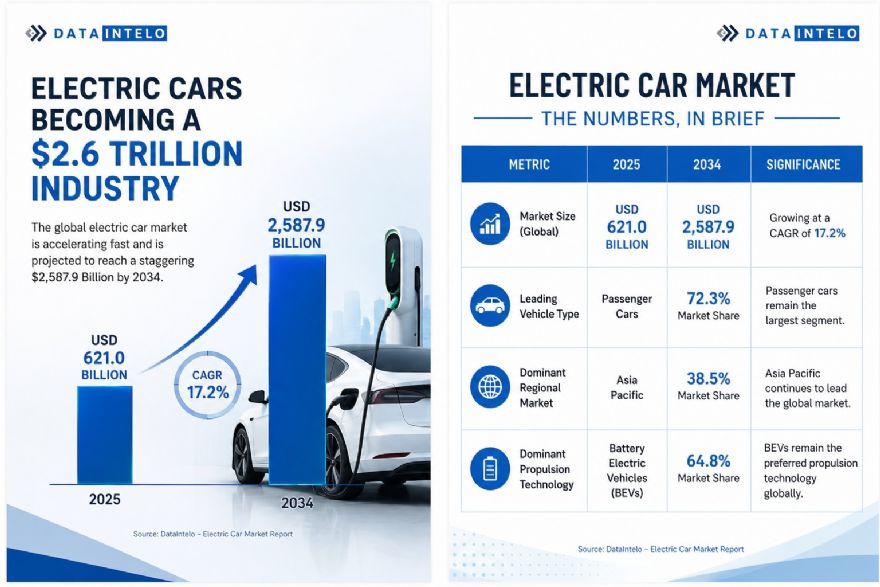
 Ashish Kolte from global market research company DataIntelo examines how falling battery costs, expanding charging infrastructure, supportive government policies and growing consumer demand are transforming electric vehicles from a niche technology into a mainstream automotive force, with the global market projected to grow from $621 billion in 2025 to nearly $2.6 trillion by 2034.
Do you remember the times when buying an electric car was considered a more daring act than any other? You had to plan your journey based on where the charging stations were and how long the battery lasted for, and perhaps even endure curious stares from your family about your decision.
Honestly, that whole vibe is mostly gone now. Chargers show up in more places than they used to, batteries hold their charge a lot better, and just about every automaker worth naming has an electric model sitting in showrooms.
And that's kind of the whole story here, isn't it. A market that used to be for early adopters and tech enthusiasts is now one of the faster-moving parts of the auto industry. Governments keep tossing in incentives, battery prices keep sliding down, automakers keep dumping money into new platforms — and buyers keep picking electric, whether that's about the planet or just because the numbers finally add up for them.
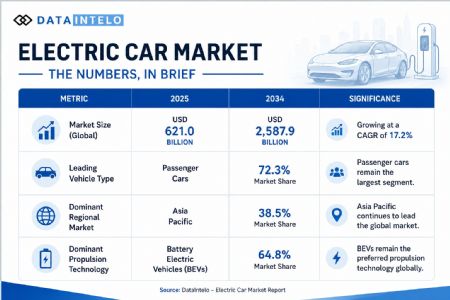
According to DataIntelo the global electric car market was worth $621.0 billion in 2025. By 2034 they expect that to reach $2,587.9 billion — a 17.2% CAGR, if you want the technical term for it.
 Batteries are not an excuse anymore
For a long time, the battery was everyone's go-to complaint. Too pricey, not enough range, charging that took forever. Fair enough, back then. But that reputation hasn't really kept pace with where things actually are now.
Lithium-ion costs have dropped a lot over the last ten years or so, and EV prices followed them down — you'll find electric cars in nearly every price bracket at this point, not just the luxury end anymore. Add in better thermal management and quicker charging, and a lot of the old hesitation just doesn't hold up the way it used to.
Tesla, BYD, Toyota, Samsung — plus a few newer battery companies nobody had heard of five years ago — are all chasing solid-state battery tech. Longer range, much faster charging, at least in theory. It's not mainstream yet. But close enough that automakers are already building it into their roadmaps.
Passenger cars still main focusMore than 72% of the market's revenue in 2025 comes from passenger vehicles. That's not changing anytime soon, probably.
A lot of the credit goes to specific cars — the Tesla Model 3, BYD Seagull, Hyundai Ioniq 5, Volkswagen ID.4, Kia EV6. These pulled EVs out of the early-adopter niche and into the "sure, I'd consider that" conversation for regular buyers. And the range of options has actually gotten pretty wide: cheap compacts on one side, premium SUVs on the other. An EV doesn't automatically mean a luxury price tag anymore, which wasn't really true even five years ago.
Commercial fleets are moving too, just a bit slower. Logistics companies, transit agencies — they're electrifying because it's cheaper to run day to day and easier to justify against emissions rules they're already facing.
Easier charger availabilityRange anxiety used to top the list of reasons people wouldn't buy an EV. Still around, sure, but it's losing steam.
Home charging is still where most of it happens. But public networks are spreading — highways, city streets, office parking lots, shopping centers, you name it. And fast chargers that can top off a meaningful chunk of battery in under 20 minutes? Those are becoming pretty normal, not some rare thing you have to plan a whole trip around.
Tesla, ChargePoint, Shell Recharge, EVgo, plus a pile of smaller regional operators — they're all building this out at once. Which is exactly why long-distance EV road trips are a lot less of a leap of faith than they were even a couple years back.
Government policy still an incentiveChina, the U.S., Germany, plenty of other European countries — they're all still offering purchase incentives, tax breaks, various regulatory carrots to get people into EVs. Add tighter emissions rules and public promises to phase out gas engines on top of that, and automakers don't exactly have a choice. They have to keep accelerating their electric plans, like it or not.
Collectively, they have already invested trillions of dollars on EVs, batteries, and dedicated electric platforms in the next decade alone. Not a small amount to spend.
Asia Pacific Dominates, While Others Play Catch Up
In 2025, Asia Pacific made up around 38.5% of global EV revenues.
Not surprising, given China's manufacturing base, its battery supply chain, and just how much local demand exists there.
North America and Europe are growing too, just from a different mix of factors — incentives, new model launches, ongoing investment in charging infrastructure. Latin America and the Middle East & Africa are further behind, but they're not standing still either. Better charging access, more awareness, friendlier policy — it's all starting to show up there too, slowly.
Looking to the futureElectric cars aren't really just "the eco-friendly option" anymore. At this point they're looking more like where the whole auto industry is headed.
Cheaper batteries, wider charging access, government money, serious capital from automakers — all of it is reshaping transportation faster than a lot of people expected even a few years ago. If DataIntelo's projections hold up, this market clears $2.5 trillion by 2034. And the companies putting real money into batteries, charging, and manufacturing right now? They're the ones probably going to be ahead of the pack when that happens.