The
UK Atomic Energy Authority (UKAEA) has completed the most ambitious experimental campaign to date on its flagship MAST Upgrade fusion device, achieving record plasma pressures while demonstrating new techniques to tackle some of the key engineering and physics challenges standing in the way of commercial fusion power.
The fifth experimental campaign on the spherical tokamak, located at UKAEA’s Culham Campus in Oxfordshire, ran throughout 2025 and 2026 and produced more than 1,100 fusion plasmas. The programme forms a major part of UKAEA’s strategy to build the scientific foundations needed to make fusion a practical low-carbon energy source.
A major achievement of the campaign was reaching the highest plasma pressure yet achieved on MAST Upgrade without triggering destabilising effects that can threaten both machine performance and component life. High plasma pressure is a critical requirement for future fusion power plants because it allows greater fusion power production within a given reactor volume.
One of the central objectives of the programme was addressing so-called Edge Localised Modes (ELMs), sudden instabilities that occur at the plasma boundary. These events can cause loss of plasma pressure and release significant amounts of stored energy, potentially damaging internal reactor surfaces and exhaust components over time. Reducing or eliminating ELMs is widely regarded as an essential prerequisite for economically viable fusion power.
Building on previous research, the MAST Upgrade team employed a combination of advanced plasma operating modes and magnetic control techniques to suppress these instabilities. Among the approaches used were Quasi-Continuous Exhaust mode (QCE-mode) and Resonant Magnetic Perturbations (RMPs), which use specially designed coils to apply three-dimensional magnetic fields that help stabilise plasma behaviour at its edge.
Researchers also successfully accessed two further operating regimes known as Quiescent H-mode (QH-mode) and I-mode. Both are recognised as high-performance plasma states that improve energy confinement while avoiding the damaging effects associated with large ELMs.
The ability to achieve these regimes on MAST Upgrade is considered particularly significant because the machine operates under conditions that differ substantially from many other fusion devices around the world. According to UKAEA, the results provide greater confidence that future fusion power plants will be able to operate with stable plasma boundaries and fewer damaging energy surges.
The campaign also delivered a world-first plasma control technique. By measuring visible light emitted by deuterium from the machine’s upper and lower divertors, researchers were able to detect tiny positional imbalances within the plasma in real time. The method enables highly accurate plasma positioning and represents a step towards the automated control systems that future commercial fusion facilities will require.
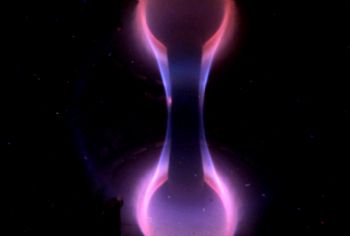
Another key focus was the management of intense exhaust heat produced by fusion plasmas. To address this challenge, the team investigated the use of small quantities of nitrogen injected into the plasma edge. The nitrogen causes a large proportion of the exhaust energy to be emitted as light, dispersing heat before it reaches the reactor walls and divertor surfaces.
James Harrison, Head of MAST Upgrade Science at UKAEA, said: “The results genuinely shape the design of future fusion power plants. Accessing four stable high-performance plasma regimes, including QH-mode, QCE and I-mode and our world-first plasma position control technique, demonstrates that MAST Upgrade is producing science at the leading edge of what is possible.
“The level of international interest in our data reflects the UK’s central role in global fusion research, and these findings take us another step closer to practical fusion energy.”
The results were presented at the European Physical Society Plasma Physics Conference 2026 in Edinburgh and are now being shared with the international fusion community to support projects including the UK’s STEP fusion programme and the ITER reactor under construction in France.
Pic: MAST Upgrade plasma with nitrogen added to spread exhaust heat (Credit UKAEA)