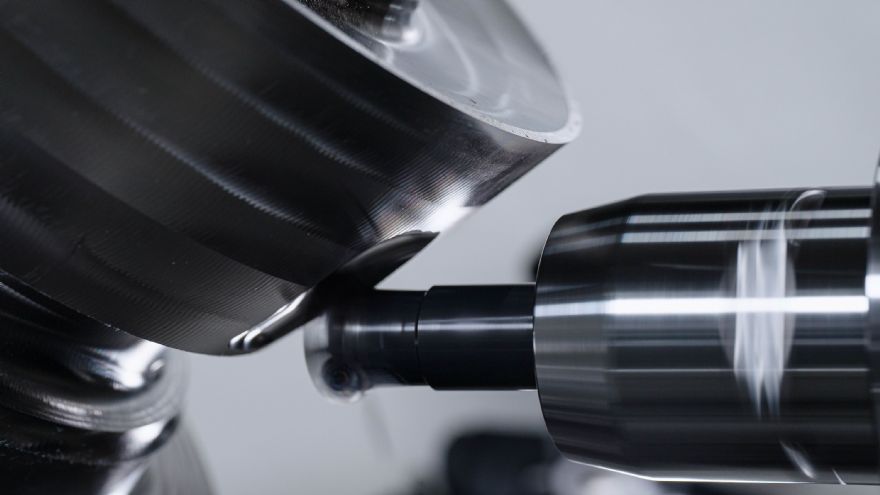
 In this article, Alvaro Ruiz, global product application specialist at metal cutting tooling manufacturer Sandvik Coromant, explains why tooling design is now centred on process security and predictable wear.
In sectors such as aerospace, energy and die and mould manufacturing, profile milling operations are rarely performed under ideal conditions. Components often feature deep cavities and thin walls that demand long tool reach with frequent interruptions, while materials generate high temperature may even self-harden and consistently product chips that are difficult to control. Under these conditions, the problem moves beyond tool life and becomes one of how the process behaves over time.
Small variations in chip load, vibration and insert stability accumulate and create unpredictability. Once operator confidence drops, machining teams respond cautiously, easing cutting data or limiting unattended operation to protect the part. The result is lower insert utilisation and reduced overall efficiency.
The stability challengeProfile milling generates highly dynamic cutting conditions as the tool moves through complex geometry. Titanium pockets often combine long reach with flexible walls, increasing vibration across the system. In HRSAs such as Inconel, heat concentrates at the cutting edge, which accelerates wear and raises the risk of failure. Stainless and duplex grades add strength and chip control challenges that load both insert and cutter body through the engagement cycle.
In this environment, even small inconsistencies in the tooling system can disrupt the cut. This is down to multiple instability routes converging at the insert interface, where engagement variation and thermal loading translate into chip thickness differences and wear divergence from tooth to tooth.
Insert micro-movement is one of the most influential factors. Even small movement at the insert seat can change chip thickness and edge loading, pushing wear off balance. As that imbalance develops, predictability drops and the risk of sudden edge failure increases. To maintain control of the process, wear needs to progress in a consistent and repeatable way, so tool changes can be planned rather than driven by unexpected breakdown.
Balancing cutting forceControlling force direction and distribution is central to stability in profile milling. Excessive radial forces increase vibration, so controlling how forces are distributed throughout the cutter body is essential to maintaining process stability under changing engagement.
Tool geometry is a key lever. Combining axial and radial geometry choices helps reduce vibration by limiting radial load while retaining edge security, particularly in titanium and stainless steel where aggressive engagement can quickly destabilise the cut.
Using a high-feed strategy also plays a role. Across many profiling operations, reducing axial engagement combined with round inserts enables a reduction in radial cutting forces while increasing feed rate, which supports material removal rate. This is especially effective in cavity milling and long-reach operations, where it is often more valuable than maximising individual depth of cut.
Designing for process security Tool development is increasingly focused on how a cutter behaves across its working life rather than how hard it can be pushed in optimal conditions. If wear is controlled and the cut stays stable, manufacturers can maintain high parameters with less risk. This focus on process behaviour informed the development of the CoroMill MR20: a positive round-insert milling cutter, with a focus on ISO M, ISO S and ISO P for profiling and face milling.
At the centre of the stage this is the new insert seat design. A large contact area between insert and cutter body reduces micro-movement under load, which helps maintain consistent chip thickness across edges. Stable seating improves load distribution and prevents early imbalance that can destabilise the process.
Durability at the seat is equally important. By maintaining its form over repeated loading, the cutter avoids gradual deformation that would otherwise introduce variation over time. The result is consistent performance across the full life of the tool rather than a slow drift in behaviour.
The same concept carries through to overall wear behaviour. The MR20 is manufactured with tight cutter-body tolerances and a new system for dimensional control, which promotes gradual and predictable insert wear. When wear progresses evenly across all edges of the cutter, the cutter stays balanced, surface finish is easier to maintain, and the risk of isolated edge failure is reduced.
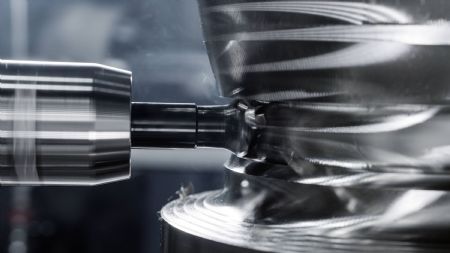
The insert itself supports this behaviour. The MR20 uses a six-edged round insert with a thick, robust body, giving it the strength to handle changing engagement without losing edge stability, which in turn allows higher feed rates without increasing instability in the cut. This is especially important when moving from roughing into semi-finishing, where variation in load can otherwise push individual edges out of balance.
Titanium and HRSA applications introduce a second challenge: heat concentration around the cutting zone. A new integrated under-coolant system helps to reduce the overall temperature during the cutting process, helping to maintain the insert coating for longer, which drives more stable wear progression in materials that would otherwise promote thermal cycling and unpredictability.
In modern machining, productivity depends on how far a process can be trusted. High feed rates only add value when they can be sustained without introducing risk. This is why profiling strategies are shifting away from peak performance in short bursts toward consistent performance that holds under changing conditions.
For high-value components, the consequences are immediate. A single scrapped aerospace structure or an interrupted cycle on a long-running part can outweigh any marginal gain in cutting speed. When the process remains stable, shops can run at higher feed rates with greater certainty and extend cycle times with less intervention. The result is a process that behaves as expected from the first part through to the last.