Agricultural machinery manufacturer
Pöttinger has replaced an ageing flexible production system in just 12 weeks, working closely with machine supplier
Starrag and automation specialist
Promot.
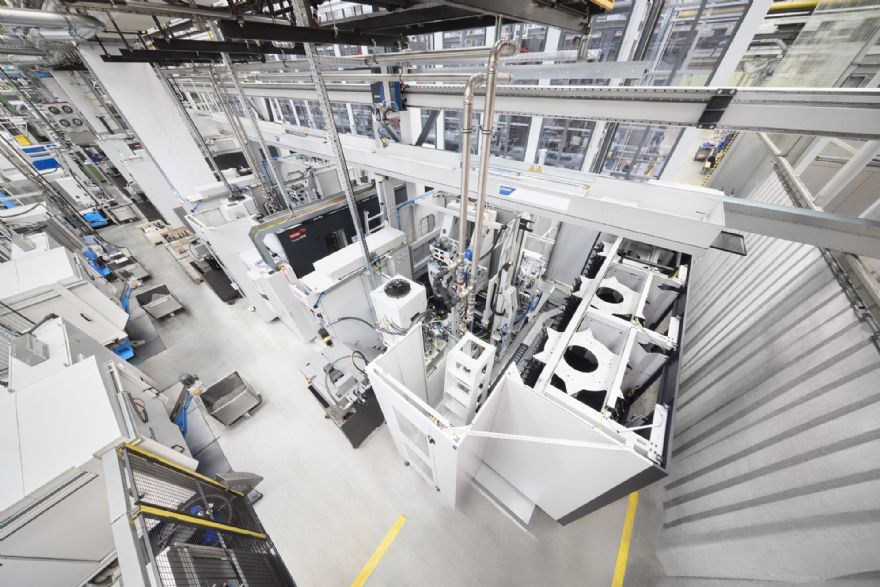
At the heart of the new installation are four Heckert H75 horizontal machining centres linked to a pallet storage system and central production control, creating a highly flexible and digitally integrated manufacturing environment.
Based in Austria, Pöttinger produces equipment for grassland management, arable farming and digital agricultural technologies. Its portfolio includes mowers, loading wagons, ploughs, cultivators and a range of software-based assistance systems.
Jörg Lechner, head of production and materials management, says: "As a family-owned company, we attach importance to sustainability, quality, and long-term thinking – values that are directly reflected in our production philosophy."
That philosophy centres on manufacturing flexibility. Rather than producing large volumes for stock, the company operates on weekly production cycles and adapts output according to market demand. The approach is particularly important in plough production, where product variation is so extensive that few machines are identical. A modular design strategy enables late-stage configuration and just-in-time manufacturing despite significant complexity.
After almost two decades of service, Pöttinger's previous automated production system was no longer capable of delivering the competitive advantage the company required. Around five years ago the search began for a replacement that would restore its position at the forefront of manufacturing technology.
Flexibility and precisionThe new system had to cope with a wide variety of components. Parts range from simple structural steel lugs weighing only a few hundred grams through to gearbox housings produced from castings weighing up to 27kg. Large welded frame components approaching 900mm in length are also machined on the line.
The accuracy requirements are equally demanding. Gearbox housings, for example, require machining tolerances measured in microns.
"This requires both robust and precise machining centres," explains Iskender Merkezoglu, head of mechanical production.
A retrofit of the existing installation was quickly ruled out. Besides the extended downtime involved, differences in software generations would have created additional complications. Instead, the company opted for a complete replacement while maintaining ongoing operations, a strategy described internally as a 'Big Bang' changeover.
Starrag secured the contract with its Heckert H75 machining centres. Developed at the company's Chemnitz facility, the machines offered larger working envelopes and collision circles while maintaining a comparatively compact footprint.
"This is an important advantage given our confined spatial conditions. It also looks ahead, as our parts will probably grow in size and complexity," says Mr Merkezoglu.
Energy performance advancesRaimund Hohensinn, responsible for overall production at Pöttinger, says: "The Starrag high-end machining centre is also extremely energy-efficient, which really suits us. At Pöttinger, we attach great importance to the economical use of energy."
For automation, the company selected Promot Automation. The combination of Starrag and Promot offered significant benefits in tool management and machine utilisation.
"For its Heckert H75 machines, Starrag offers an affordable tool magazine with 260 positions," says Mr Merkezoglu. "As Promot can link the magazines of the four machines via its Toolmaster gantry loader, 1,040 tools in total are available to us. We can exchange them between the four machines as required."
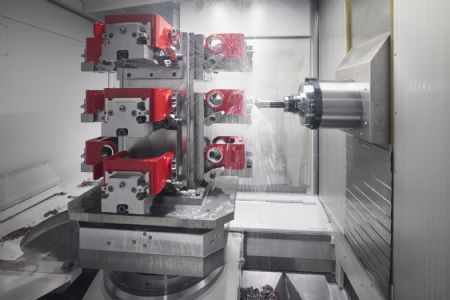 Pic: The working area of the Heckert HMC
The arrangement reduces tooling costs and increases production flexibility. Because all tool data is available across the system, the production control software can allocate jobs to whichever machine is free, improving utilisation without major planning effort.
Mr Merkezoglu explains that a Balluff chip integrated into each toolholder transfers presetting information directly to the machine, ensuring tool data is immediately available throughout the cell.
"In the end, the deciding factor for the Starrag/Promot solution was the complete package of technology, efficiency, and cooperation," says Mr Hohensinn. "Starrag assisted us greatly during the project phase and provided prompt answers. This built trust. The same applies to Promot. As a team, we worked very well from project planning through to commissioning."
Speedier digital preparationPöttinger managed overall project coordination, while Promot took responsibility for system integration. The completed installation consists of four Heckert H75 machining centres connected to a high-bay warehouse containing 134 pallet locations distributed across five levels and served by a Palmaster FFS1500 stacker crane. Four Vario set-up stations are also included, two of which feature motorised tilting capability.
A central master computer supplied by Promot communicates directly with SAP and controls the entire production process.
According to Mario Hamedinger, responsible for programming and production planning, digital preparation was essential if the ambitious 12-week installation target was to be achieved.
He introduced Pimpel's CHECKitB4 software, which enables NC programs to be tested through a virtual control system before machine installation.
Starrag supplied a detailed digital twin of the Heckert H75, accurately reproducing both machine behaviour and control functions. Using the virtual model, programmers could simulate ISO code, verify machining operations and identify potential control issues months before the machines arrived on site.
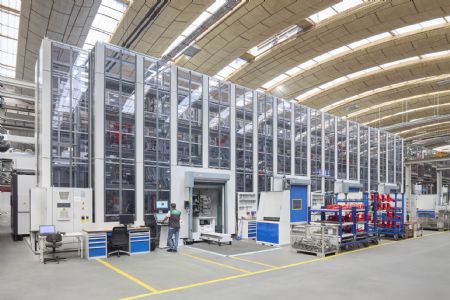 Pic: The new production system with four Heckert H75 machining centres
In addition, Starrag assembled the four machines at its Chemnitz facility ahead of shipment, allowing Pöttinger personnel to validate processes under production conditions.
"My colleagues and I were in Chemnitz for around four weeks to start up the programs," reports Mr Hamedinger. "Without the digital twin and CHECKitB4, we would never have been able to meet the twelve-week retrofitting time frame."
The digital approach dramatically reduced risk during commissioning and ensured the machines could enter production far more quickly than would otherwise have been possible.
Productivity gains beyond machiningThe project also provided an opportunity to optimise surrounding processes. One improvement focused on component cleaning. Previously, finished workpieces were flushed inside the machine after machining, occupying valuable production time.
"Our aim was to take the flushing step out of the machine," explains Mr Hamedinger.
Working together, Starrag and Promot developed a solution that transfers completed components via a rotary table to a dedicated set-up station within the warehouse. There, automatically closing gates and integrated air and coolant nozzles perform the cleaning cycle while machining has already resumed on the next component.
"This saves us at least one minute of production time per pallet change, which equates to almost 20% of the cycle time," says Mr Hamedinger. "An enormous gain in productivity, without having to reduce the milling times."
During the upgrade, Pöttinger also replaced its decentralised coolant arrangement with a centralised system holding 8,500 litres. The new approach improves process reliability, reduces maintenance requirements and simplifies daily operation.
Looking further ahead, machine condition monitoring provides additional operational benefits.
"Starrag gives us a so-called fingerprint for these machines, with which we can request all important machine data on site without service technicians," says Mr Merkezoglu. "We send the data to the Starrag factory in Chemnitz, where specialists generate a report or analysis for us within one day."
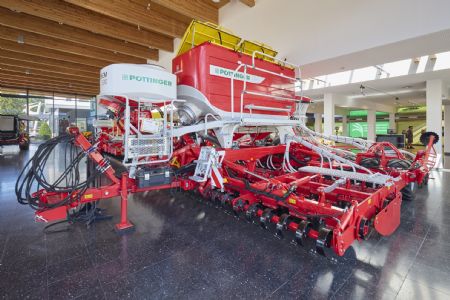 Pic: One of Pöttinger's grassland management machines
Comparing this information against historical data allows potential problems to be detected before they lead to breakdowns. Maintenance can therefore be planned more accurately, helping reduce unplanned downtime.
The site acceptance test was completed after only 12 weeks. Full production capability followed within a short period as the four machines were run in parallel and fine-tuned by programmers and setters.
To ensure complete interchangeability, each machine is configured identically and set up using the same master pallet. The production control system therefore treats the installation as a single resource rather than four separate machining centres, allowing orders to be distributed automatically without regard to individual machine identities.
For Mr Lechner, however, the project's success goes beyond machinery and software.
"The success is based on the fact that employees assume responsibility and actively work together on the further development of the processes," he says. "The most important thing for us is that we manage to take people on the journey. Everyone contributes something – and that's not because it is required, but because they are passionate about it."
He also credits the close, trust-based collaboration between Pöttinger, Starrag and Promot, together with the commitment of employees across the business, for delivering a project that has established a highly productive and future-ready manufacturing platform.