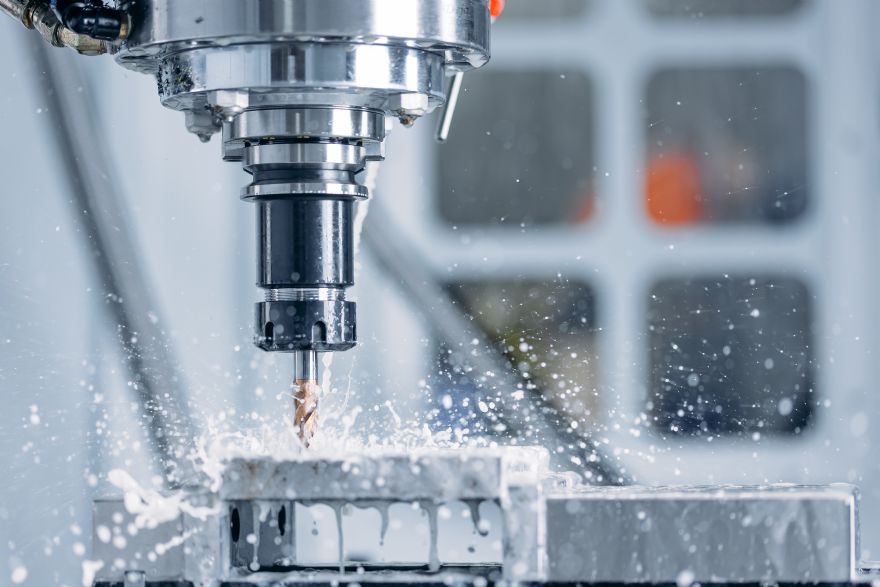
 In this article Ross Turnbull, director of business development at application specific integrated circuit (ASIC) specialist Swindon Silicon Systems, explains how the electronics controlling CNC machines influence precision and where custom ICs can help machine tool builders and control system suppliers improve signal quality and repeatability.
Manufacturers are increasingly investing in technologies that allow production systems to become more connected and responsive. Deloitte’s 2025 Smart Manufacturing and Operations Survey found that 41% of manufacturers surveyed identified factory automation hardware as a priority investment area, while 34% highlighted active sensors. The report notes that these technologies enable manufacturers to “monitor and sense the manufacturing environment”, creating the data foundations needed for more advanced automation.
For CNC machine builders, this means that precision increasingly depends not only on mechanical design, but also on the quality of the electronic systems capturing and interpreting machine data. This is particularly important as manufacturers push towards tighter tolerances, higher throughput and more automated production, where small variations in machine behaviour can affect part quality and process consistency.
Accuracy is a closed-loop problemFeed axes in a CNC machine are normally controlled as closed-loop servo systems. The controller issues a command, feedback devices report actual motion and the drive continually corrects the difference. In a machining environment, this feedback loop is what allows the machine to maintain accurate tool positioning throughout a cutting operation, even as loads, speeds and cutting conditions change. Spindle control can also use feedback where accurate speed or orientation is required.
The electronics in this chain do not replace good mechanics. A machine can still lose accuracy to backlash, structural deflection, spindle run-out or thermal growth as it warms up, whatever the quality of its control electronics. But poor feedback or control electronics introduce a different kind of error on top of these: noise, timing error and measurement uncertainty that erode the accuracy an otherwise capable machine should be able to deliver.
Some of this comes down to where the feedback is taken from: a rotary encoder on the motor is common, but higher accuracy architectures use a linear encoder on the axis itself to avoid errors introduced by the mechanics in between.
Turning movement into trusted dataWhich type of encoder a machine uses matters less than what happens to its signal on the way to the controller. Encoders can provide information in different ways, from analogue incremental signals requiring conditioning and interpolation to digital position data transmitted directly over a serial interface. Absolute encoders can provide position immediately at start-up, while incremental systems track movement relative to a fixed reference point.
In each case, the interface between the sensing element and the CNC or drive has to preserve the information the encoder can deliver. Analogue front ends may need low-noise amplification, filtering and interpolation, while digital interfaces need robust timing and communications.
For machine tool builders and motion control developers, the importance is not simply how the encoder communicates, but how accurately the control system can understand the position of the tool relative to the workpiece. Any uncertainty introduced in this signal path can affect dimensional accuracy, repeatability and surface finish. This is an area already familiar to Swindon Silicon, whose industrial ASIC work includes position encoder systems for factory automation and mixed-signal sensor interfaces.
Reading the cutting processPosition feedback answers where the machine is, but not what the cutting process itself is doing to the tool and the part. In high-value machining operations, where surface finish, dimensional accuracy and tool life directly affect productivity, process monitoring can help operators catch changes in the cut early, reducing unexpected tool failure and keeping production output consistent.
These signals do not provide a simple one-to-one measurement of wear. Cutting parameters, workpiece material, tool geometry and machine dynamics can all affect them, so useful monitoring depends on signal processing that can separate a developing trend from normal process variation.

For example, increasing tool wear can be associated with changes in cutting force and vibration under otherwise comparable conditions. Chatter also produces distinctive vibration behaviour and can damage surface finish. Temperature measurements can support thermal monitoring, although measuring close to a rotating cutting edge is not always practical.
For an electronics designer, this creates a mixed-signal challenge: sensor outputs may be small, noisy and spread across different bandwidths. Bringing amplification, filtering, analogue-to-digital conversion and local processing closer to the sensing point can improve the quality of the data passed to the machine controller or monitoring system.
Designing for the machine tool environmentMaintaining this signal quality is particularly challenging in CNC environments, where sensors, encoders and cabling close to the machining zone may be exposed to vibration, coolant, contamination and temperature change, while electronics in the drive and control cabinet must coexist with high-current switching and electromagnetic interference. These conditions make signal integrity, grounding, filtering, protection and temperature behaviour system-level concerns.
Machine builders therefore need electronics designed around the electrical characteristics and operating limits of the application, rather than forcing the system around general-purpose components.
Improving CNC controlWithin CNC architectures, ASICs are typically used in the lower-voltage control and interface layer, where machine data is captured, processed and communicated. They do not replace the high-power stage that drives a spindle or servo motor.
Depending on the application, one device can integrate functions such as encoder interfacing, signal conditioning, analogue-to-digital conversion and communications, helping machine tool builders manage the flow of information between sensors, feedback devices and control systems.
In CNC systems, this can reduce opportunities for electrical noise or variation to affect positioning accuracy, repeatability and machining consistency. However, integration does not automatically make a system more accurate or reliable. Performance still depends on careful characterisation, calibration and verification across the intended operating range.
Maintaining consistency across machine platforms
For machine tool builders producing control platforms over many years, consistency across production units is critical. An ASIC can give greater control over the electronic signal chain, supporting repeatable behaviour across machines and predictable performance throughout the equipment lifecycle.
Precision in CNC metal cutting is ultimately the result of the complete machine: mechanics, tooling, thermal control, feedback and software working together. ASICs occupy a largely hidden part of this chain, but where CNC position and process signals must be captured consistently and processed predictably, custom silicon can help the suppliers developing CNC control, sensing and feedback systems gain greater control over the electronics supporting accuracy and repeatability.
Swindon Silicon Systems designs mixed-signal ASICs for industrial control, position sensing and sensor interface applications.