 Rodriguez
 has introduced a new collaborative transfer unit that extends the operating range of cobots through a movable seventh axis, enabling a single robot to serve multiple workstations and increasing flexibility in industrial automation applications.
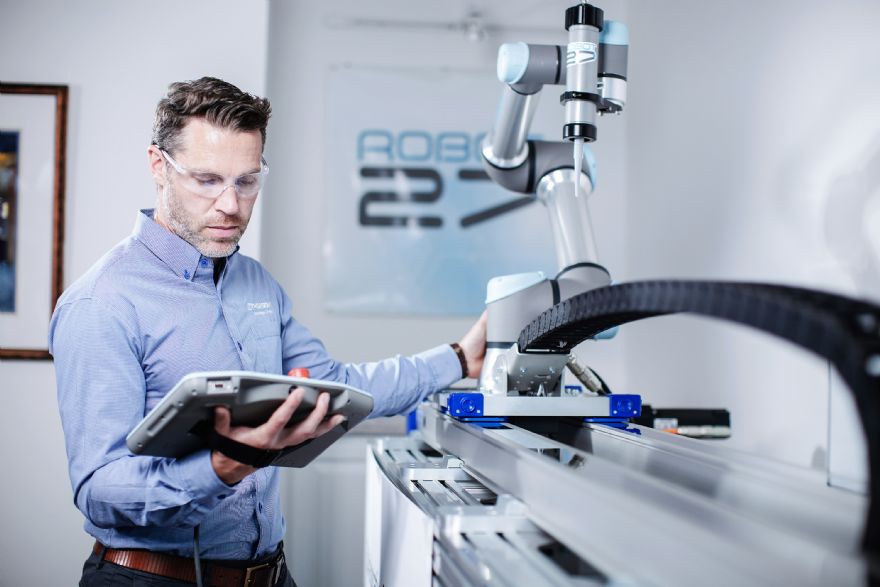
Based on Thomson's Movotrak Cobot Transfer Unit (CTU), the system is designed to help manufacturers deploy collaborative robots more efficiently across production environments that require frequent changes or multiple process stations. By allowing a cobot to travel along a linear axis, the solution significantly expands the robot's working envelope and reduces the need for additional robotic systems.
The Movotrak CTU enables cobots to move between different positions along a production line, providing access to multiple machines or workstations from a single installation. Depending on the configuration, the system can extend a robot's operating range by up to 10m, making it suitable for larger manufacturing cells and automated production lines.
Rodriguez says the modular design allows the transfer unit to be integrated with a wide range of commercially available cobots, giving users greater flexibility when designing or upgrading automated systems. The ability to reach multiple work areas without extensive retooling is intended to support manufacturers seeking more adaptable production operations and improved utilisation of automation assets.
A key feature of the Movotrak CTU is its integrated collision detection capability. According to Rodriguez, it is the only collaborative seventh-axis system currently available with collision detection built into the transfer unit itself. The technology continuously monitors movement and automatically stops the carriage if a collision is detected.
The company says this functionality helps support deployment in environments where humans and robots work in close proximity. While the feature enhances the overall safety architecture of the installation, Rodriguez notes that it is intended to complement rather than replace the safety measures required by applicable standards and regulations.
The addition of a mobile seventh axis offers several operational benefits, including the ability to deploy a single cobot at multiple stations, reduce changeover times and increase overall system utilisation. Manufacturers can also modify machine and workstation layouts more easily without compromising robotic access to production processes.
Installation flexibility is another aspect of the system. The transfer unit can be mounted horizontally, on a wall or suspended from a ceiling, enabling it to be integrated into a variety of factory layouts where floor space may be restricted.
The CTU also incorporates a Freedrive function, allowing operators to manually guide the robot into position and save locations directly. This simplifies programming and set-up tasks, particularly in applications that require frequent adjustments or teaching of new positions.
The system is built around two linear units engineered to provide high rigidity and torque capacity, even when the cobot arm is fully extended. Rodriguez supplies the complete package, including motor, gearbox, control cabinet and application-specific engineering support.
Potential applications span a range of manufacturing and industrial processes. These include inspection and testing operations for large components, machine tending, material handling tasks such as palletising, packaging and order picking, as well as large-area welding, soldering, grinding and dispensing processes.
By combining extended reach, collaborative operation and integrated collision detection in a single platform, Rodriguez believes the Movotrak CTU can help manufacturers increase the productivity of their cobot installations while providing the flexibility needed for increasingly dynamic production environments.