In this article, Keith Murphy, director of product marketing at
Arc Impact, examines how researchers at Switzerland’s SUPSI are using binder jet 3D printing to manufacture complex graphite structures that could improve methane cracking processes and support more sustainable production of hydrogen and solid carbon.
Graphite is valued for its chemical stability, resistance to high temperatures and ability to withstand thermal shock. These properties make it an important material in a growing number of advanced applications, from energy storage systems to industrial heating technologies.
As demand for high-purity carbon materials rises, traditional production methods are attracting increasing environmental scrutiny due to their greenhouse gas emissions. In response, researchers are exploring cleaner ways to manufacture carbon-based products and produce hydrogen.
One organisation contributing to this effort is the Department of Innovative Technologies (DTI) at the University of Applied Sciences and Arts of Southern Switzerland (SUPSI). Within DTI, the Hybrid Materials Laboratory (HML) specialises in carbon-based and porous ceramic materials, supporting research for both manufacturing and energy applications.
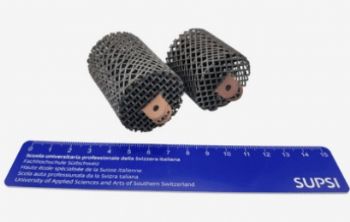
A recent project saw the team develop graphite-based electrodes with highly engineered geometries known as Periodic Open Cellular Structures (POCS). These lattice-like structures consist of repeating unit cells that create predictable material properties and interconnected pores, promoting efficient heat transfer and fluid flow.
The researchers investigated whether graphite POCS could act as structured internals for methane cracking reactors, where they support direct internal Joule heating and help produce hydrogen and solid carbon.
Methane crackingMethane cracking breaks methane (CH₄) into hydrogen (H₂) and solid carbon without directly generating carbon dioxide. Compared with conventional hydrogen production routes, the process offers the potential to produce high-purity hydrogen while simultaneously creating a valuable carbon by-product.
The challenge is that methane cracking requires significant energy input. Conventional reactors typically rely on external heat sources, which can limit efficiency and heat transfer.
To overcome these constraints, the SUPSI team explored direct internal heating. Rather than applying heat from outside the reactor, electrical current is passed through conductive structures inside the reactor itself. This localises energy generation where it is needed most.
The graphite POCS play a dual role in this process. Not only do they act as heating elements through direct Joule heating, they also contribute to the reaction itself.
As researcher Matteo Balzarotti explains: "The POCS reduce the heat demand of the methane cracking process due to its carbon composition. In this process, graphite serves as a catalyst."
Initial feasibility studies combining direct Joule heating with 3D-printed graphite structures produced encouraging results, suggesting a pathway towards more efficient methane cracking systems.
Manufacturing challengesProducing complex graphite structures is far from straightforward. Graphite is difficult to machine and cannot be melted, ruling out many conventional additive manufacturing technologies that rely on melting and solidifying material. The intricate geometry of the POCS adds another layer of complexity.
The structures consist of interconnected bars forming an open lattice network. Some feature cell sizes of just 4mm and struts as thin as 1mm. Such delicate geometries are difficult to manufacture using traditional machining techniques because they can easily deform or break.
Balzarotti noted: "It's nearly impossible to produce these complex graphite parts conventionally without laborious or complicated manufacturing processes."
The team assessed several alternative manufacturing routes. A hybrid process combining powder bed fusion and infiltration was considered but deemed overly complex. Fused deposition modelling was also evaluated but did not provide the required quality or process reliability.
Following these trials, the researchers selected binder jetting.
"We worked closely with Arc Impact's binder jetting team to assess the technology's capabilities with different carbon and graphite materials in complex geometries," said Balzarotti. "For this application, binder jetting proved to be the most reliable method for producing the graphite POCS."
Binder jetting graphiteThe POCS geometry was designed in-house at HML and manufactured using the Innovent X binder jetting system.
A graphite and carbon black powder blend formed the powder bed, while a phenolic resin was selectively deposited as the binder. During printing, the binder was applied layer by layer until the entire structure was created.
The resulting green parts underwent drying and pre-curing to provide sufficient strength for handling. Unbound powder was then carefully removed using brushes and low-pressure air.
To achieve the final material properties, the printed components underwent precursor infiltration and pyrolysis (PIP). During infiltration, a carbon-rich furan resin was introduced into the porous structure. Pyrolysis then converted this material into a stable carbon form through controlled heating.
The combination of binder jetting and PIP enabled the team to manufacture highly complex graphite structures that would be difficult, if not impossible, to produce conventionally.
Advantages of binder jettingThe project highlighted several benefits of binder jetting when working with graphite and other challenging materials.
The first is dimensional stability. According to Balzarotti: "Binder jetting is a very straightforward process. The green body is already 90% of what would be the final product. With other methods, your structure will shrink significantly."
The technology also offers broad material flexibility. Researchers can evaluate different powders and tailor material systems to specific applications.
As Giovanni Bianchi, senior researcher at HML, explained: "It is really easy to work with the initial material. You have to find the right powder, but with binder jetting, you can choose any material."
Although identifying the correct material and binder combination required extensive experimentation, the team reported that the process became highly reliable once parameters had been established.
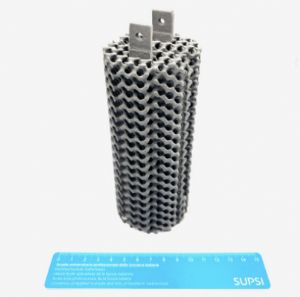
Perhaps the greatest advantage is freedom of design. Binder jetting can create reticulated and lattice structures that are difficult or impossible to manufacture using conventional methods.
"At the moment, binder jetting is the most interesting, suitable technique to produce complex geometries like the reticulated structures," Bianchi said. "It simplifies the manufacturing of complex designs."
The researchers also highlighted the technology's speed, repeatability and scalability. Because the process is digitally controlled and involves relatively low thermal stresses, consistent results can be achieved across multiple builds.
From laboratory to industryThe positive performance of the 3D-printed POCS has encouraged SUPSI to expand its work towards larger-scale applications.
"The next step is to scale up this process of cracking methane under more industrially relevant conditions," said Balzarotti. "Larger binder jetting systems are already available, and we have begun 3D printing a higher volume of samples using the X25Pro binder jet system as a first step toward industrial-scale production."
Researchers believe the technology could support cleaner hydrogen production while also opening opportunities in other sectors requiring complex graphite components.
Over the past several years, HML has used binder jetting to develop applications including compact high-temperature heat exchangers, porous burners, chemical reactors, seasonal heat storage systems and radiotherapy X-ray collimators.
Future projects may include the production of graphite moulds for casting processes and custom-designed graphite heating elements for industrial systems.
Collaboration drives innovationSUPSI's work has been supported through close collaboration with Arc Impact's binder jetting specialists and industrial partners.
The team believes binder jetting can help manufacturers produce lighter, more efficient and more sustainable components across sectors including aerospace, automotive, healthcare and energy.
"We believe that additive manufacturing with binder jetting technology has the potential to meet the industry's needs and challenges by facilitating the production of complex geometries and lightweight structures using a variety of materials, including metals and ceramics," said Balzarotti.
The researchers emphasise that successful adoption requires careful optimisation of materials, process parameters and post-processing methods. Once suitable combinations are developed, they can be transferred to industrial production platforms where prototypes and production parts are manufactured and tested.
This continuous cycle of research, testing and refinement is helping to accelerate the development of new binder jetting applications. Supported by programmes such as Innosuisse and Horizon Europe, collaborations between research institutions, technology providers and industry are expected to play a key role in bringing advanced manufacturing solutions from the laboratory into commercial use.
At SUPSI, that process is already demonstrating how binder jetting can unlock new possibilities for graphite, enabling geometries and applications that could contribute to more sustainable energy and materials production in the years ahead.